How the Jaffe-Flament house on South Park Boulevard ushered in the era of Mid-Century Modern residential architecture.
By Michael Peters
Photography by Kevin G. Reeves

From its founding in 1912, Shaker Heights grew at an astonishing pace through the 1920s and ‘30s.
Adhering to architectural guidelines put in place by the Van Sweringen Company, each house had to be designed by an architect (not a common practice at the time), be approved by the company, and be unique in its design.
By the time the Architectural Board of Review assumed stewardship of the City’s housing design approval process, many of the former restrictions had been relaxed, opening a pathway for more contemporary designs.
Enter Joseph Jaffe and his wife Virginia, who were eager to build a modern house in Shaker Heights. The Jaffes had relocated from California – Mrs. Jaffe was originally from Northeast Ohio – together with their young daughter. Mr. Jaffe was in the lighting business, and was likely familiar with the popular designs of architects such as Cliff May, who were building in the “California Ranch” style in the late 1940s. The style included short but wide awning windows set high on the walls, minimal decoration, and open multi-purpose rooms.
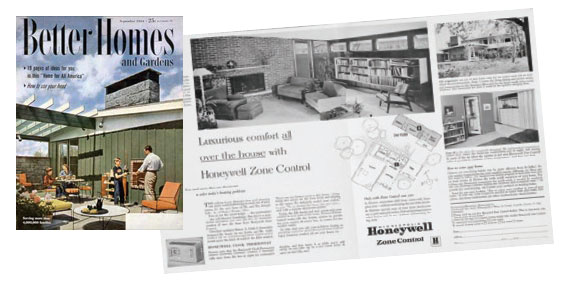
The issue of Better Homes and Gardens that introduced the “Home for All America” concept, featuring Little’s various
designs.
There was a buildable lot on South Park Boulevard, with views of a 300-year-old tree on the edge of Lower Lake, that caught the Jaffes’ eye, and the search for an architect that fi t their aesthetic began. Fortunately for them, a young Harvard-trained architect by the name of Robert Little had arrived in Cleveland in 1947. They soon discovered both a personal connection and a design connection with Little.
After studying under renowned modernist Walter Gropius, Little worked in Boston, where he met and married Ann Halle. After Little’s service in World War II, the couple moved to Cleveland, where Ann grew up before leaving to attend Smith College, the same alma mater as Virginia Jaffe.
Ann Little would have been familiar with Shaker Heights, being a graduate of Laurel School, and from visiting her uncle, Salmon Halle. Salmon and Ann’s father, Samuel, founded and ran the Halle Brothers Co., with its fl agship department store in Playhouse Square. By the late 1940s, the Halles were planning their fi rst branch store on Shaker Boulevard adjacent to Shaker Square.
The commission to design this store went to Samuel Halle’s son-in-law, Robert Little, who proceeded to design not just the building but also a new window display system that he patented. It was also his first encounter with a Board of Review – the Van Sweringen Company’s – which was led by architect Carl Guenther. As Little recalls in his unpublished autobiography (Cleveland Public Library Special Collections), “Carl looked at the flatroofed, largely windowless, fl oating brick block of my design and said, ‘But it’s not colonial.’” Little persevered, “and when the building eventually won prizes… he [Guenther] was the first to send congratulations.”
Little’s small architectural fi rm – which included a young Robert Madison, who would go on to start his own successful firm in Cleveland – kept busy with residential work. Little explains in his autobiography:
“We designed a number of houses that attempted to fi t the land, the sun, the budget, and the clients’ ideas of how they wanted to live. A custom-designed house should fi t the owner as well as a custom-made suit. I always tried to fi nd the special hobbies, tastes, desires, and life-style concepts of a client before drawing a line on paper.”
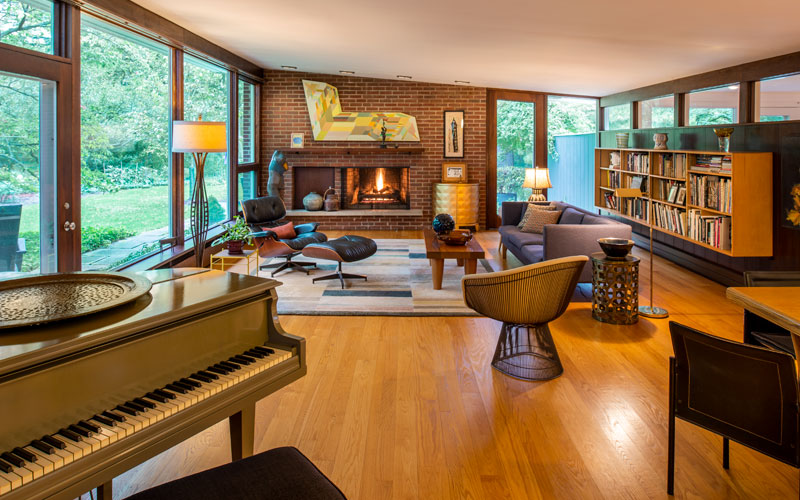
A 670 lounge chair and ottoman designed by Charles and Ray Eames for Herman Miller.
Bringing Nature Inside
For the Jaffes, these elements included the land and sun working together, a budget of $38,000 (or just under $400,000 in current dollars), and lifestyle concepts around family life with their young daughter.
This allowed Little to refine concepts he had been developing since the late 1940s: barriers to maintain privacy from the street, and a floorplan that gave both the adults and their daughter delineated spaces within the house and yard. Short awning windows high on the home’s front wall would provide privacy, allow in light, and maximized storage space. The large windows on the rear of the house let in morning light for the adult spaces and afternoon light for the child’s space.
The floorplan is essentially a “T” shape, with the top a two-story section that faces the street and the bottom a single-story wing that contains the living and dining areas.
The upper story has three bedrooms and two full baths. The parents’ room is at one end with an en suite bath, while the child’s room is at the opposite end, adhering to Little’s belief that adults and children each needed their privacy. In the middle are a small guest room and shared bath.
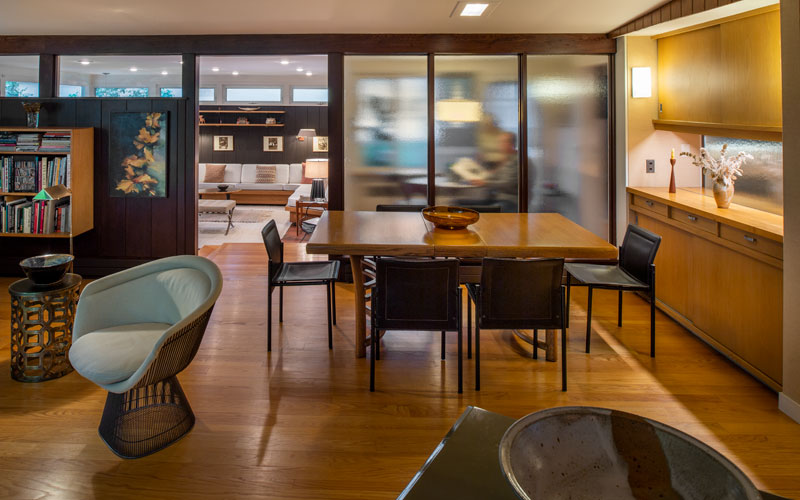
The lower level is dominated by a large open living and dining area with a wall of east-facing glass. The kitchen is connected by a pass through of sliding glass above cabinets with drawers that open into either the kitchen or dining area. The entry foyer opens into the living and dining area with a connection to the attached garage and half bath to one side and the kitchen entrance to the other. What was originally designed as a maid’s suite is accessed from the kitchen.
Many of the light fixtures are from the Cleveland-based Perfectlite Company, where Joseph Jaffe held design patents for various lighting fixtures.
The ribbon-style awning windows set high on the wall in the north-facing front of the house are carried through to the western wall of the living room.
This wall, constructed of redwood, extends into the backyard beyond the room itself, creating a continuous separation that originally created two outdoor “rooms”: the child’s play area to the west that captures the afternoon sun, and to the east, a garden outside the large glass windows of the living room. This tied into the arrangement of the bedrooms: the parent’s bedroom and balcony look out onto the garden, while the child’s room looks out onto the play area below.
The placement of the windows and roof overhangs also takes into consideration the position of the sun as it varies with the seasons: high in summer, low in winter. This design function incorporates Little’s taste for including nature in his work, and was so often part of his process that he patented a machine called Solux to aid architects with passive solar design.
A Revolutionary Design
In his autobiography, Robert Little traces modern architects’ incorporation of nature as a design inspiration to Frank Lloyd Wright.
“Modern architecture was a revolution – literally a turning about.” After 400 years of “cribbing ideas from ancient temples, Renaissance palaces, and Cotswold cottages” Little writes, “America in 1945 was living in copybook colonial and half-timbered houses.” Frank Lloyd Wright, “with the unalterable convictions of a genius, and a full generation in advance of his nearest follower, developed the essential philosophy and forms of new architecture. Wright, during his long career, produced singlehandedly almost all of the innovations of Modern architecture – use of natural materials, non-symmetry, open spaces between rooms, strips of glass, indirect lighting.”
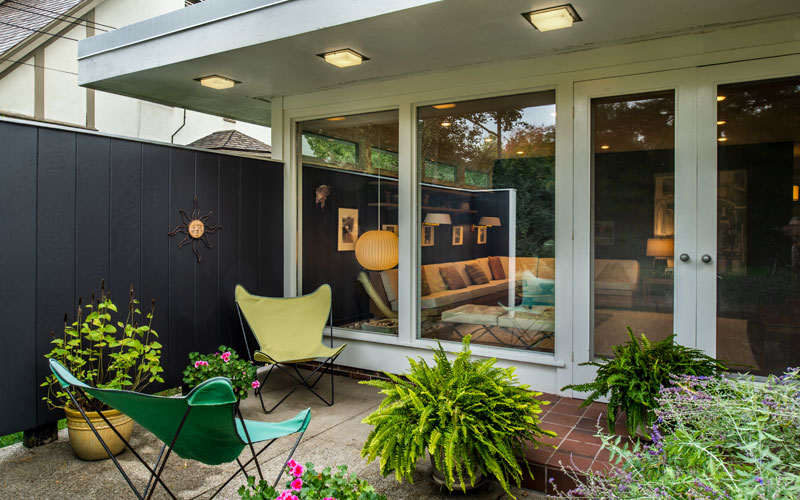
Mid-century Modern butterfly chairs decorate the patio. In the window, a George Nelson & Associates Bubble Lamp designed by William Renwick originally for Howard Miller. In 2016 Herman Miller took over production rights.
Little goes on that Wright “was followed in time and comparative stature by three architect Giants – Mies Van der Rohe, who saw architecture as Science, Corbusier, who saw it as Art, and Gropius, who saw it as Sociology. Wright had seen it as all three – instinctively and totally.”
“Most of us who had been exposed to the innovative thoughts of a Gropius or a Wright were True Believers, sharing our teachers’ views, if not necessarily their talents. So when I came to Cleveland, I was one of the first “modern” architects in town, relatively untested but totally secure in my beliefs.”
These beliefs included incorporating advances in technology. Little recognized that the various levels and open spaces within the house he was designing for the Jaffes would heat and cool at different rates, due in part to the solar gain from the large windows on the southern side. Rather than use unsightly and decidedly un-modern radiators, radiant heating was embedded into the floors and ceilings of the house through copper tubing.
 Unlike traditional houses that had one thermostat that treated the entire house as one “zone,” Little incorporated new Honeywell controls that separated this copper tubing into two zones. Honeywell, in turn, featured the house in advertisements for the new system, bringing it and Robert Little additional renown. The completion of the Jaffe house in 1951, along with two houses in Gates Mills and two in Akron, led to a builder in Chagrin Falls hiring Little’s firm to design “speculative” houses, a departure from the custom house model he had employed so far.
“We would design for the Average Family and the Average Site – a totally different concept and approach,” he wrote. Five houses were designed and built. Two became “Five Star” homes for Better Homes and Gardens magazine. Each issue featured a Five Star Home, including plans and photographs.
In the early ‘50s, the American economy was transitioning from wartime to peacetime. Thousands of GIs were back, with many earning college degrees thanks to the GI Bill. The demand for houses, lots of houses, for young families was in turn creating demand for new approaches to home design and construction.
The popularity of Little’s Five Star Homes in Better Homes and Gardens led to the magazine commissioning Little to design “The Home for All America” for the September 1954 issue. To promote the article (and sell house plans), 96 houses were built across the country to coincide with the release of the issue. As Little explains, the Home for All America “sold more plans than any house in [the magazine’s] history. The house was designed with variations of roof, garage, and exterior materials to produce 52 different-looking houses from one plan – a matter of combinations and permutations I had learned doing Target Analysis for Air Force Intelligence.”
The Home for All America was a single-level plan (with optional basement) – the challenge of separating public and private spaces, as well as adult and child spaces, had to be modified from the Jaffe design – but otherwise the lineage is clear. Combined living and dining areas, expanses of glass and awning windows, and walls that extend beyond the living area to create the separation of spaces are all concepts originated and refined from the Jaffe house.
Even today, 70 years since it was built, the South Park house feels timeless. One is immediately struck by a sense that the house could have just been built. This is a house that can be found anywhere in the country today, and in many ways is the house that inspired the transition to modern residential design in America.
A Brown Shoebox
The Jaffes lived in the house until 1985, when they sold it to Gale and Michael Flament. The Jaffes had made a few alterations; they enclosed a portion of the children’s play area to create a family room and breakfast room, and changed the heating system to baseboard heat. But otherwise, the house was as Robert Little built it.
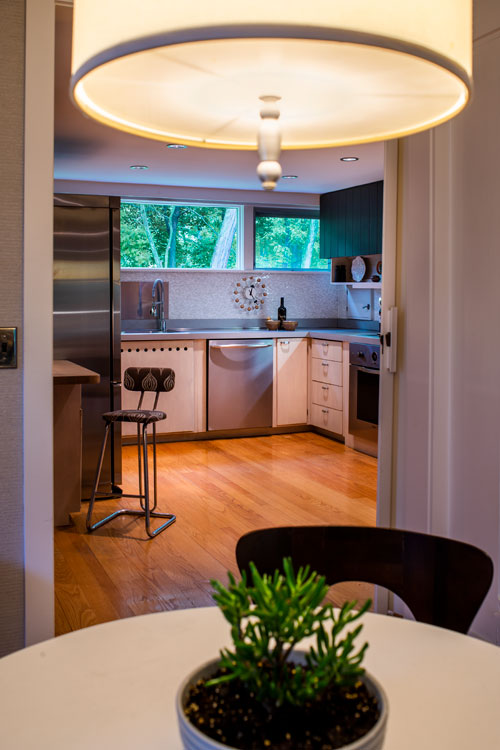
A George Nelson & Associates Ball Clock designed by Irving Harper for Howard Miller.
The Flaments already lived in Shaker, but were looking for a larger home. The classified ad for the Jaffe house mentioned the “park-like setting on South Park Boulevard,” as Gale Flament recalls. Despite the price being above their intended budget, they scheduled a time to visit. The views from the kitchen across South Park Boulevard to Lower Shaker Lake and the large lot – nearly an acre – lived up to the ad’s promise.
The ad did not mention that the house had been designed by Robert Little, and in fact it had been on the market for some time. But when Gale Flament walked into the house for the first time, she had a feeling she was in a Little house. A few years earlier she and Michael had been invited to a wedding at the Littles’ Pepper Pike home. They mused with him that someday they’d have him design a house for them. Clearly everything was aligning.
One of the great advantages was that the Flaments didn’t need to do much furnishing. Nearly every room has built-ins, from cabinets to desks to wardrobes. While the low-sloping roof means there is no attic for storage, the second-floor hall connecting the bedrooms is lined with built-in cabinets below the awning windows. The space under the stairs connecting the first and second floors and the stairs to the basement provides additional storage.
However, there was not complete family harmony around the move. The Flaments’ daughter Gretel, the older of their two children, was not happy. In a letter to Robert Little a few years later, she explained: “I was horrified. I was a senior in high school at the time, and I told my mother I was embarrassed for my friends to visit me at ‘The Ugliest House in Shaker.’ I couldn’t believe they actually liked that brown shoebox masquerading as a house.
“As time went on, I began to realize that our new house was the most comfortable and interesting house I had ever lived in. I especially loved being able to stand in the living room and look around and see trees, flowers, and grass. It was almost like living outside! All of my friends loved the house, too, which was, of course, very important. I found myself feeling sorry for people who had to live in boring old colonial-style houses.”
To which Little responded, “If you had a little trouble adjusting to the unconventional design, you should have seen the Shaker Heights Architectural Review Board in 1950.”
Requiem for a Trailblazer
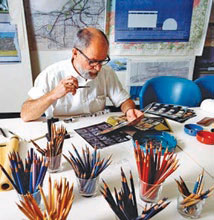 Working exclusively from Cleveland, Robert Little would go on to design notable projects like the MetroHealth Towers, the Air Force Museum in Dayton, the Hawken School’s Upper Campus in Gates Mills, and the beloved Musicarnival tent theater on Warrensville Center Road that brought musical theater and performances by bands like The Who, Led Zeppelin, and The Doors to generations of Clevelanders between 1954 and 1975. He was also the recipient of the Cleveland Arts Prize in 1965.
Little’s trailblazing work paved the way for other modernist designers in Shaker Heights, including Larry Perkins, who designed the Shaker Heights Middle School in 1954, and Don Hisaka, who designed for his own residence on Drexmore Road in 1967. Little himself designed another Shaker home in 1968, on Weybridge Road.
It is quite likely that around this time Little was also instrumental in Frank Porter’s selection of Walter Gropius as the architect for Tower East. Porter had hired Little in the late ‘40s to redesign his new Central Cadillac showroom in downtown Cleveland – a project that didn’t get beyond the drawing stage due to complications with construction that had already begun. Now, Porter wanted to build a significant development in Shaker Heights at the intersection of Chagrin Boulevard,
Warrensville Center Road, and Northfield Road. Tower East would be Gropius’ last major project, and is a National Historic Landmark property. But perhaps Robert and Ann Little’s favorite project was Pepper Ridge. A development of modern homes on a former farm in Pepper Pike, theirs was the first of a dozen built on a narrow, winding cul-de-sac starting in the early 1950s.
Little designed everything down to the mail boxes. They raised their two sons there and it was their home until Robert’s passing in 2005 and Ann’s in 2012.