A unique home is ready for another century while remembering its past.
By Sharon Holbrook
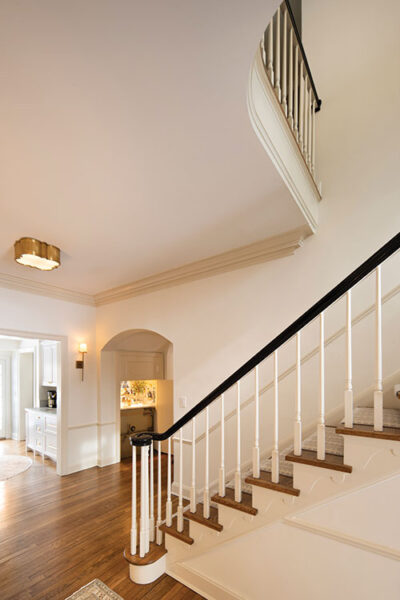
Entryway to the former garage and staff quarters of the Van Sweringen mansion. Photos by Kevin G. Reeves
This tucked-away Shaker Boulevard home started its life as a garage and staff quarters for the iconic Van Sweringen mansion at 17400 South Park Boulevard. Now, it’s a spectacular home in its own right, freshly updated and expanded by new owners Andrew Wolfort and Anna Strohl.
In 1910, there were almost no homes in Shaker Heights. In fact, it would be another two years before Shaker Heights itself officially existed. A few 19th-century homes dotted the area. The community of North Union Shakers was long gone, leaving remnants of an old mill, earthen dams on the Shaker Lakes, and little else. But change was coming: Real estate developers and brothers Mantis and Oris Van Sweringen were building a handful of “demonstration homes,” examples of the desirable residences they were hoping to sell in their new planned community.
They were also building a grand mansion for themselves on the street now known as South Park Boulevard. Behind the house they built a sizeable garage, now the beautiful home of Andrew Wolfort, Anna Strohl, and their three young children.
From the time it was built in 1910, it has undergone two major renovations. In the mid-1940s, it was converted into a spacious single-family home. Now, the family has completed a renovation and expansion worthy of this singular home’s next phase.
A COVID Homecoming
When the pandemic hit, Wolfort and Strohl were living in Chicago with their first two children, and Strohl was working as a physician and Wolfort as a business executive. As Covid gave them time to pause and think about their family’s next steps, they realized it was time to come home to the Cleveland area.
Strohl grew up on Kingsley Road, where her parents still live, just a short distance from their Shaker Boulevard home. She met Wolfort, who grew up in Moreland Hills, when they were students at Hawken School. Even while in Chicago, Wolfort was working for Cleveland-based Olympic Steel. With such deep roots here, the decision was soon made.
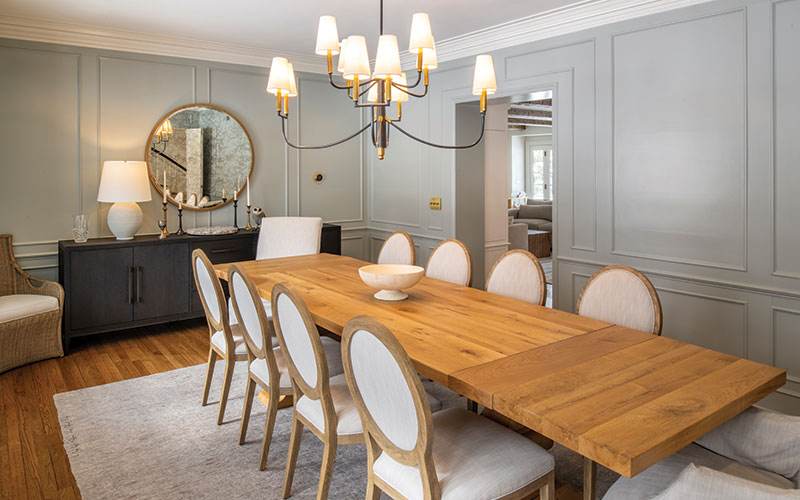
The dining room showcases restored architectural details, including crown molding, wall detail, and pocket doors.
They had just started a low-key search for their next home when the house at 17715 popped up on Wolfort’s screen as a for-sale-by-owner listing: a historic house sited on a large Shaker Boulevard lot. Already anticipating that they’d want to put their own touches on any historic home, Wolfort and Strohl had connected with Molly and Fritz Machmer-Wessels, Shaker residents and owners of the design-build firm Woodland Design Company. Still in Chicago, they asked Molly Machmer-Wessels to take a look at the listing. She thought it must be a typo – a lot that large on Shaker Boulevard didn’t exist – or could it?
Tucked Away
The confusion about 17715 is understandable. It’s easy to pass by without knowing the house exists. A single-lane driveway leads quietly off Shaker Boulevard, passes between two 1950s-era homes, and opens onto spacious grounds. Under towering trees and new gas-lit lamp posts, the drive meanders through a large lawn before circling in front of the home. From this quiet vantage point, you’d hardly know Shaker Boulevard’s cars and rapid transit trains were passing by at all.
Considering the origins of the home, it’s not so surprising that the house was hidden. It started its life in 1910 as a home for cars and servants – there’s no evidence there were ever horses or carriages in it, though the idea is intriguing. The history of the home is as hidden as the house itself. But we know that in 1945, at the same time the South Park mansion’s extensive property was being subdivided and sold, the garage was converted into a single-family home. Both the current owners and the Shaker Heights Library have copies of those renovation plans, which include drawings of the home both before and after
that first major expansion.

The breezeway represents a new chapter in the home, connecting the recent addition to the original house.
The pre-1945-construction drawings show a second floor with a turret, two bedrooms with a bath, a small sitting room, a hallway bath, and three tiny dormered rooms each marked as “maid.” The first floor of the building was dominated by its four garage bays and included a modest kitchen off to one side.
In contrast, architect George Burrows’ midcentury changes include the addition of a walnut library, intricate plaster moldings, an enlarged kitchen with butler’s pantry, bay windows, a new roofline, and an impressive living room and stairway. Two of the four garage bays were taken over for the kitchen. Parts of the hinges of those double doors were left in place on the exterior of the renovated house, a nod to the building’s past. They’re still there today, thanks to the family’s desire to preserve the history of the home.
Updating the Updates
By the time they were looking at 17715 Shaker Boulevard in 2020, the house hadn’t had a major renovation in 75 years. The house was mostly in good condition but needed some overdue improvements. Wolfort and Strohl wanted a bigger, up-to-date kitchen; an overall style refresh; and additional spaces that suit modern family life. Their renovation, which they did through Woodland Design with architect Jessica Powell, wound up touching every room in the house and adding more.
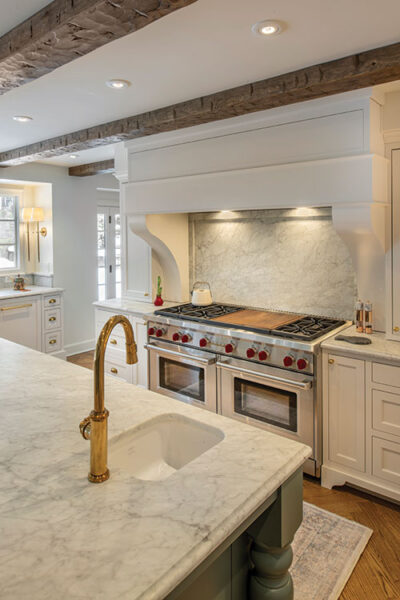
The renovated kitchen bridges both the new addition and the original building. Reclaimed
beams were added as a nod to the kitchen’s former life as an outbuilding.
A major change was the expansion of the kitchen into the two remaining garage bays, allowing for a generous island and for the kitchen to spill into a connected family room. Wooden ceiling beams, a fireplace, and built-in shelving add a cozy, lived-in feeling to the new space. One thing that hasn’t changed is that the kitchen sink still looks out at the backyard, with a view of the towering stone wall and vintage Rose Iron Works gates that separate the property from
the backyard of the main house.
Now that the old garage was gone, a new garage was needed. A new wing on the west end of the house is connected to the existing footprint by a bright, glassed-in breezeway and includes a living room, upstairs guest suite, bathroom, and a spacious garage and mudroom. Other major updates in the living spaces include moving the laundry to the second floor, reconfiguring the second-floor layout, and modernizing all bathrooms, plumbing, and electrical.
Of all the mysteries and surprises that the house holds, one of the most intriguing is a massive safe on the first floor. Wolfort said they opened a “weird half door” to find an enormous locked safe sitting on bare dirt under the back stairs. How did the safe, which is extremely heavy and has an 1871 patent date on the lock, wind up here? Did the Van Sweringens hide their valuables out here in the garage, where no one would suspect they’d be hidden? Was there anything in it? Fritz Machmer-Wessels and the Woodland Design team, using a stethoscope and a lot of patience, figured ou the combination and opened it. It was empty, but no matter. It’s now a handsome mini-bar, with a stone counter topped with glassware and a Great Gatsby-inspired mural.
Underground Transformation
Wolfort and Strohl knew that waterproofing the basement would be one of the most difficult challenges of updating the house. While the rest of the house was dry, the basement was decidedly not. An old coal chute was not secure, and water would pour in during rainstorms.
More interesting, but even trickier, was the basement tunnel that originally connected to the mansion on South Park. It’s unclear whether this was for staff on foot or heating and water connections or both, but the fact was that when the family arrived, it was unusable in any sense. Through an archway and down a couple steps, it then wandered about 80 feet before reaching a cinder block wall. More alarmingly, it had about six inches of standing water in it. The tunnel is now transformed and, finally, usable again. Woodland Design shortened the tunnel, waterproofed it, and added electricity and a custom arched door. Now, it’s an attractive wine storage area with not a drop of water in sight.
Just like the house, it remembers its past, but is refreshed and ready for another century.