Shaker students in advanced German are translating the memoir of an eyewitness to some of the most significant cultural and political events of the 20th century.
By Scott Stephens
Photos by Gus Chan
Max Reiner had a front-row seat to history.
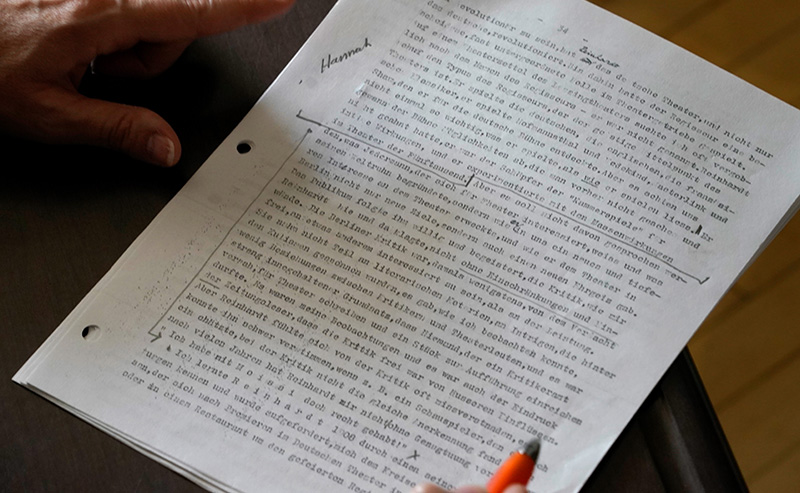
Some 100 years later, Shaker Heights High School students have pulled up a chair beside him. Reiner, an important but little-known Jewish-German journalist who lived and worked in Berlin, wrote extensively about his experiences in pre-World War II Germany from 1904 until 1938 when he, his wife, and foster daughter escaped to Palestine. His memoir, which vividly describes life leading up to the pogroms and the Nazis seizing power, has fairly much languished in the dustbin of history, untranslated from German and largely forgotten.
Until now.
For the past 18 months, Shaker students in advanced German classes at the High School have been translating Reiner’s 254-page memoir as a part of a two-year project for the U.S. Holocaust Museum in Washington, D.C. Entering the 2022-2023 school year, the students have 50 completed pages, with another 100 nearing completion.
The unique assignment came about after Joseph Reiner Bialock, a nephew of Reiner and a board member of the Jewish Family Service Association (JFSA) of Cleveland, asked if anyone knew of a reasonably fast translating service that could work on his great-uncle’s memoir. JFSA received a copy of the memoir from the Holocaust Museum, where it has been in the permanent collection since 2015.
Susan Bichsel, president and CEO of the JFSA of Cleveland, happened to be a Shaker Heights resident with a daughter in the International Baccalaureate (IB) program at the High School. Knowing that IB is grounded in critical thinking skills, inquiry, teamwork, and community service, she reached out to Shaker Heights High School Principal Eric Juli with a proposal: the Holocaust Museum, it seemed, was overwhelmed by translation projects. German translation services, in particular, are in short supply in the United States. Could Shaker students studying German help?
“I was aware that kids are looking for various projects to attach themselves to and thought this would be a great one for maybe someone in the German program,” Bichsel says.
Juli, whose grandparents were holocaust survivors, jumped at the chance. The rest, as the saying goes, is history.
“It’s projects like this that give our students an opportunity to learn by doing,” he says. “Our students can connect with history while doing something meaningful for the community.”
Colloquialisms and Nuances
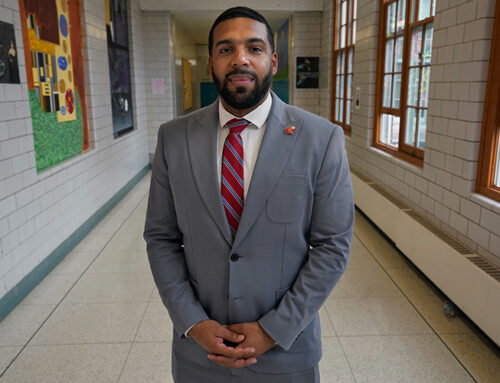
German teachers Andrea Bradd Cook and Keith Szalay, pictured right, were equally enthusiastic. Reiner was an eyewitness to some of the most signifi cant cultural and political events of the 20th century. Translating his memoir provided their students with college-level courses in language, political science, history, geography, the arts, and other academic disciplines.
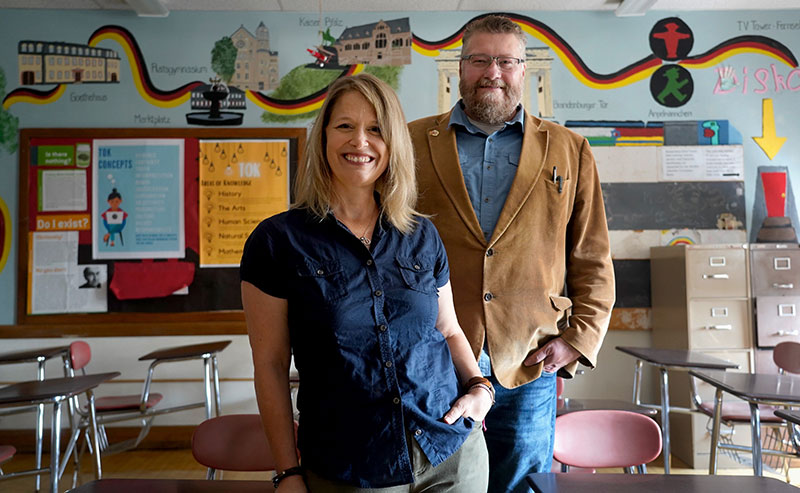
Shaker High German teachers Keith Szalay and Andrea Bradd Cook.
“We are learning things I didn’t know about life back then,” Bradd Cook says. “I’m a lifelong learner. This has been a gift I didn’t know I was getting.”
Working in teams, the students translate sections of the memoir and turn them over to Bradd Cook and Szalay, who refi ne the translations and ask additional questions. The teams also add links for additional information about events and personalities mentioned in the text. The biggest challenge: colloquial language and nuances that can, a century later, confuse and confound even the most advanced German student.
“It’s 100 years old,” Szalay says. “We come across things that don’t exist anymore in the language.”
Adds Bradd Cook: “It’s given me a new-found appreciation for the skill of translating. You can know the language, but not know how to translate it.”
“The work was certainly daunting, but the chance to help legitimize a piece of German history was an honor.”
Part of the appeal of the project was the richness of Reiner’s story. Originally from Czernowitz (now part of Ukraine) and Vienna, Reiner describes with arresting prose his experience in Austria and Germany prior to his emigration to Jerusalem. In his text, Reiner describes his impressions of turn-of-the century Czernowitz, which was then part of Austria-Hungary, his move to Vienna to begin his career as a journal st, his move to Berlin at the age of 23, his subsequent career with the Ullstein publishing house, his service in the army during World War I, and his eventual return to Berlin.
Reiner provides detailed descriptions of key events and personalities of the Weimar Republic, including political figures such as Stresemann, Ebert, Rathenau, and Wirth, as well as cultural fi gures such as Max Reinhardt and others in the musical and theatrical circles of Berlin, a cultural hothouse during the fi rst half of the 20th century.
Reiner was a guy who knew how to live: He once had a 24-hour game of spades with the legendary composer Richard Wagner, and dined with Felix Saltern, the author of Bambi, a book intended as a parable of the dangers and persecution faced by Jews in Europe.
“He was an arts critic for much of his career, but for the fi rst part of his life he was really into politics,” Szalay says. “The breadth of the history he covers is amazing.”
More harrowing is his account of the impact that the Nazi takeover of power had on him, the growing anti-Semitic measures, increasing censorship of his work, his expulsion from Ullstein and fi nally Kristallnacht – a two-day blitz in which the Nazis torched synagogues, vandalized Jewish homes, schools, and businesses, and killed close to 100 Jews.
In the aftermath of Kristallnacht, the “Night of Broken Glass,” some 30,000 Jewish men were arrested and sent to Nazi concentration camps. After fleeing to Palestine, Reiner wrote his text, titled “My Life in Germany,” in response to a project at Harvard University in 1940 seeking autobiographical texts from Germay and Austrian emigres. He received British citizenship there in 1941 and died three years later.
Witness to History
Reading and translating the drama that was Reiner’s life had an impact on the Shaker students. Aggie Augustine, who graduated last June, says she is grateful for the opportunity the translation project afforded her and other students. She worked on the translation as part of the IB CAS (creativity, activity, and service)
Project, in which IB learners are asked to demonstrate engagement in all three areas.
“The work was certainly daunting, but the chance to help legitimize a piece of German history was an
honor,” she says. “When the process of translation began, it was clear that Reiner had fascinating experiences
in early 20th-century Germany, and I felt that my understanding of a more conversational level of German
increased greatly.
“Obviously the project was an opportunity to improve our relationship with the German language, but Reiner’s memoir also served as a personal connection to some of the darker periods of German history, especially considering his Jewish identity,” she says. “The first-hand account of both German life and the rise of fascism developed my understanding of history and the pervasiveness of prejudice.”
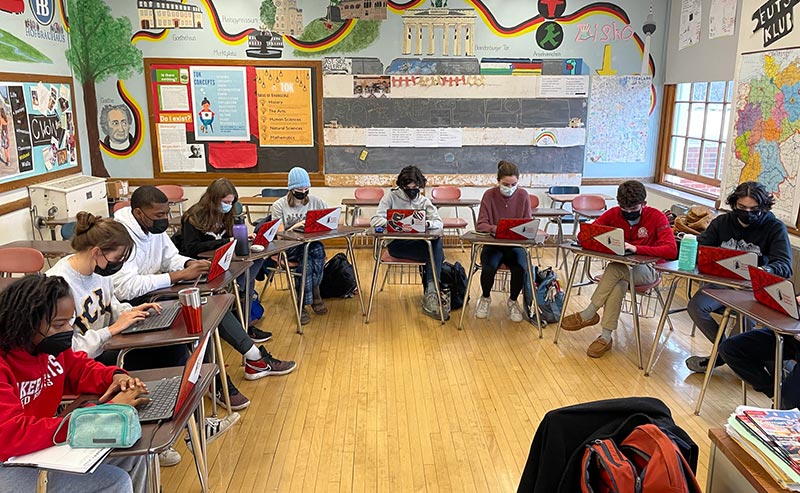
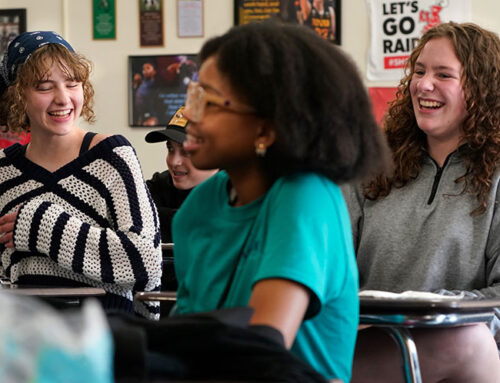
Shaker High German students.
To augment the translation project, German students at the High School have had the opportunity to participate in several discussions with fi rst-person witnesses to history. In March 2021, the students had the chance to meet Bialock via Zoom. During the call, the students also had the opportunity to hear from Erika Gold, a Holocaust survivor who serves on the JFSA Holocaust Survivor Program’s advisory committee.
Gold shared her own story and provided historical context for students.
Last February, the students met with the Kol Israel Foundation members and Steve Wertheim, a family member of a Holocaust survivor who shared his father’s story. Once the project is completed, the translated work will be presented to Max Reiner’s family and to the Holocaust Memorial Museum. Bradd Cook and Szalay hope the project doesn’t end there. They would like to see their colleagues consider translation projects in other languages, as well as a translation class, so that others can enjoy the learning experience they and their students benefited from.
“We don’t plan to stop here,” Szalay says. “It feels like we’re working on something really important. It’s a unique style of learning.”
Scott Stephens is executive director of communications and engagement for the Shaker Heights City School District.