With the help of creative teachers and staff, Shaker students can find a place to nurture a passion or serve their community in a low stakes, high reward environment.
By Joe Miller
Photos by Gus Chan
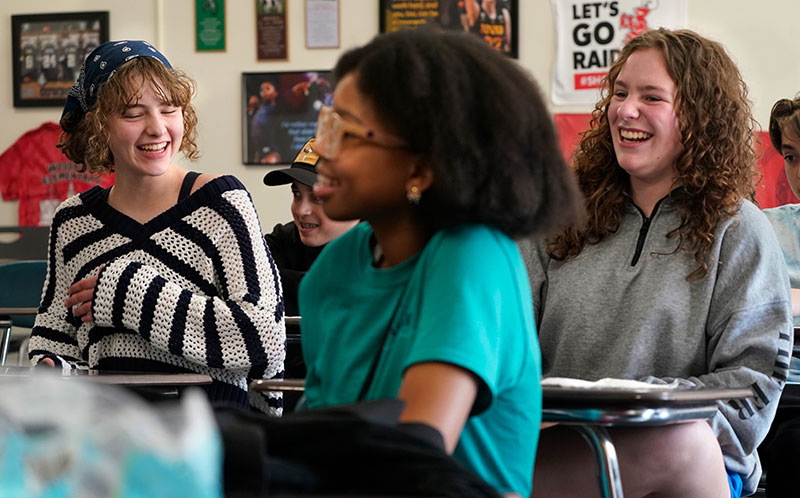
As young people struggle to connect with others in today’s post-pandemic world, the Shaker Heights City School District is finding that extra-curricular clubs and activities are an effective way to help boost students’ sense of belonging.
“It’s really about helping our students find their passion and getting them involved in things outside of just the strictly academic portions of the day,” says Dr. Felecia Evans, Shaker’s assistant superintendent of learning and teaching.
Evans says research consistently shows that when students feel safe, connected, and valued within their school community, they are more likely to attend school regularly and achieve academically. In response, three years ago, the district introduced “positive school culture” – as measured by middle school students’ sense of belonging – as one of the District’s five key performance indicators.
“Positive school culture and belonging hold equal importance with traditional academic measures like graduation rates and literacy because they’re foundational to student success,” according to Evans.
I feel like once in a while everyone needs reminders to be nice and to be good.
To measure sense of belonging, the District looks at surveys of students during the middle school years, a period that Evans describes as “crucial for social-emotional development.”
This past fall, survey responses from 802 Shaker Heights Middle School students showed that only 40 percent responded positively to questions about belonging. Although slightly up from the previous year, it was well below the national average for the same age group when compared to pre-pandemic levels.
“We saw what the pandemic and being at home did in terms of isolation and students feeling lonely,” Evans says. “Creating clubs is one strategy, among others, to really create connections for students in lower stakes environments.”
Although the effort is led by Shaker’s “passionate teachers, staff and paraprofessionals,” Evans says it also depends on participation by other stakeholders, such as the Shaker Schools Foundation, local businesses, and community volunteers.
young people struggle to connect with others in today’s post-pandemic world, the Shaker Heights City School District is finding that extra-curricular clubs and activities are an effective way to help boost students’ sense of belonging.
“It’s really about helping our students find their passion and getting them involved in things outside of just the strictly academic portions of the day,” says Dr. Felecia Evans, Shaker’s assistant superintendent of learning and teaching.
Evans says research consistently shows that when students feel safe, connected, and valued within their school community, they are more likely to attend school regularly and achieve academically. In response, three years ago, the district introduced “positive school culture” – as measured by middle school students’ sense of belonging – as one of the District’s five key performance indicators.
“Positive school culture and belonging hold equal importance with traditional academic measures like graduation rates and literacy because they’re foundational to student success,” according to Evans.
To measure sense of belonging, the District looks at surveys of students during the middle school years, a period that Evans describes as “crucial for social-emotional development.”
This past fall, survey responses from 802 Shaker Heights Middle School students showed that only 40 percent responded positively to questions about belonging. Although slightly up from the previous year, it was well below the national average for the same age group when compared to pre-pandemic levels.
My favorite part was getting to know everyone and doing the show with everyone. It was really fun.
“We saw what the pandemic and being at home did in terms of isolation and students feeling lonely,” Evans says. “Creating clubs is one strategy, among others, to really create connections for students in lower stakes environments.”
Although the effort is led by Shaker’s “passionate teachers, staff and paraprofessionals,” Evans says it also depends on participation by other stakeholders, such as the Shaker Schools Foundation, local businesses, and community volunteers.
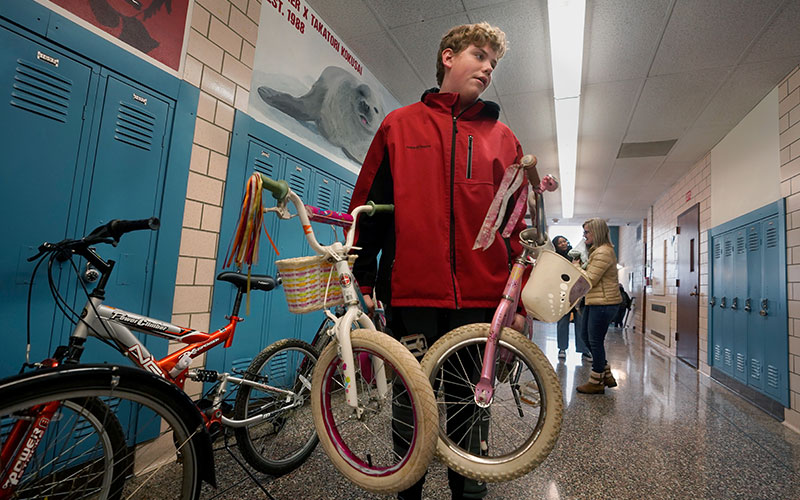
“We’ve had this bike for a while,” says Benard. “Let’s see if we can find the problem.”
Welcome to the Bicycle Repair Club, or as its members affectionately refer to it with an exclamation point, Bike Club! Launched last year by Scanlon and fellow teacher Yvonne Horstman, the club seeks to teach students how to bring bikes back into working order and then put them into the hands of kids who otherwise couldn’t afford them.
When the club started, members regularly learned repair skills from Matt Jaffe, owner of Cedar Lee Bikes in Cleveland Heights. Although Jaffe still stops by occasionally, the lessons this year are coming mainly from Scanlon and Horstman – who have since taken a bicycle repair course – and even Cormac, who apprenticed in Jaffe’s shop over the summer.
“He’s come back and is sort of our expert now,” Scanlon says.
The club purchased the repair racks and tools with a grant from the Shaker Schools Foundation. The bicycles themselves – about 27 overall – are the result of Scanlon seeking donations from the Shaker community on Facebook.
So far, many of the repaired bicycles have gone to immigrant families in the Cleveland area with the help of the U.S. Committee for Refugees and Immigrants, a national non-profit agency with a local office. Scanlon is also talking to high school administrators about building bikes for Shaker students who need transportation to school.
“If we can continue to grow, there are people more than happy to get rid of fine bikes, and there’s definitely a population in the community that is very happy to take these bikes off our hands,” says Horstman.
Recently, club members delivered eight bicycles to a young Congolese family living on Cleveland’s West Side. “The kids were jumping up and down. They were so excited,” says Shaker junior Johnathan Bailey-Jenkins. “You should have seen the smiles on their faces.”
In This Club, Kindness Counts
It’s an unusually warm day in March, and most of Onaway Elementary School’s third grade is outside, loudly enjoying recess on the crowded playground.
But not everyone. Inside, eight students are spending their recess hanging out in the second floor music room, working on projects that they hope wil bring happiness to the whole school.
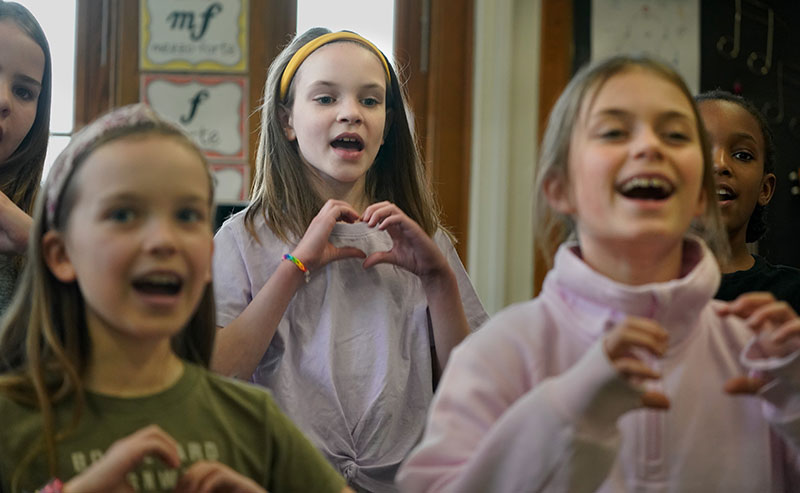
This is Kindness Club, the brainchild of Onaway music teacher Christine Fader. Offered since October to third and fourth graders, the club’s activities have included sending every child in the building words of encouragement, singing songs at assemblies about helping others, and surprising Principal Dora Bechtel with a giant birthday card.
During this day’s meeting, club members are assembling a giant “kindness chain” that will hang in the hallway for all to see. Kids throughout the school provided the paper chain links, each featuring phrases or drawings related to being kind.
My favorite part was getting to know everyone.
Fourth grader Eli Rehner takes over the work from the third graders during his recess. Eli looks over each of the links before stapling them into interlocking loops. His own link, which is already part of the chain, states “All are welcome.”
“I feel like we’re doing a good job,” he says. “I feel like once in a while everyone needs reminders to be nice and to be good.”
Since she started Kindness Club, Fader has had more than 30 kids stop by her room to help on these projects. “There’s something special about this club,” she says. “They can see the smiles they put on teachers’ faces and other kids’ faces when they’re walking around and doing something for others. They see it in action.”
Recess clubs came about at Onaway this past fall when Bechtel asked her single-subject instructors – music, art, physical education, and library – to create social opportunities for students outside the regular classroom. Although the clubs currently are only for the third through fifth grades, Bechtel hopes to expand to the other ages next year.
“The goal is to level the playing field and to give more students access to opportunities during the school day that they might not have available to them after school,” Bechtel says. “Clubs, for some, are the reason they want to get out of bed in the morning and go to school,” she adds.
Along with the Kindness Club, Fader runs a drum circle club for fifth graders.
“Some kids don’t want to go outside everyday. It’s too loud, it’s too noisy, it’s too much,” Fader says. “We want to give every child an opportunity to find what they want to do so they have that outlet. Because it’s not always running on the playground. Sometimes it’s banging on a drum. Sometimes it’s making a kindness chain.”
A Sign of Togetherness
When American Sign Language instructor Kate Slosar silently asks students at Shaker Heights Middle School’s ASL Club how they are doing today, the group confidently signs back their responses.
“Fine,” one girl conveys with hand gestures and facial expressions. “Tired,” answers another. “Excited,” signs a third. When small talk is over, Slosar and co-instructor Sophia Paige seamlessly transition the club into reciting letters and numbers using ASL, and then into signing song lyrics.
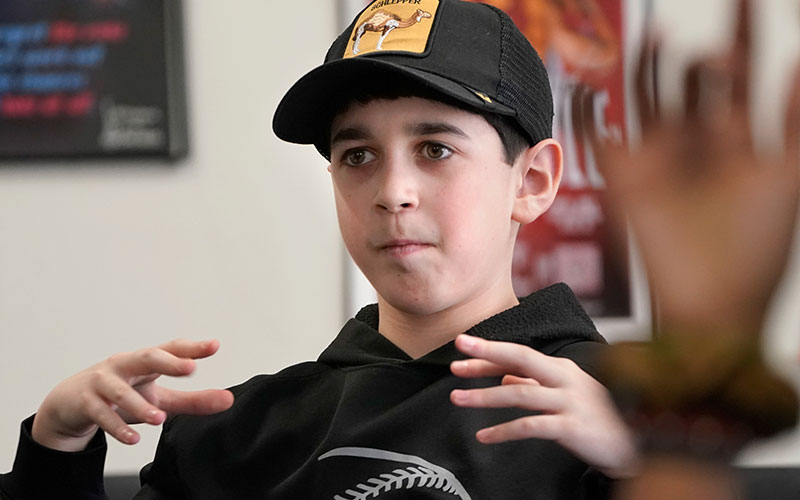
Slosar, who is deaf, has been teaching the ASL Club – and many of these same kids – since the group first started at Woodbury Elementary School in February 2022. That longtime relationship is evident in how the students respond to her and each other.
“I feel like we’ve become a community,” says seventh grader Eliana Brown, who first joined the club in fifth grade. “It’s cool to have a common interest,” adds eighth grader Daphne Kollin.
The club originally was the idea of a Shaker parent – Julie Kaufman – who wanted the District to offer ASL as another language option in the curriculum. Although ASL wasn’t added as a class, Kaufman was able to recruit Slosar, an employee at the Cleveland Hearing & Speech Center, to run a new club instead. The Shaker Schools Foundation agreed to fund the program. “Finding Kate was like finding a unicorn,” Kaufman says.
Last year, the club moved to the middle school as an after-school option with teachers Beth Casey and Maureen Pelegrin as the club advisors. Paige, who is also deaf, came on board as a second instructor in the fall.
Along with the language, the club’s current 12 members are learning about Deaf culture and history, and even participating in community events such as a recent Deaf Appreciation Night at the Lake Erie Captains’ baseball stadium. At the game they performed “Take Me Out to the Ballgame” using ASL.
The kids say they have found their ASL skills useful elsewhere, whether it is talking to a Deaf person in a doctor’s office waiting room, or secretly communicating with each other during the school day.
“For me, it’s great seeing people at such a young age pick up American Sign Language,” Slosar says through an interpreter. “They can develop more fluency as they get older and actually hold a conversation. And just the ability to expose people to the language and culture of deaf people, that’s been exciting to see.”
Now playing: Lomond Theatre
At Lomond Elementary School’s after-school theater club, third, fourth, and fifth graders are lining up inside the building’s auditorium, getting ready for the spotlight.
It seems chaotic at first, but as soon as the music starts, the students hit their marks and begin singing and dancing in near-perfect unison. This day’s staging may be just a rehearsal, but these kids are putting their all into every choreographed move and song lyric.
“It starts with a dream!” they all sing out together to conclude the final song.
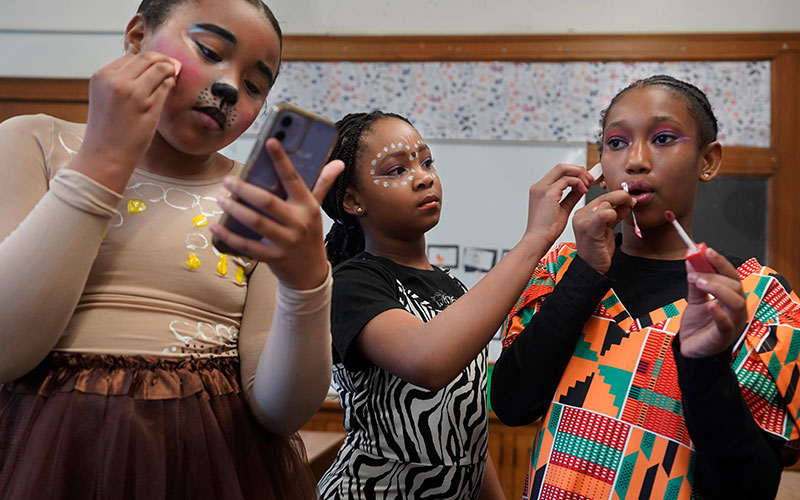
In just its first year, Lomond Theatre is a smash hit with students, parents and staff. Under the direction of Mariah Watts, a second grade teacher at the school, the group
in early March successfully staged three showings of The Lion King KIDS, a 30-minute adaptation of the beloved Disney movie. More than 70 students worked on the production, with about half in acting roles and the other half working behind the scenes on costumes, props, and even sound effects.
“My favorite part was getting to know everyone and doing the show with everyone. It was really fun,” says fifth grader Shara Dolleh, who played a villager in the musical and was dance captain. “Next year it’s going to be very sad to leave because I won’t be able to see them all at the middle school.”
David Bell, also a fifth grader, landed his dream role as Zazu, a hornbill bird who is advisor to the king. “This is a whole new thing for me. I haven’t been acting or dancing,” David says. “I was really hoping to get Zazu, so this has been very exciting.”
Lomond Theatre launched in the fall when the school was chosen to participate in Disney Musicals in Schools, a free program created by Disney to bring musical theater to underserved elementaries. Run locally by Playhouse Square, the program provided Lomond with two professional teaching artists for 19 weeks to work directly with the kids. The artists are also training Watts and her team of teachers and parent volunteers to run the club independently for years to come. “We’re trying to create a sustainable theater program,” Watts says.
Disney Musicals in Schools provided Lomond Theatre with the performance rights to The Lion King KIDS for this year – as well as scripts and choreography – and will do the same next year for another musical based on a Disney movie.
Carter Haynes, a third grader, loved working with others on sound crew, but next year he has different plans. “I want a role,” he says. “I either want to be a lead character or someone who is special in the movie.”