The Shaker Heights City School District is eliminating racially segregated classrooms and ending the practice of tracking students. These changes are aligned with the District’s educational equity policy and will positively impact students now and in the future.
By Jennifer Kuhel
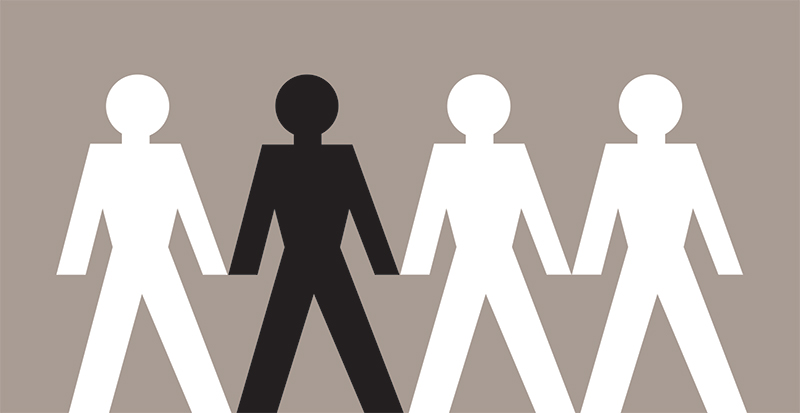
When David Glasner became Shaker Heights Schools Superintendent in the fall of 2019, he visited a Woodbury core-level classroom with the District’s Chief Academic Officer Marla Robinson. Nearly all of the students in the classroom were Black.
Robinson quietly asked one of the students where all the white students were.
“They’re in enriched,” the student answered.
Glasner remembers the student’s straightforward response as a sucker punch to the gut. “We had to ask ourselves, what are we doing to students if we’re sending the message explicitly and implicitly that white students are enriched and Black students aren’t,” he says.
Prior to Glasner’s superintendency, the District formed an equity task force, provided equity training to faculty, staff, and community members, and conducted an anti-racist book study for faculty and staff. But Glasner’s Woodbury classroom visit – which mirrored his own cumulative observations as principal at the Middle School and then as interim principal at the High School – left him with an urgency to take action and implement changes that he believes will improve outcomes for all students.
In his first year as superintendent, Glasner prioritized Black student excellence, worked to create an Office of Diversity, Equity and Inclusion (DEI), and ensured that the District’s Educational Equity policy was embedded into its latest Strategic Plan.
At the start of the 2020-21 school year, Glasner announced that the District would eliminate racially segregated classrooms, end its practice of tracking (grouping students according to their perceived ability), and consolidate honors- and core-level courses at the Middle School and the High School. He adopted the theme “Shaker Rising” as the District’s call to action:
Every Shaker student would be provided an educational experience designed to help each one rise and meet their potential.
Last November, the District received a $117,000 grant to begin the Grade 7-9 math-focused pilot project “Black Excellence and Inclusion in Mathematics” as part of its efforts to eliminate racially segregated classes and advance academic excellence.
And then in March, the Shaker Schools Foundation partnered with the DEI office to launch the Educational Equity Fund to support key District-wide diversity, equity, and inclusion initiatives.
“We need to prepare students to go into the world and interact, collaborate, and solve problems with people of different backgrounds, experience and expertise, and that’s what our classrooms need to look like,” Glasner says. “This commitment to equity and our decision to end racially segregated classrooms is really about the sustainability of our students, our community, and our economy at large.”
Learning from the Past
The District is no stranger to overhauling its practices to improve outcomes for all students. In fact, Glasner’s efforts to eliminate racially segregated classrooms and achieve educational equity bear a striking resemblance to the District’s efforts to integrate elementary schools in the early 1970s.
“It was becoming evident that something would have to be done to change the racial mix at Moreland and at the almost all-white schools,” then-Superintendent John Lawson reflected in a 1971 issue of the Mini Journal, published by the Ohio Department of Education Office of Equal Educational Opportunity. “The statement of philosophy of the Shaker Heights Board of Education and administrative policy require that the moral values of students be developed and that they be prepared for responsible citizenship. It was felt that this could best be accomplished in racially mixed schools.”
The change Lawson referred to was The Shaker Plan – a plan to desegregate the District’s seven elementary schools. The Plan, originally proposed in February 1970, called for mandatory reassignment of students in the top three grades at the former Moreland Elementary School (now the Shaker Heights Public Library Main Branch), which was predominantly Black, to one of six other predominantly white elementary schools. Critics of The Shaker Plan feared that mixing Black and white students would lower the quality of education and result in an increase in discipline problems. They also worried that teachers would not be adequately prepared to teach in a desegregated setting.
“We need to prepare students to go into the world and interact, collaborate, and solve problems with people of different backgrounds, experience and expertise, and that’s what our classrooms need to look like.”
In May 1970, the Board of Education adopted a modified Shaker Plan: Reassignment of Moreland students was no longer mandatory, but voluntary. Some 200 families participated in the program in its first year with more joining in the second, with many white families sending their kids to Moreland. And, according to Lawson, the District did not experience the outcomes so feared by its critics.
Lawson concluded his piece in the Mini Journal with words that still ring true at the District today: “This debate should not be over whether we are going to provide integrated education but how and when. We must insure [sic] that the debate about means does not obscure the end being sought. The American dream of equality cannot be realized in separate schools and neighborhoods.”
Working Toward Equity in 2021 and Beyond
What can the District learn from its own history to forge a new path toward creating a sustainable, equitable education for all students?
“If we want to advance educational sustainability for our children and for our children’s children, then we have to make these large-scale systemic changes that improve our lives from a racial, economic, and social justice perspective,” says JeffriAnne Wilder, executive director of Diversity, Equity and Inclusion. “We have to think about what we’re recycling, what narratives we’re recycling, and what we need to stop recycling. All the language that applies to our lived environment applies just as well to our educational environment.”

JeffriAnne Wilder, executive director of Diversity, Equity and Inclusion for the Shaker Schools
Wilder has focused her work on identifying those recycled narratives and having authentic discussions with parents, students, and staff about the racial inequities that exist within the District. She kicked off the start of the 2020-2021 school year with a Districtwide workshop on equity and anti-racist practices. Also last fall, she hosted a Shaker Rising Roundtable with District administrators to share more information with the community about the District’s efforts to eliminate racially segregated classrooms.
Wilder also played a key role in the Shaker Schools Foundation’s proposal for the “Black Excellence and Inclusion in Mathematics” pilot project for Grades 7-9. The project has two components: develop strategies for differentiation in math instruction that can be implemented across subjects District-wide, and build capacity among teachers through equity training.
In January, Wilder led a Board of Education work session called “Eliminating Racial Segregation: Advancing Inclusivity & Academic Excellence.” The presentation included insights from District administrators, teachers, advisors, and also students, several of whom spoke candidly about their experiences.
“I’ve heard that this is just as much for white students as it is for Black students. And that really demeans the fact that solving systemic racism, in this case the practice of tracking, is entirely for oppressed students. The oppressed are those who have this struggle and the oppressed is who this whole effort is for,” Shaker Heights High School sophomore Jaimee Martin said at the Board work session.
I think that the struggle of a white student who has been in honors classes all their life and who has been missing out on the perspective of a Black student is not at all equivalent to a Black student who’s had the idea instilled within them that they are inadequate and that they are not good enough. That’s heartbreaking and I’ve felt that personally.”

Shaker Heights High School sophomore Jaimee Martin
Martin added that the District should reimagine its definition of success. “True success is more than just trying your best. Because trying your best and succeeding don’t equal each other,” she said. “Instilling integrity and pride is important through each step of detracking. Finding integrity and hard work within this effort is really important.”
Marla Robinson says the District is working to ensure that inquiry, imagination, and innovation are incorporated into all classrooms and is leveraging diverse instructional methods and hands-on learning experiences that incorporate technology.
“Our hope is that students will come home and say, ‘My teacher posed this problem and we researched it and had this great debate.’ This is the kind of learning that keeps students excited about and engaged in their learning,” she says.
Professional learning for teachers will be a key component throughout the District’s work to achieve educational equity. Earlier this school year, the District’s secondary-level teachers participated in professional learning on Nearpod, an interactive web-based tool that facilitates student
engagement, which is especially important when teaching students at multiple levels. Teachers also participated in professional learning related to setting student performance tasks, identifying their depth of knowledge levels, and matching those to student outcomes.
Wilder looks forward to these sweeping, sustainable changes at the District and across the country, especially as more communities and organizations engage in equity-related conversations and actions. “The work we’re doing is aligned with work at the national level,” she says.
Despite these positive steps, Wilder cautions against a sense of complacency. “Our biggest threat is that we rest on our laurels and say that ‘we are Shaker and we’ve done a lot.’ But that’s not enough. It’s taken some time to get where we are and it’s going to take some time to work through all this,” she says. “We have all these resources, all this history and contemporary ways of thinking. We have to use all that to do better. We have a moral obligation to be better.”