One of the few things educational researchers agree on is the value of a high-quality early education program.
By Scott Stephens
Photos by Gus Chan
The only tears shed by the pint-sized scholars in Danielle Klink’s preschool classroom come when it’s time to go home. To these tiny students, their teachers are rock stars.
“They are sad when the school day ends,” says Julie Langhinrichs, a paraprofessional who helps Klink with the class of 3- to 5-year-old students. “I ran into some parents the other day at the Van Aken District and they said, ‘You’re an idol in our household!’”
“When offered, universal pre-K helps close the opportunity gap.”
One of the few things educational researchers agree on is the value of a high-quality early education program. A majority of research shows that many pre kindergarten or pre-K programs benefit students in both the short and long run. A recent study in Georgia, for instance, found students who attended the state’s preschool program had higher math scores when they reached the middle grades. Researchers in San Antonio found that students who attended that city’s pre-K program were less likely to be assigned to special education later on. A study released earlier this year by a Massachusetts Institute of Technology economist found that attending preschool at age 4 makes children significantly more likely to go to college.
In other words, what happens in preschool doesn’t stay in preschool.
“We feel our responsibility is to provide an equitable, safe, and developmentally appropriate environment that not only gets a preschooler ready for kindergarten, but also helps them become lifelong learners,” says Kristin Koenigsberger, a preschool teacher at Onaway who has taught in the District for 16 years.
Research aside, it is clear that preschool is often a child’s first experience in dealing with adults and other children outside the cocoon of their family. And for many families, preschool is their first foray into their child’s education experience. That all means that preschool, amid the naps and crayons, can be a powerful driver of equity.
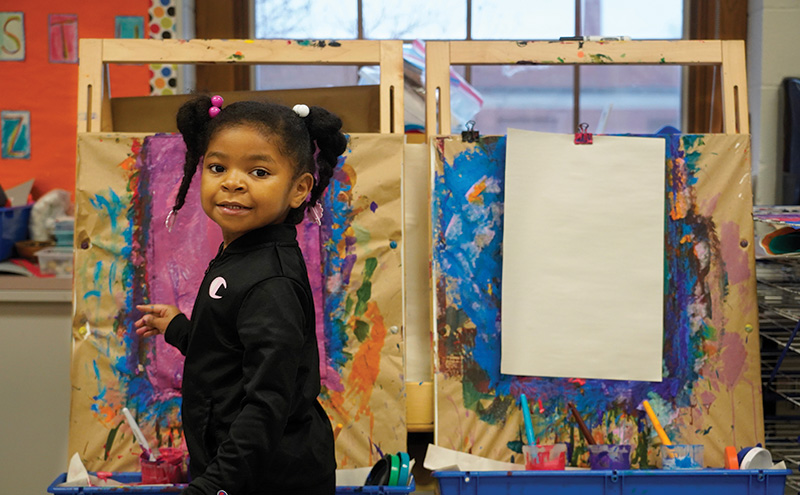
Learning and fun go together hand-in-hand om pre-K teacher Danielle Klink’s classroom.
Onaway Principal Dora Bechtel says the exposure to language and socialization young learners receive in a high-quality preschool program is especially important to children from marginalized families, or those who have special needs. Many times, students diagnosed with disabilities who receive strong intervention services in preschool no longer need special accommodations after they matriculate to the later grades.
“It allows everyone to start with the same foundation,” Bechtel says. “Preschool can really level the playing field.”
Striving to Close the Achievement Gap
In the U.S, access to high-quality preschool is a confusing patchwork. As a result, it is difficult to determine how many children are enrolled in preschool. The National Institute for Early Education says that approximately 39 percent of the nation’s 4-year-olds were enrolled in some kind of preschool program during the 2020-2021 school year.

Learning and fun go together hand-in-hand in pre-K teacher Danielle Klink’s classroom at Onaway Elementary School.
National plans for universal preschool programs have stalled in Congress, so governors and state legislators are taking the lead. This year, at least 14 states are discussing preschool expansion. But what that expansion might look like, and how it would be funded, varies widely.
Ohio, for instance, will receive $48 million in federal grant dollars over the next three years to increase access to early childhood education for children, most of them from low-income families and those with special needs. While the funding boost is welcome, it is a far cry from the scale of the ambitious universal pre-K programs under consideration in Colorado, Illinois, Michigan, and other states. Shaker Heights is striving to close that gap.
Last year, Shaker Heights Board of Education President Emmitt Jolly proposed a transformative expansion of the District’s current pre-K program with the goal of establishing universal preschool in the community. Doing so could establish the community as a national model in early childhood education.
“Research shows that high-quality preschool programs enhance the social and emotional well-being of young learners, prepare them for kindergarten, lead to enhanced academic outcomes, and reduce disciplinary problems later in their school career,” Jolly says. “These positive outcomes are especially true for children from historically disadvantaged and marginalized communities.”

Paraprofessional Stephen Shinn offers a congratulatory hug to a preschool student at Onaway Elementary School.
Jolly’s proposal is part of the District’s long-term facilities planning process, which is expected to conclude this spring. Where to put an expanded preschool program – and how to pay for it – are issues that have been under discussion since the fall. In January, the Board of Education indicated it wanted to explore placing a preschool site at the old Ludlow school building and potentially maintaining the current program at Onaway.
Jolly acknowledged at the time that finding a funding stream to pay for an expanded preschool program – and the space to house it – is not easy. But he argues that the return on investment is great.
“It is the kind of transformative investment that Shaker has historically made to maintain our tradition of academic excellence,” he says.
A Community-Wide Collaboration
identified to have disabilities and those who have not been so identified. The practice of blending students in general education with those who have special needs – a “peer model” approach – provides constructive examples to students with special needs and exposes general education students to children with differences.
“In Shaker’s early childhood program, IB is the umbrella for all that we do,” says Allison Colvin, a preschool teacher at Onaway. “It is an inquiry-based program where the children engage in researching and exploring topics that affect our classroom, school, community, and our world.”
Onaway’s program is open to children between the ages of 3 and 5 who live within the District and are toilet trained. The program is tuition-based for general education students but on a sliding scale for families who qualify for free or reduced-cost meals.
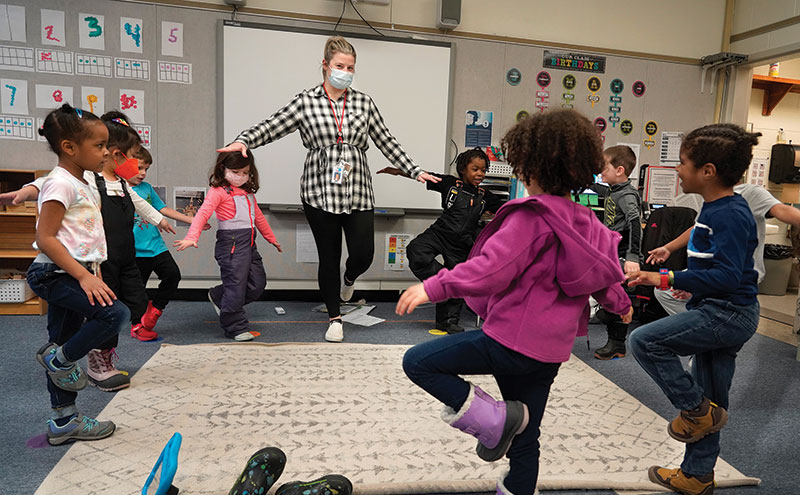
This year, there are about 85 students enrolled in the District’s preschool program – both full-day and half-day. Nearly the same number of children are on the waiting list. Full-day preschoolers get a taste of all of the basic subjects their older peers get, as well as “specials” such as music, art, and physical education. Half-day students get an abbreviated version of that menu. All children go on a wide variety of field trips.
Onaway maintains a long and constant preschool waiting list, confirming the belief that a market for high-quality pre-K exists. Marla Robinson, the District’s chief strategic priorities officer, views expanded preschool opportunities as a community-wide collaboration, rather than a competition.
“We’re all better if we work together,” Robinson says. “We are committed to collaborating with other local preschool programs. Wherever the children are attending preschool, they are still our children.”
A strong preschool program was an attraction for parents such as Nellie Brown. A Shaker graduate who now works in the District’s Human Resources Department, Brown and her husband, Shannon, moved back to Shaker for the diverse, high-quality education opportunities the District affords, including its strong preschool program.
This year, Brown’s daughter Emma, 5, attends preschool at Onaway. She has two other children, Dorothy and William, in the school system.
“Emma was a COVID kid – she was at home with me,” Brown said. “The children she is in preschool with now are her first group of friends. She loves it! She talks about all her friends and loves her teacher.
“I went to Onaway,” Brown adds. “We moved back to Shaker to give our children the same diverse experience that I received.”
On a cloudy mid-winter morning, the children in Klink’s class at Onaway are unconcerned about enrollment numbers and education research. Gathered around their teacher in a circle, they are focusing their attention on the picture book “Waiting for Mama,” a tale of the challenges animals face living in the Antarctic.
“Where is mama going?” Klink asks as the children stare at images of penguins soldiering through their icy home. “Do you have a prediction of where she is going?”
“She’s looking for food,” someone volunteers.
“Preschool can really level the playing field.”
“Let’s find out!” Klink says.
It sometimes feels like the journey to expand preschool to more of the community’s young learners is as daunting as the challenges facing those hungry penguins.
Preschool advocates such as Colvin point out that because high-quality pre-K for all children is not compulsory in Ohio, it will require a partnership between the community and the School District to expand the District’s preschool opportunities. Because so many skills were lost or under-developed during COVID, high-quality preschool and early intervention services are even more critical now, she says.
“I believe it can happen with proper planning and adequate resources and support,” she says. “Although change takes time, I believe this kind of change can’t wait. Many families in our community cannot afford to wait. Their childrens’ futures depend on what happens now.”
Scott Stephens is executive director of communications and engagement for the Shaker Heights City School District.