Shaker Heights High School’s Machining and Manufacturing class is one of the courses that comprise the Engineering and Science Technologies pathway at the school. It typifies the District’s commitment to student engagement through hands-on learning.
By Jennifer Proe
Photography by Gus Chan
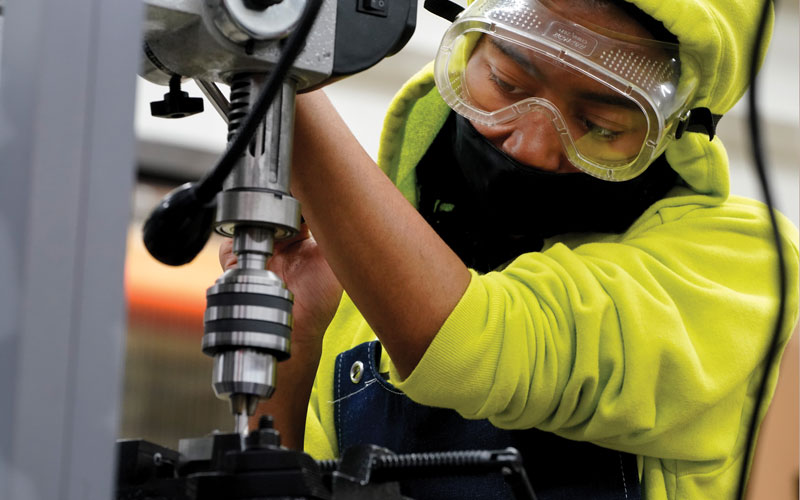
Junior Camille Billips enrolled in the Machining and Manufacturing course at Shaker Heights High School to get a better understanding of engineering basics.
There’s a delicate operation underway in Room 20 at Shaker Heights High School. Wearing goggles, masks, and aprons, the students work in pairs, intently focused, handing one another implements. “Clamp it tight,” says one student. “Now keep the pressure fi rm and steady.”
As the operation comes to a successful conclusion, there is a round of applause. It’s not surgery, but it requires the same careful touch and concentration to get it just right.
These students are learning how to “drill and tap,” a technique that involves punching a perfectly centered hole into a solid block of aluminum using a drill press. Next, they’ll create precisely calibrated grooves that will allow it to accept a bolt or screw. These are just a few of the techniques they’ll master in the Machining and Manufacturing class, one of four courses that comprise the Engineering and Science Technologies pathway at the high school. (The other courses are Intro to Engineering, Robotics and Advanced Manufacturing, and Engineering Applications.)
Some of these students are taking this course as a way to explore working with metal or to nurture a budding interest in engineering. Others are combining it with a prescribed series of classes that will allow them to earn a Career Tech Education (CTE) certification, which can lead either to college or to employment in the manufacturing field immediately after graduation.
All of them will leave this class with useful, working knowledge of some pretty cool state-of-the art equipment. In addition to the drill press, students will get hands-on experience with a band saw, mill, lathe, pedestal grinder, and a full complement of hand tools that would be the envy of any professional machinist.
Getting Up and Running
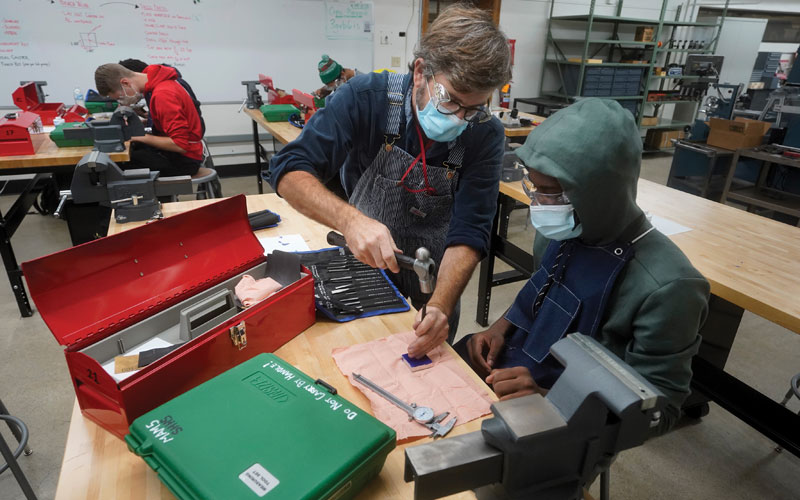
Machining and manufacturing teacher Marty McGuan shows senior Aaron Witt how to mark the center of an aluminum block before drilling.
The new machining room was built, and the equipment installed, during the pandemic; three classrooms were reconfigured to make one large work area. The cost was underwritten by the Shaker Schools Foundation’s Innovation Fund, established in 2018 at A Night for the Red & White, the annual benefit in support of Shaker Schools.
Thanks to direct donations at that event, and subsequent contributions from generous donors and corporate sponsors, the Innovation Fund soon grew sizable enough to support a project of this magnitude, along with many others. The Perkins grant funding is part of the CTE program. The idea for the machining room funding was championed by Shaker’s engineering and robotics teacher, Joe Marencik. He envisioned a space where students could learn real-world skills that would open multiple doors for them, whether at college or in the workforce, or both.
He also envisioned the kind of teacher whose passion for machining would be second only to a passion for teaching. He found it in Marty McGuan, a former elementary teacher at Onaway who is also a serious hobby machinist and self-described “creative and divergent thinker.”
Coming on board during a pandemic was a challenge, as the first cohort of students began learning in a remote setting. McGuan put his creative thinking talents to work: He sent tool kits home for the students and had a video camera installed in the machining room so he could demonstrate the equipment they would eventually be using. By the time the students returned to in-person learning in the spring, they couldn’t wait to get their hands on the real thing.
All of them will leave this class with useful, working knowledge of some pretty cool state-of-the art equipment. I
Naukiya Worley, Class of 2021, was blown away when she finally saw the room in person. ‘I’d never seen this type of equipment in a school. I was excited to use it because I feel like you can get the experience for yourself instead of just hearing a teacher talk about it.”
It doesn’t take long for students in this class to apply what they’re learning to the real world. This year, for instance, they built sheet-metal octagonal pits used for the sport of gaga, a kinder, gentler version of dodgeball. The fruits of their labor will be enjoyed by their younger peers at Woodbury Elementary School during recess.
“This is a perfect example of learning by doing,” says Shaker Heights High School principal Eric Juli.
This type of student engagement through hands-on learning was precisely the reason District administrators were enthusiastic proponents of expanding the curriculum to include these pathway classes. The experiences they gain epitomize the International Baccalaureate (IB) framework the District embraces at all grade levels: an emphasis on creative problemsolving, teamwork, hands-on projects, and inquiry-based learning.
“As we look at the world our students are entering into, it is important, now more than ever, to provide multiple pathways to become successful adults,” says Marla Robinson, the District’s chief academic officer. “Education is no longer onesize-fits-all. I’m not sure it ever was.”
Whether students go on to study engineering in college, or enter the workforce immediately after high school, the class builds the kind of skills students need to be competitive in a modern, global economy.
“Many good manufacturing jobs cannot be filled because employers cannot find qualified applicants who have had the kind of training we have at Shaker Heights High School,” Juli says.
Adds Robinson: “These are not lesser-than options. These are very viable options for all of our students.”
One Class, Many Paths
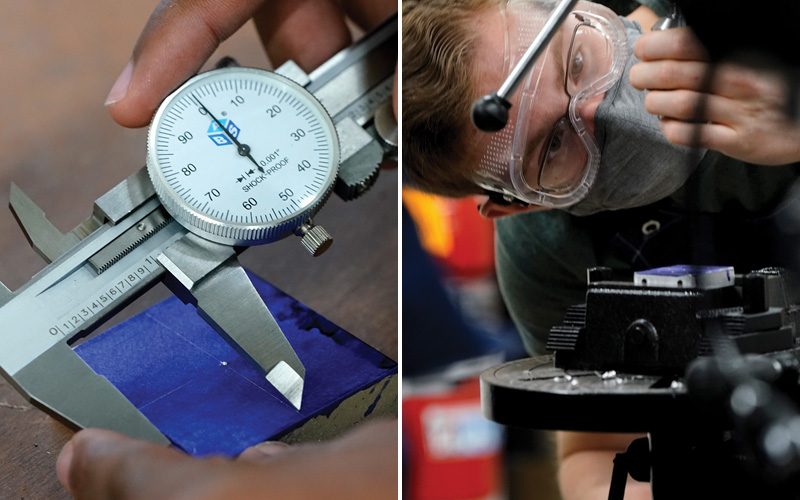
Learning the tools of the trade: at left, students use a micrometer for precision measuring; at right, senior Ben Witt adjusts his settings on the drill press.
A quick poll of the students in both sections of the Machining and Manufacturing class reveals a common thread: students who enjoy working with their hands and learning by doing.
But what they plan to do with this knowledge varies from student to student. Forrest Chaney took Intro to Engineering as a freshman and was hooked. He then took Advanced Engineering as a sophomore and is now enrolled in Machining and Manufacturing to get a more well-rounded experience.
For senior Aaron Witt, this is his first experience with one of the pathway courses. “I just wanted to give it a try,” he says.
For Matt Ritley, a senior, this course is one step on a long journey to pursue a Ph.D. in either mechanical or electrical engineering. “I like working on machines and I do private contracting outside of school,” he says.
Giles Foster, a senior, is keeping all of his options open. “I might go into architecture, but I also like acting. I wanted to take a class that would teach me something I could do outside of school.”
Camille Billips, a junior, says “I want to be an engineer, so I wanted to get a better understanding of the basics.”
But she also loves coding and computer science, courses she’s taking as part of the Career Tech Education program. She starts her day at Heights High, which participates in a five-district consortium to provide all the courses for that certification.
Michael Timberlake, a senior, is also working toward his CTE certification, with a goal to become a carpenter. He takes a woodworking class in Maple Heights.
Retooling Shop Class
When students first enroll in the course, McGuan takes pains to dispel any preconceived notions of what manufacturing entails.
“I show them vintage videos of machine shops and factories, which are probably the image they and their parents have of what machining is – dirty and dark,” says McGuan. “It’s completely changed from that. Manufacturing facilities now are high-tech, brightly lit, nice places to work.” To demonstrate, he shows them recruitment videos from local companies like Rockwell Automation, Lincoln Electric, Swagelok, and Timken. “This is an exciting field, and these places are hungry for bright, young, skilled workers,” he tells them.
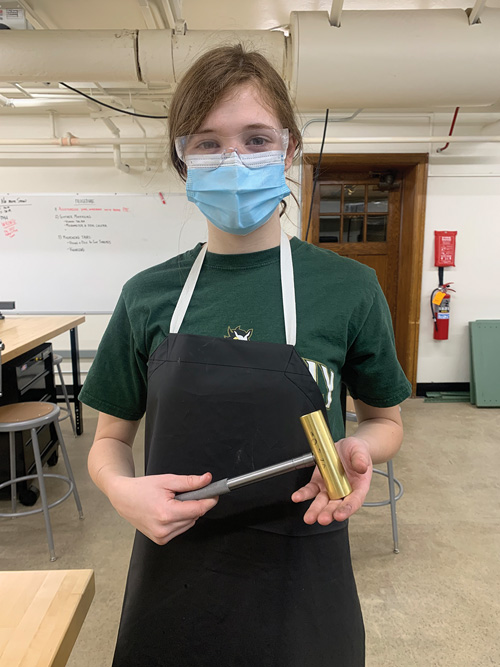
Senior Katy Christian shows off the hammer she made in the Machining and Manufacturing class. She couldn’t wait to put her classroom experience to work in a real-life setting at Shaker Numeric. Photo courtesy Katy Christian.
The students had a chance to learn this for themselves when they took a field trip to attend Manufacturing Day 2021 at Great Lakes Science Center. There, they rubbed elbows with representatives from those companies and many others, as they participated in a variety of hands-on demonstrations and activities like augmented-reality welding.
The students came away impressed. “I was surprised by all the opportunities there are in manufacturing. There’s onsite training and it pays well,” says junior Parker Roeder.
Getting some real-world experience under their tool belts is a huge draw for many students. Says senior Katy Christian, who took the course last year, “I jumped at the opportunity to take the Machining and Manufacturing class and was not disappointed. It opened up new doors for me as I learned to operate machinery I wouldn’t otherwise have access to.
Importantly for Katy, who wants to become an engineer, the contacts she made from a class project allowed her to obtain a summer internship at a local aerospace machining company, Shaker Numeric. There, she ran many of the main machines used in manufacturing, which solidified her career aspirations.
Internship opportunities are an important real-world connection, one that the Shaker Schools Foundation helped forge. Says Holly Coughlin, executive director of the Foundation, “One of our goals is to create partnerships with local businesses that can provide meaningful internships and mentoring opportunities for our students.”
This year, students from the Machining and Manufacturing class will have the opportunity to intern at Rockwell Automation over the summer. Students may also have the opportunity to visit a few times during the school year to get their feet wet.
“It’s really a win for both parties, because those manufacturing companies hope to gain our students as employees one day,” says Coughlin.
McGuan agrees. “One of the things I love about this course is the connection we have with manufacturing here in Cleveland. All you have to do is drive around and you’ll see help wanted signs at these manufacturing facilities,” he says. “If you can show you’re a good problem solver, reliable, and interested in what you’re doing, the possibilities are limitless.”