This fall Ludlow Elementary School opens once again as part of the Shaker Heights City School District welcoming the youngest Shaker students to the District’s new preschool program.
By Scott Stephens
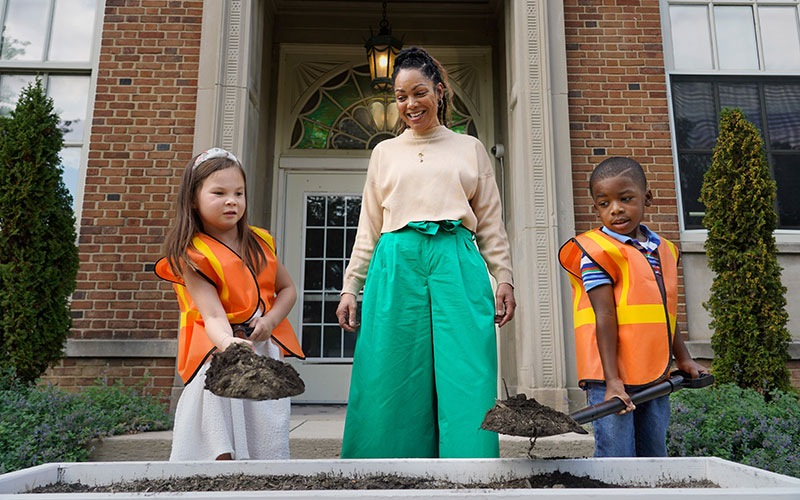
Shaker Heights preschool teacher Allison Colvin and students Ayla Heller, left, and Julian Bunkley are looking forward to the new Ludlow Early Learning Center, which opens August 2025. Photos by Gus Chan.
The weight of history and the hope for a brighter future dwell behind the aged brick walls of Ludlow Elementary School.
For decades, the school served as the social and educational anchor of Ludlow, a tree-lined neighborhood that straddles the border between Cleveland and Shaker Heights and boasts a storied history of supporting and fighting for racial equity, social justice, and integration.
By the 1980s, the Shaker Heights City School District was coming out of the baby boom explosion of the previous two decades. With too much space and too few students, the District decided to close schools, including Ludlow and Moreland
Elementary School, both cherished neighborhood institutions with majority Black enrollments.
Now, as the Ludlow Elementary School prepares to celebrate its 99th birthday, the venerable old building is getting a dramatic makeover: new classrooms, a new gym, a preschool playground, and a community playground.
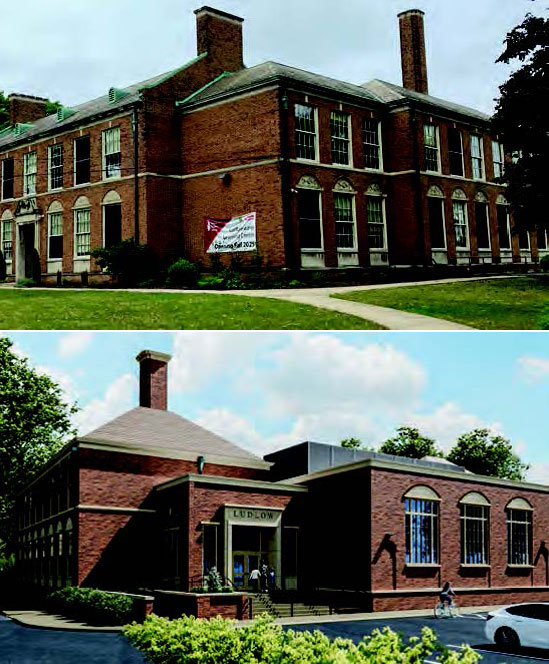
Ludlow School, top, turns 99 years old this year. An architect’s rendering of the Ludlow Early Learning Center, bottom, shows a specially designed entrance for the pick-up and drop-off of preschool students. The new center will open August 2025.
This August, the newly renovated school will reopen as the Ludlow Early Learning Center, a facility that will be home to the District’s greatly expanded preschool program.
District officials believe a school that once stood as a national model for integration will soon be a national model for early childhood education, reflecting the diverse student body that makes the Shaker Heights Schools and community such a unique place.
“What truly excites me is that this investment will directly benefit the historically underserved Ludlow neighborhood, transforming it into a vital resource for our students and families,” says Felecia Evans, assistant superintendent of learning and teaching. “We are reclaiming a key part of Shaker’s history – one that played a pivotal role in our community’s civil rights movement.
By revitalizing Ludlow, we are restoring it to its rightful place as a beacon of learning and hope, offering a brighter future for our youngest citizens.
That’s good news for a community that watched its beloved school close in the 1980s and sit empty until it was leased to the Positive Education Program (PEP), which serves children challenged by complex developmental trauma, mental health issues, and autism.
In 2022, PEP purchased a building near University Circle and moved, leaving Ludlow empty once again. But the departure of PEP created an opportunity for the District to reconnect with the community.
“The Ludlow community is excited to have our school back and functioning after almost 40 years,” says Benjamin Hsu, co-president of the Ludlow Community Association.
“This reopening signifies a revival of our community spirit and a reconnection with Shaker Heights as a whole.”
A Very Specific Design
The District hired the GPD Group, an Akron-based architectural firm with vast experience in school design, to create the new center, which will include a drop-off and pick-up entry specially designed for pint-sized students. GPD and the construction firm on the project, Gilbane Building Co., have worked closely with the neighborhood and the City on issues such as traffic flow, parking, landscaping, and preservation of the trees and athletic fields.
GPD has also worked closely with the preschool faculty and staff to design space that serves the unique needs of a preschool.
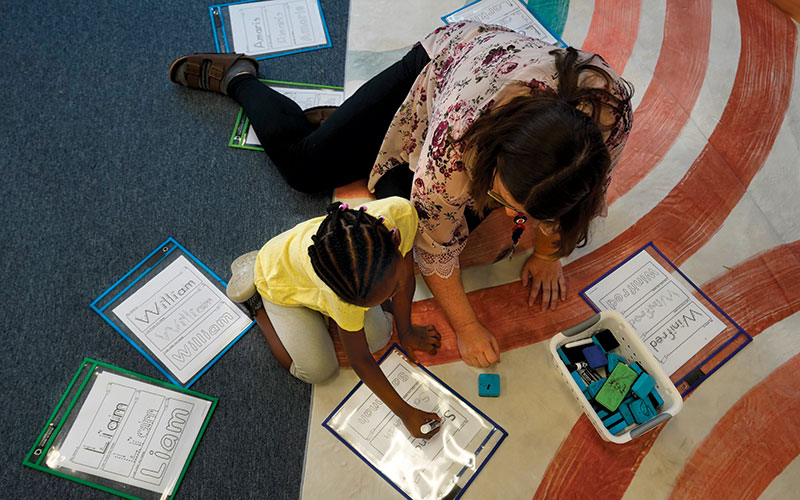
“We work very closely with teachers because this is their building,” Mark Salopek, who leads the education group for GPD, told the Board of Education. “We do a lot of school work and working on a building for 3- to 5-year olds puts a smile on your face.”
Educational researchers rarely agree on much, whether it’s how to best teach math or what to serve for lunch in the cafeteria. But virtually no one disputes the value of a high-quality preschool program. A majority of research shows that many preschool programs benefit students in both the short- and long-run, preparing them for success in kindergarten and making them more likely to eventually walk across a commencement stage. A study released in 2023 by a Massachusetts Institute of Technology economist found that attending preschool at age 4 makes children significantly more likely to go to college.
“By investing in preschool, we create equitable opportunities for lifelong learning and academic readiness, reducing disparities and fostering future success,” says John Moore, director of curriculum and instruction. “These aspirations can be accomplished by ensuring that young learners gain essential academic, social, and emotional skills early – bridging gaps that can widen in kindergarten and beyond.
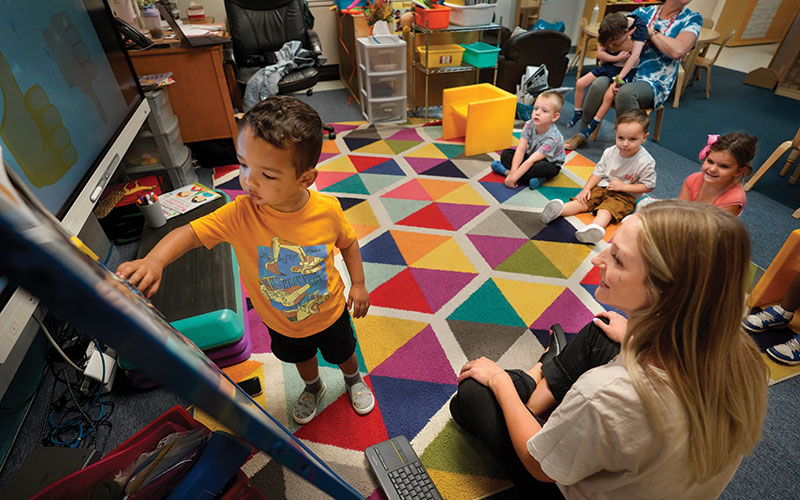
A well-designed, inclusive curriculum fosters language development, critical thinking, and collaborative skills – empowering children with diverse learning needs to succeed in preschool and throughout their Shaker experience.”
Now the Board of Education is including an expanded preschool program in its long-term facilities plan. The goal: make high-quality preschool available to as many Shaker children as possible. In November 2023, voters approved a facilities funding package that included seed money for the expanded preschool program at Ludlow.
Programming Unique To The Region
All classes will include both students who have been identified to have disabilities and those who have not been so identified. The practice of blending students in general education with those who have special needs – a “peer model” approach – provides constructive examples to students with special needs and exposes general education students to children with differences.
Full-day preschoolers get a taste of all of the basic subjects their older peers get, as well as “specials” such as music, art, library, Spanish and physical education. Half-day students get an abbreviated version of that menu. All children go on a wide variety of field trips.
“This type of programming is not being offered anywhere else in Cuyahoga County,” Evans says.
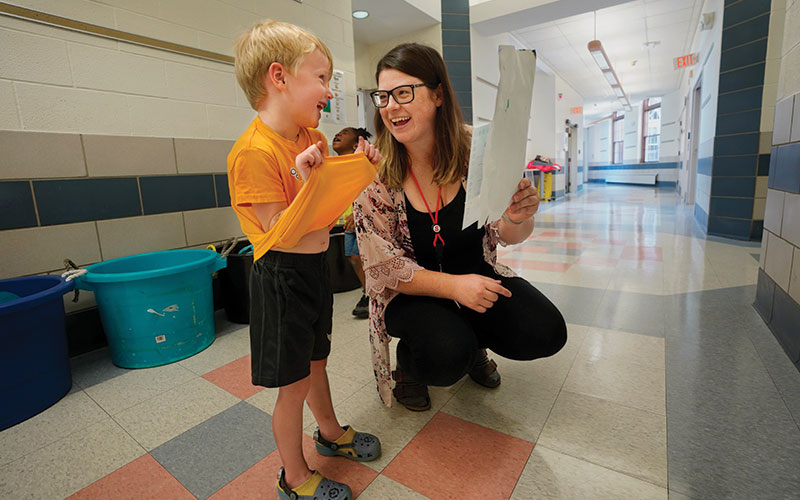
The program will be open to children between the ages of 3 and 5 who live within the District and are toilet-trained. The current program is tuition-based for general education students but on a sliding scale for families who qualify for free or reduced meals. While a sliding-scale tuition system will continue, the expanded program at Ludlow will offer unprecedented access to all families, regardless of their financial means.
Last May, Cuyahoga County informed the District that it had been awarded a Universal Pre-Kindergarten (UPK) grant from Invest in Children. UPK is a countywide initiative aimed at providing high-quality early childhood education to preschool-aged children, particularly those from low- and middle-income families. The award provides the District $660,000 over three years and can be used for tuition assistance, teacher training, and family support.
Additionally, the expanded preschool program will accept vouchers. The Ohio Department of Job and Family Services offers this financial assistance to eligible parents and guardians to help them with child care costs while they engage in work, education, or job training. Families can be eligible to have all or part of their monthly child care expenses paid on their behalf.
“When families can’t access affordable child care, they lose wages and opportunities to provide for their future, creating a cycle that is hard to break,” Evans says. “By expanding preschool spots for Shaker children, we are not only empowering families but also positively impacting our local economy and community. This is an investment that benefits everyone.”
Casting A Wide Net
As of September 2023, 81 students were enrolled in the District’s preschool program housed in Onaway Elementary School – both full-day and half-day. The District hopes to at least double that number in the new Ludlow Early Learning Center, which will be able to accommodate 200 young learners.
Onaway usually maintains a long and constant preschool waiting list, confirming the belief that a market for high-quality preschool exists. But the District is leaving nothing to chance. In late 2023, it embarked on a wide-ranging marketing and enrollment campaign aimed at ensuring the community is aware of the expanded program.
This proactive, grassroots approach is aimed at reaching historically marginalized families who could benefit most from increased access to high-quality preschool, says Trina Jones, the District’s family and community engagement liaison.
She and Chrystal McNeal, a paraprofessional and family and community engagement liaison at Onaway, go as far as to sit down with families who began a preschool application for their student but failed, for whatever reason, to complete it.
“We’ll work with a family and talk through what the barriers are,” Jones says. “What is the disconnect? Why didn’t you finish the process?”
To Jones and McNeal, ensuring that the Ludlow Early Learning Center succeeds – and, in the process, reclaiming a part of Ludlow’s history – is a mission more than it is a job.
“We both are in the Ludlow community,” Jones says. “We live there.”
Scott Stephens is the executive director of communications and engagement for the Shaker Heights City School District.