The District spotlights athletics for its power to bridge racial and cultural divides and serve as a tool in the quest for diversity, equity, and inclusion.
By Joe Miller
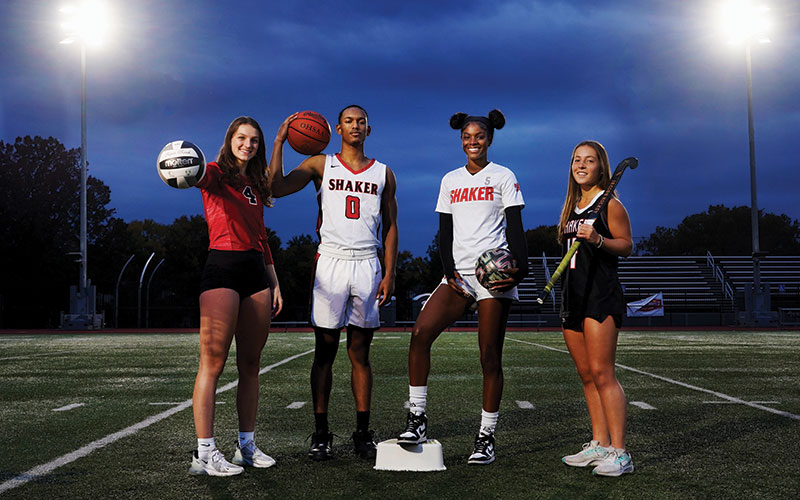
Shaker Heights High School seniors Chloe Brown, Kellon Smith, Meilani Walker and Javiera Baeza. Photography by Gus Chan.
It’s a cold Friday night in early October, and the rain is falling steadily at Shaker Heights High School’s Russell Rupp Stadium.
The Homecoming game is underway, and Raider fans, many wearing winter jackets and huddled under umbrellas, have packed the stands. Football players slip and slide on the artificial turf as the stadium lights transform the raindrops into a spotlit waterfall. Suddenly the crowd – a mosaic of Black, brown, and white parents, students and alumni – is on its feet screaming. The Raiders score on a 31-yard touchdown run.
When the game finally ends in a 34-16 Raider victory, senior Meilani Walker is among the brave fans still cheering. “It was freezing and everyone was soaked,” she recalls. “But it was a great game.”
“There’s really an opportunity through sports to unify people.” — Mity Fowler, Shaker Parent
High school football, a longtime Saturday afternoon tradition in Shaker Heights, turned into a Friday night festival this year thanks to temporary sets of LED lights towering 52 feet above the field. “It makes the games more fun for students and players,” says Nolan James, a senior baseball player and frequent attendee of the night games. “Shaker may win or it may lose. Either way, the energy of those nights and those games, it’s ecstatic.”
Superintendent David Glasner wants to tap into that energy.
In his fourth year leading Shaker Schools, Glasner sees athletics – and its ability to bridge racial and cultural divides – as a key tool in his quest to make diversity, equity, and inclusion (DEI) a guidepost for every aspect of the District. Furthermore, he believes sports can help provide opportunities for every student to meet their full potential and heal damage done during the COVID-19 lockdowns.
“It has really struck me, talking to students about the way that athletics has continued to reemerge from the pandemic. What a powerful, community-building opportunity this has become,” Glasner says.
He sees promise in the broad reach of sports. At the High School, nearly half of the student body plays on at least one of its 31 varsity teams or its junior varsity or club teams, from cross country and tennis, to basketball and lacrosse. More often than not, those teams are bringing together kids who might not interact otherwise.
“Excellence in athletics goes beyond the final score,” says Glasner. “It also means developing a team that works together, that communicates. Students of different backgrounds and performance ability are working together to get better, to make the team better, and to make their surroundings better. Athletics is one of the ways that we can help facilitate and build an inclusive community that strives toward excellence.”
Rented stadium lights may look like just an attempt to raise Raider spirits. But coaches, players, and parents say the lights – as well as other key moves, from the addition of a new training center to increased DEI training for the staff – are making Raider sports teams more competitive and helping to tear down inequities for athletes and fans alike.

Photo courtesy of Shaker Heights Schools.
The Value of Athletics
The five light towers didn’t just give Raider football, soccer, and field hockey teams the ability to play night games in front of bigger crowds. They also provided more evening practice opportunities on the District’s only artificial turf field. That was particularly important in late fall, as days grew shorter and teams needed to rev up for playoffs.
On top of that, the night games were more convenient for working parents – and potentially college scouts – and allowed for events that targeted elementary school kids, attracting the next generation of athletes, Black and white, to sports they may never have considered otherwise.
“We’re trying to get people excited about being a Shaker Raider,” says Michael Babinec, the High School’s athletic director. “We want little kids in our District to be looking forward to playing in our gym and our stadium.”
Babinec, a former baseball coach and English teacher at the High School, is leading the charge with an athletic department team that includes three other former coaches: Marc Enie, Vikki Long, and Michael Summers. The department has already made a name for itself with a new website and the weekly Raider Roundtable, a newsletter that highlights Raider athletes both past (such as champion rower Sophie Calabrese; see Scene in Shaker) and present.
But Babinec’s job goes beyond communication or keeping team schedules straight. His efforts to give all students the same Raider experience involve working closely with stakeholders such as the relaunched Shaker Heights Sports Boosters parents club, local youth sports organizations, the City’s Recreation Department, and the Shaker Schools Foundation.

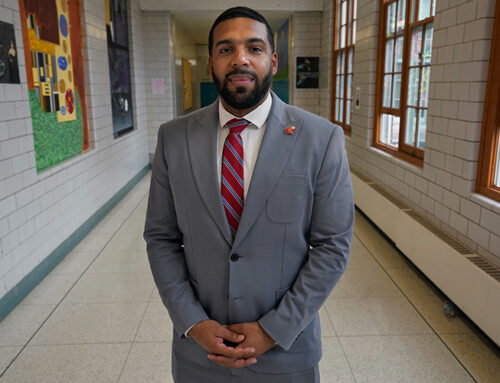
Top: Shaker Heights High School Athletic Director Michael Babinec. Bottom: Dr. Lawrence Burnley, Chief Diversity, Equity and Inclusion Officer
He has also teamed up with the District’s new Chief DEI Officer Lawrence Burnley, as they chart next year’s return of the High School teams to the more competitive Greater Cleveland Conference (GCC). The District pulled out of the GCC two years ago in part because of racist taunts that Black athletes faced at away games.
“There’s a lot of work to be done internally, in terms of preparing our own athletes, coaches, staff,” says Babinec. “Not just for the move to the GCC. That’s just a piece of the puzzle. But preparing them more holistically and focusing on what we can do better here in Shaker.”
Aside from the lights, the biggest hits with most students have been the opening of the High School’s new training room – dubbed the Raider Athletic Center or RAC – and last year’s hiring of Joe Schlesinger, the school’s first head of sports performance.
The District replaced the old basement workout room with the RAC in 2020 by renovating a larger multipurpose room. The RAC features $250,000 in donor-funded equipment and is run by Schlesinger, a former strength and conditioning coach for the Pittsburgh Pirates. That combination has made fitness classes at the High School among the most popular for athletes and non-athletes alike.
“It’s a really cool dynamic to be able to work out with athletes who are out of season or even in season, or who aren’t athletes,” says Chloe Brown, a senior volleyball player who has committed to playing for the University at Buffalo next year. “And it gives the varsity athletes a chance to teach others.”
“It shows our commitment to the kids,” adds Danny Young, the High School’s long-time boys basketball coach. As with academics, the District wants to create “that same sense of pride in athletics with the resources and tools to help students reach their maximum potential.”
But upgrading facilities and equipment is a relatively easy fix compared to changing the culture of a community.
“Athletics is one of the ways that we can help facilitate and build an inclusive community that strives toward excellence.” — Superintendent David Glasner
When Timeka Rashid’s family moved to Shaker Heights, she wanted to raise her Black sons in a community dedicated to diversity. But when she attended their football games, Rashid noticed that Shaker Heights’ diversity didn’t always carry over into the team rosters or the fan base.
“In Shaker sports there was such a disconnect,” she says.
Rashid wasn’t the only one who felt that way. In 2018 she and other parents from a wide variety of backgrounds began to brainstorm ways to improve the experience for all Raider athletes and fans no matter what the sport or the color of their skin. The result was the “reboot” of Shaker Heights Sports Boosters, which had disbanded a few years prior.
“When we talk about diversity in Shaker, there’s really an opportunity through sports for kids to play together, for parents to sit together in the stands and cheer for their kids,” says Mity Fowler, another leader of those early meetings. “There’s really an opportunity through sports to unify people,” she says.
Some of the ideas from those early meetings have already been realized. Sports Boosters early on lobbied for stadium lights as well as free admission for High School students, new this year, as a way to eliminate attendance barriers and to fill seats. Sports Boosters also expanded concession offerings at the stadium and has made them available at all home games for all sports.
Babinec has entrusted the parent group with senior posters – four-foot-tall banners, each featuring a closeup of a senior athlete. Sports Boosters has transformed the posters into season-long celebrations of the High School’s many sports. This fall, 65 of them covered nearly half of the High School stadium’s fence.
Behind the scenes, Sports Boosters is coordinating fundraising among the sports, providing grants to coaches to cover team needs. Its leaders have also worked with the Shaker Schools Foundation to fund bigger projects, such as the RAC, and to create programs such as Level the Playing Field, an effort to diversify youth sports with scholarships for kids.
“If you’re going to solve the problem of diversity, you can’t do that in high school. That’s too late,” says Scott Shelfer, who approached the Foundation with the idea for Level the Playing Field. Shelfer, who was co-president of Sports Boosters last year, believes scholarships for more expensive sports such as ice hockey can make a difference. “But economics is just one barrier,” he says.
Babinec and Burnley are hearing that first-hand from the community. With the upcoming return to the GCC looming, the two men have made a point of giving players, parents, and coaches opportunities to detail their own personal experiences and concerns behind closed doors and in public. That included three “listening and learning tour” meetings in October with more to come.

“We need to be prepared to hear things that may be uncomfortable,” Babinec says. “And be prepared to hear things that may present additional work for us.”
“This is going to take time, and we’re going to have to do things differently,” says Burnley. “We have to develop the capacity to talk about these things honestly with transparency, candor, and respect. And we have to keep people at the table.”
During those meetings, Black athletes have described not only hearing racial slurs at the stadiums, but also feeling a lack of belonging at home in sports where most of their teammates are white. Some worry about going back to the GCC, but others point out that athletes of color – as well as other marginalized groups – can face discrimination wherever they play.
Meilani Walker is a standout athlete in three sports – soccer, basketball, and track. But it’s only on the soccer pitch, where she is one of the few Black players, that she sees a difference in the way game officials treat her. And this season, Walker and her teammates faced a referee who suggested the officiating might not be impartial if the girls knelt during the National Anthem. They knelt anyway.
Babinec says the District continues to support students’ right to kneel – in this case to protest racism – and he has made sure that official will not ref other Raider games.
“We have a lot of work to do,” says Walker. “But I appreciate our school being open to people voicing their concerns and then backing them.”
A lot of that work will fall on Babinec and Burnley. Both men and their departments have been meeting with other GCC districts to educate them on what Shaker Heights expects from their opponents. They are also working with their own coaches to create District-wide policies and protocols for dealing with racism on and off the field and even in their own locker rooms.
“Honestly, it’s work we have to do independent of the decision to go back to the GCC,” says Glasner. “We know that our students are going to experience the dynamics and the challenges and the tensions that exist in our society at large.”
“Getting this right,” says Glasner, “is critical.”
Shaker Sports Leaders On & Off the Field
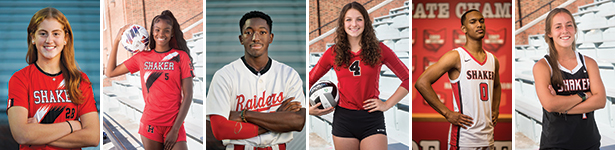
Shaker’s student-athletes are impressive and hard working. Click here to meet and learn more about some of these sports leaders.