The Shaker Heights Schools’ new diversity, equity and inclusion chief says the core of his work is helping people see themselves in others, and others in themselves.
By Jennifer Proe
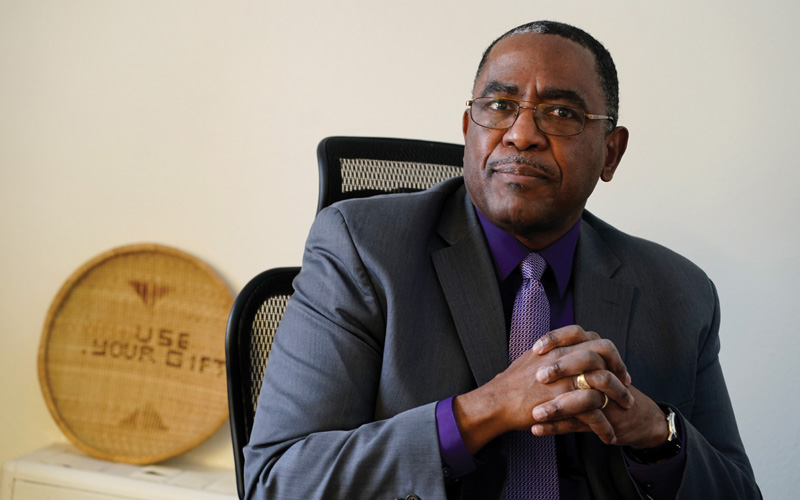
Dr. Lawrence (Larry) Burnley (SHHS ’74) joined the Shaker Heights City School District as the new Chief Diversity, Equity and Inclusion Officer from the University of Dayton. Photo by Gus Chan
Lawrence (Larry) Burnley has held many roles: Husband. Father. Historian. Activist. Probation Officer. Minister. Published Author and World Traveler. Vice President for Diversity and Inclusion at the University of Dayton. And now, Chief Diversity, Equity and Inclusion Officer for the Shaker Schools.
Burnley was a student at Shaker Heights High School in 1973 and 1974.“You wouldn’t necessarily have projected me to be that guy,” says he. “I didn’t think I was that guy. But there were people in my life who saw things in me that I didn’t necessarily see in myself.”
He describes himself at that time as an average student, “just learning, having fun, going to games and parties.” He and his buddy Zach Green co-managed the girls volleyball team.
Another classmate, Dee Jordan Perry, recalls playing cards, going bowling, and roller skating with their friends.
“Larry has a very caring, sincere, down-to-earth personality and has always been a great person to be around,” she says.
Burnley sheepishly recalls getting a one-day suspension for smoking in what was then called “Hippie Hall” (the egress at the High School). “But I wasn’t a bad kid,” he says. “It was more of a ‘scared-straight’ kind of thing.”
Burnley arrived at Shaker Heights High School as a junior when his family relocated to the Shaker Heights City School District from the Lee-Harvard area. It was only a few miles from where he had grown up, and yet it was a whole world apart.

Larry Burnley’s father moved to Shaker Heights in 1973 in part to take advantage of the excellent Shaker schools. Shown here, clockwise: Larry (in tie) with his father Halo Burnley, Jr., mother Francis Burnley, and siblings Constance Washington, Carolyn Porter, David Burnley, Sr., and Dr. Margaret Spearmon (center). Photo courtesy fo the Burnley family.
“Coming to Shaker was life-changing for me,” he says. “I grew up in a predominantly Black area, and Shaker was a predominantly white community. It was my first time navigating that.”
It was also eye-opening from a socio-economic standpoint, seeing both white and Black students whose parents were professionals and took interesting vacations. “It exposed me to more diverse views of the world and influenced my imagination of what could be.” Yet his social circle remained mostly Black.
“I think I really only had one white friend in High School.”
Crucially for Burnley, “Shaker set me on the path to college. It surrounded me with a peer group that had a clear pathway and commitment to education. A kind of positive peer pressure if you will.” His mother and father, a mail carrier in South Euclid, had made it clear that they expected the Burnley children to attend college. Larry, the middle child of five, gamely followed his older sister’s footsteps in that direction.
Upon enrolling at the University of Cincinnati, Burnley’s initial ambition was to become a pilot. A first-year course in African-American history upended those plans. Up to that point, the only African-Americn history he’d been offered in school covered slavery, Booker T. Washington, Martin Luther King, Jr., Rosa Parks, and other icons of the civil rights movement.
A pivotal experience
“How had I never known about the resistance of African people to chattel enslavement? The brilliance of Black scientists, inventors, and doctors? An awareness of pre-Colonial African civilizations through an African-centered lens?” he asks.
The awakening propelled him to change his major to African American studies with a concentration in history and pre-law. He also became an activist.
“I started really searching. I was upset about the role of the church in the enslavement and genocide of people around the world, and the misuse of the Bible to justify white supremacy. I was angry.”
Returning to campus from Thanksgiving break, he had a pivotal experience. A cab driver refused him a ride back to campus, telling him to get out so he could take three white students instead. The students told the cab driver, “If he doesn’t get a ride, we’re not going either.”
That moment made Burnley aware that “I was becoming that which I hated. God was showing me that there are good people who don’t look like me. It planted the seeds of a ministry of reconciliation and healing,” and set him on a path to justice work that became his life’s calling.
In 1979, Burnley married his Shaker classmate and former prom date, Angie Seldon, and they became parents to a son, Rashad. They later divorced but remained committed co-parents throughout Rashad’s life, which was tragically cut short by a drowning accident in 1999. A photo of Rashad, a 1997 Shaker graduate and Minority Achievement Committee (MAC) Scholar, sits within arm’s length of Burnley’s desk, reflecting the same warm and charismatic smile as his father’s.
“Rashad was an exceptional young man,” says Burnley. “Mature beyond his years. Funny. He was a reconciler, a critical thinker.” He excelled at the trumpet and karate, as well as his studies. He played football at Shaker and at the College of Wooster, where a fellow student recalls, “There were many potential lines of separation, but Rashad crossed them all.”
Eventually, the Burnley family found a way to channel their profound grief by establishing a fund at the Shaker Schools Foundation in Rashad’s name. The fund provides a scholarship each year for a deserving MAC Scholar to use toward college. Last June, Burnley gave the keynote address at the MAC Scholars’ 30th reunion gathering and was gratified to hear Shaker students speak of Rashad. “His story persists; they still share his values.”

Larry Burnley treasures time spent with his wife, Naima, and son Thulani. His family has established a fund to honor his late son, Rashad, at right.
“Use your gifts”
As his career unfolded, Burnley became aware of a gift he had for walking alongside people and relating to them. After graduation, he served as the program director for Friendly Inn Settlement House (the first settlement house in Cleveland to have an interracial staff) for two years and then as a probation officer for juvenile offenders in Cuyahoga County. He became acutely aware of the inequities baked into the justice system, the disparities in dispositions and sentencing for minority youth, and how money, or lack thereof, impacted their outcomes.
He also began to sense a calling to ministry he could not ignore. In 1986 he entered the Christian Theological Seminary in Indianapolis, where he earned a Master of Divinity. His ministry work took him to the University of Pennsylvania, first as an associate director of a campus ministry, then as
a graduate student, earning a Ph.D. in History of American Education.
Prominently displayed in his office is a woven basket from one of his travels to numerous African countries that says, “Use Your Gifts.” It serves as a reminder to Burnley “to continue to give voice to the voiceless as a historian, as a minister, as an educator. This is my challenge, to give back and to use my gift to help others to see and be seen.”

Larry, Naima and Thulani Burnley were honored to meet African Anglican Archbishop Desmond Tutu during one of many trips to South Africa and other African countries.
Those travels also led him to his wife Naima, an attorney, minister, and social justice activist whom he met at the All-Africa Council of Churches conference in Addis Ababa in 1997. He recalls, “We were supposed to go as a group to a jazz club, but we were the only two who showed up. We spent the next several hours pouring our hearts out to one another,” and the rest is history.
He and Naima have a 20-year-old son, Thulani, who has Down Syndrome. He is also a talented percussionist, a compassionate natural helper, and loves basketball. Burnley treasures downtime spent jamming on bass guitar with Thulani on the drums.
While Burnley forged a bold path as the inaugural vice president of Diversity and Inclusion at the University of Dayton, Naima used her skills as a former Legal Services attorney to promote equity for persons with developmental disabilities in their hometown of Centerville, Ohio. She also served on the Montgomery County Board for Developmental Disabilities. She brings the same passion to that cause as she did as an advocate for indigent persons, refugees, and racial justice.
Parenting Thulani has given Burnley an expansive view on equity. “Persons with disabilities are among the most invisible and marginalized,” he says. “Any institution that’s making a commitment to DEI must understand that inclusion means everyone. I understand and resolutely affirm Shaker’s focus on Black excellence. At the same time, we cannot allow that focus to result in our unintentionally contributing to the marginalization of other persons, whether by gender, gender identity, sexual orientation, or disability, and we need to understand the intersectionality there.”
The road ahead
Burnley brings a depth of professional expertise to his new role at Shaker.
Paul Benson, provost and executive vice president of Academic Affairs at the University of Dayton, describes Larry as having “a big heart and a capacious soul.” He says, “Larry made an extraordinary impact here. He recruited an outstanding staff, oversaw the most comprehensive assessment of campus climate we have had, and led the development of a strategic framework for the University’s work over the next four years to advance diversity, equity, and inclusion.” He also helped forge valuable community connections resulting in entrepreneurship and venture development in the surrounding area.
Burnley’s first order of business in Shaker is a listening, learning, and visioning tour. “I have a vision of inclusive excellence, but I don’t have a predetermined vision of the DEI work and how that will happen in Shaker,” he says. “I realize there’s a train that’s moving here, and I can sense the anticipation and excitement for what’s coming. I want to be responsive to the need without getting ahead of it.”
“This is my challenge, to give back and to use my gift to help others to see and be seen.”
Superintendent David Glasner is thrilled to add Burnley’s talents to the senior leadership team of the Shaker Heights Schools. “The DEI department under Larry’s leadership will continue the important work to disrupt societal and historical inequities and eliminate disparities within our District so that all our students and staff can thrive,” he says. “His experience, leadership, and expertise will drive forward the Strategic Plan and Educational Equity Policy created by the District.”
As the person who arguably knows him best, Burnley’s sister Margaret Spearmon says of him, “Larry is a formidable character who strives for excellence in all that he does. He goes the extra mile. He’s always on a quest to learn more, to contribute more, to hold himself accountable to a concept of shared humanity called ubuntu — a Zulu term that translates as ‘I am because you are.’”
Or, as Burnley puts it, “My neighbor is really an extension of myself. I’ve learned from my faith and other cultures this interconnectedness we have. To help see ourselves in others, and others in ourselves, is at the center of my work. We’ve created these categories as a way to separate ourselves and divide us. Instead, we can use these pillars of unity and justice to let love drive us.”
Originally published in Shaker Life, Spring 2022
Multicultural Curriculum: Bringing DEI Into the Classroom
A multicultural curriculum aims to prepare students to be productive citizens in a democratic society by teaching them to consider the needs of all individuals. It takes into account how issues such as race, ethnicity, culture, language, religion, gender, and disabilities intersect with educational processes and content.
A growing number of educators agree that a multicultural curriculum prepares students for the world they will face after leaving school. It should include a variety of perspectives, include the contexts of equity and inclusion, and should foster critical thinking skills.
In the Shaker Heights Schools, these goals are realized through a “windows and mirrors” approach to resources and learning experiences, says John Moore, Director of Curriculum and Instruction. Curriculum and instruction must provide a window into the lived experiences of others while serving as a mirror in helping to understand ourselves.
“This means offering an educational experience in which all young people have the ability to explore the perspectives of others while deeply reflecting on their own,” Moore says. “This requires resources that are representative of our local and global communities so that students better understand the contributions of all people to the knowledge and understanding of our world.”
Lawrence Burnley, the District’s new Chief of Diversity, Equity and Inclusion, says all students – through books and educational materials – must make a connection with what they are being taught. “If you’re not seeing yourself, that’s a problem,” he says.
As a former history teacher, Superintendent David Glasner says schools have to make sure that students are exposed to multiple perspectives, including the hard truths of history that they can address and improve upon. Confronting reality, he notes, is absolutely essential to producing an educated citizen who has the tools to be successful.
“When I talk to industry leaders they really believe these are the skills students need to succeed in the world,” he says.
Moore says that in the Shaker Heights Schools, the Learning and Teaching Department collaborates with the Office of Diversity, Equity and Inclusion to develop a formal system of reflection on lesson plans and units of instruction. As teachers create lesson plans, they examine practices for inclusion by asking questions such as, “What biases are represented in the unit, and how are they addressed?” and “How are curriculum materials used to show diverse perspectives of marginalized culture, gender, class, etc.?”
“These questions, and the discussions they generate, serve to hold us accountable to the goal of a truly representative curriculum that engages all learners,” Moore says.
— Scott Stephens