Cell phones in classrooms is a hotly debated issue across the country and within the Shaker community. With the help of stakeholder input and expert resources, the Shaker Heights City School District built a new cell phone policy that launched this school year.
By Scott Stephens
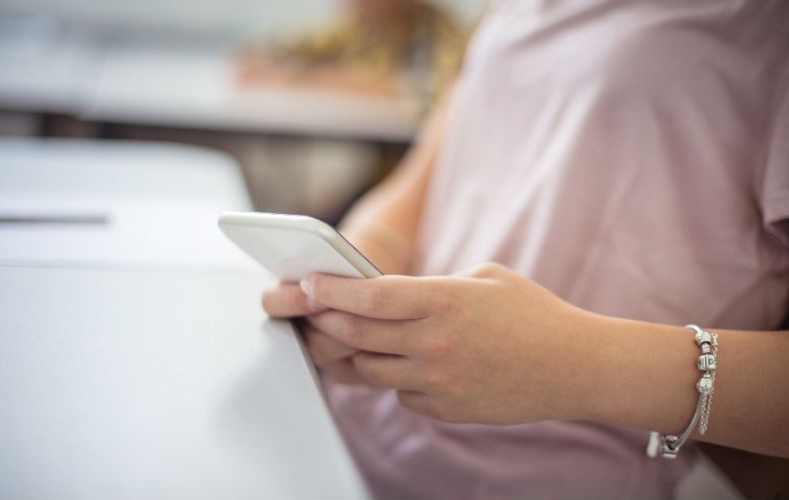
W hen it comes to the use of cell phones in school, the Shaker Heights City School District is practicing addition by subtraction. Teachers, administrators, parents, and the majority of students agree that the use of cell phones by students is a distraction in the classroom, cafeteria, and hallways. Most concur cell phones have a negative impact on school climate and safety. Many refer to the use of cell phones as an addiction that should be treated as a mental health issue rather than a disciplinary issue.
To them, restricting the use of the ubiquitous devices has a nice ring to it. “We’re really looking at this as a wellness initiative,” says Assistant Superintendent of Learning and Teaching Felecia M. Evans. “We are seeing an impact on students’ mental health and also teachers’ ability to teach and students’ ability to learn.”
As a result, the 2024-2025 school year marks the start of a new policy dramatically restricting the use of cell phones by students. Its aim: enhance the well-being of students, foster educational engagement, reduce distractions, and promote a focused and safe learning environment.
The District’s policy states the following:
- Preschool-Grade 5: Cell phones and wearables (such as earbuds and Apple watches) must be turned off and stored in backpacks from arrival to dismissal.•
- Grades 6-12: Cell phones and wearables must be turned off and stored in the student’s assigned Yondr pouch from arrival to dismissal. The bag is sealed by a magnet that cannot be opened until the school day concludes.
- Exceptions to this policy may be granted by the school administration on a case-by-case basis for health-related reasons, special educational needs,
or other significant circumstances.
The Path to a New Policy
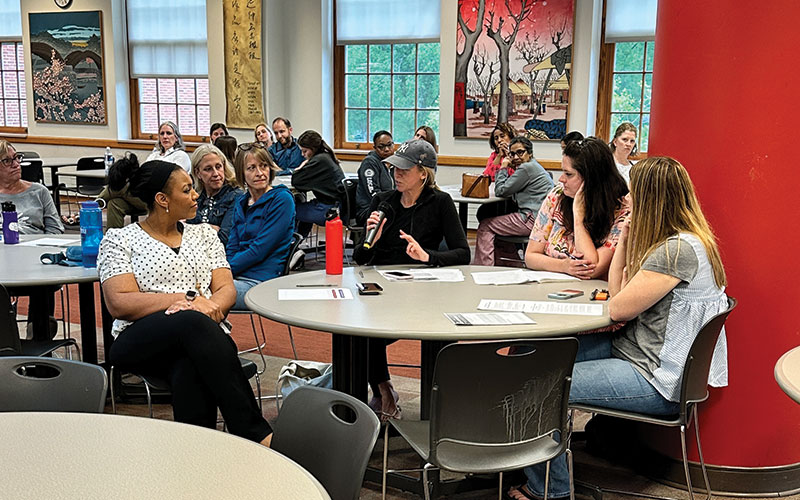
The policy was the product of months of research and discussion among a broad range of stakeholder groups. In early 2024, the District convened a district-wide committee and committees at both Shaker Heights Middle School and Shaker Heights High School to explore ideas and gather stakeholder feedback about the use of mobile devices in schools. That effort included staff, administrators, and parents from both the high school and middle school.
Their work included visiting multiple schools where cell phone restrictions had been implemented, and meeting with experts from the medical, mental health, and legal fields to review the latest research and implications around cell phones in school.
The District also conducted a survey that was sent to all staff, families, and students in grades 3-12. Some 3,000 individuals responded. The results? About 85 percent of the families responding favored cell phone restrictions during the school day. About 92 percent of teachers favored such restrictions, as did 51 percent of support staff such as bus drivers, paraprofessionals, and administrative assistants.
About 85 percent of families responding to a District survey favored cell phone restrictions during the school day.
“I think the data says to us that our community wants to do something different,” Eric Juli, principal of Shaker Heights High School, told the Board of Education.
Significantly, about 60 percent of students responding to the survey agreed that something should be done. “As a high school student, I’m not oblivious to what’s happening,” says junior Bahji Jenkins. “It is a problem and it needs to be addressed.”
That kind of candor doesn’t surprise educators, who say students – perhaps more than anyone – are aware of the negative effects of cell phones in an educational setting.
“I can say without reservation that I have never seen a more devastating circumstance and condition than access to phones,” Emily Geier, a social worker at Shaker Heights Middle School, said at a parent meeting.
“I know that all the kids I work with are very much aware and are able to articulate the negative consequences of this. I’m not surprised they favor greater restrictions.”
Shaker’s policy was developed in conjunction with a growing call across the state for policies guiding the use of cell phones by students during school hours. In May, Gov. Mike DeWine signed into law a bill that will require boards of education to adopt a policy governing the use of cell phones by students during school hours by July 2025. Superintendent David Glasner said implementing the new policy this school year will give the District time to make any necessary adjustments and share its experience with other districts.
“I don’t know of a school not having this conversation right now,” Glasner says. “We’re a little ahead of the curve.”
The Road Ahead
No one expects implementation to be easy, especially at the high school level. Juli says the implementation of an identification badge policy at the high school last school year should provide a valuable trial run for requiring the use of Yondr bags. During one day last May, for instance, only 10 of the high school’s 1,500 students neglected to bring their ID badges to school. He expects to have a similar success rate with the use of Yondr pouches.
92% of teachers surveyed by the District favored cell phone restructions during the school day.
“There’s no question kids will find work-arounds,” he says. “But the vast majority of kids are going to do the right thing. And when the majority of kids are doing the right thing, having a phone out is going to be incredibly obvious.”
Adds Board of Education member Doug Wang: “The devil is going to be in the details. We have to keep an open mind and fix it as we go along.”
All agree that communications and education will be keys to making the policy work. Evans says that many families have indicated a desire for help in dealing with cell phones. Some parents of younger students have said the District’s policy has made them rethink their decision to buy their child a phone. She says the District plans to have an education series this school year to help families cope with the challenges of children, cell phones, and social media.
“We need to get the parents involved,” Martinique Future, who has two children in the District, said at a parent meeting. “The consequences need to be set. The rules need to be put in place – and stay in place.”
Cell Phones & School Emergencies
In theory, cell phones are a vital tool to reporting an emergency. In practice, cell phones can do more harm than good during a school emergency. In fact, cell phones can actually be detrimental to the safety and security of students and staff, experts say.
Kenneth Trump, the founder and head of the National School Safety and Security Services, a private, independent national school safety consulting firm based in Cleveland, says the focus of students during an emergency should be on following the practices and procedures they learned during drills, not on texting home or taking photographs.
“If we’re relying on the kids to make 911 calls, we really do have a bigger problem that goes beyond cell phone issues,” Trump says. “Cell phones could make a child less safe in a school because it’s distracting from their ability to pay 100 percent attention to the directions of adults and follow steps that could save their life.”
The National School Safety and Security Services says student use of cell phones impacts school safety in a number of ways:
- Cell phones have been used to make bomb threats, shooting threats, and other threats to schools.
- Cell phones have been used for making threats to individual students, cyberbullying, and instigating fights.
- Cell phone use by students can hamper rumor control and disrupt and delay effective public safety personnel response.
- Cell phone use by students can impede public safety response by accelerating parental and community arrival at the scene of an emergency during times when officials may be attempting to evacuate students to another site.
The organization concludes that the use of cell phones by students and others in the immediate school community could potentially decrease, not increase, school safety during a crisis.