Social/emotional learning became Job One in the Shaker Heights Schools in the wake of the pandemic.
By Jennifer Proe

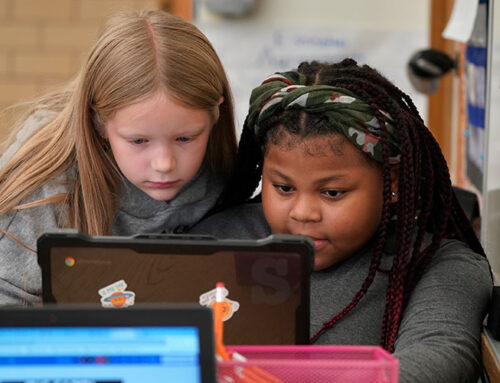
Elementary students learned new coping strategies throuhj small-group work. Photos by Gus Chan
At the start of the 2020-21 school year, Lomond Elementary School teacher Elisabeth Bates noticed something different about her first-grade students. While educators had anticipated delays in reading and math skills due to the pandemic, the lag in social skills was especially prevalent. It was showing up in playground disputes, name calling, and other hurtful behaviors.
“They were a full one to two years behind where students that age would typically be socially,” says Bates. “There were no block parties or play dates where they would have learned those skills. I’m a teacher who has always taught kindness, but I had to focus really hard on friendship skills and how to treat others.”
The effects of the pandemic on social and emotional well-being were at every grade level, though they manifested in different ways. Students at Woodbury and the Middle School exhibited increased social anxiety, school avoidance, and conflicts with others. And at the High School, there was a significant rise in students who reported being depressed, feeling anxious or overwhelmed, and having thoughts of self-harm.
Not every family was affected in the same way. While some struggled to deal with loss of employment, or shift to remote work, others dealt with the raw grief of losing a family member to COVID-19. Shaker students’ behaviors and symptoms mirrored alarming national trends. In December of 2021, United States Surgeon General Vivek Murthy issued a rare public advisory on the severity of the mental health crisis facing young people.
Data tracked by the Centers for Disease Control and Prevention, and reported in the National Survey of Children’s Health, showed that these problems pre-dated the pandemic but were clearly exacerbated by it. In 2019, 13 percent of adolescents reported having a major depressive episode, a 60 percent increase from 2007. Visits to the emergency room for children and adolescents also rose sharply for anxiety, mood disorders, and self-harm.
A Coordinated Response
While increasing students’ social/emotional health and well-being was already a key District goal, the effects of the pandemic brought it to the very top of the priority list. At the start of the school year, Liz Massey came on board as the District’s first Supervisor of Student Wellness and Success. Drawing on her background as a licensed K-12 intervention specialist, the dean of instruction for Breakthrough Schools, and a former social services case worker, she quickly assessed what resources were already in place and what gaps needed to be addressed.
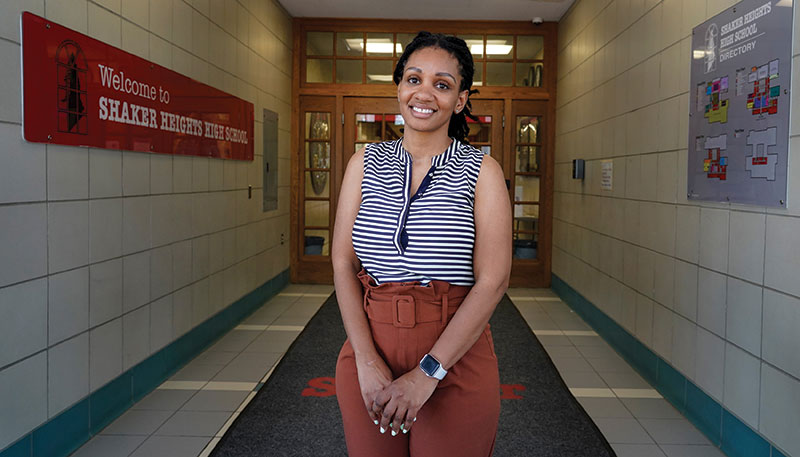
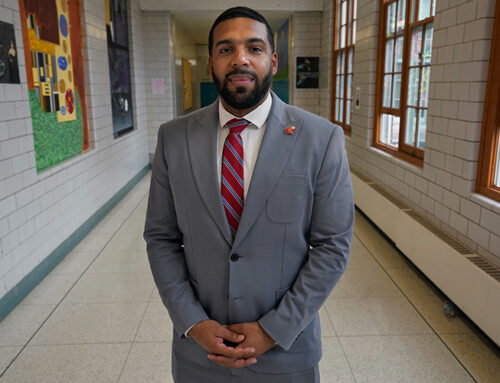
As the District’s first Superintendent of Student Wellness and Success, Liz Masseycoodinates staffing and resources to meet students’ social/emotional needs.
“My initial observations were that the schools needed consistent access to social workers and a clear, unified protocol for risk assessment,” she says.
She got to work identifying the staffing, resources, and strategies that could have the biggest immediate impact. Superintendent David Glasner, the District’s leadership team, and Board of Education members worked jointly to allocate the necessary funds to increase social and emotional well-being and learning across all grade levels.
The Shaker Schools Foundation also made it the funding focus of the Shaker Schools’ 30th annual fundraiser, A Night for the Red & White, which raised nearly $100,000 for expanded social/emotional learning resources and programming. Massey’s first order of business was to close the coverage gaps by creating a coordinated social/ emotional learning (SEL) team.
“I created a schedule for the team so principals could see who was available to them on any given day,” she says.
“They were a full one to two years behind where students that age would typically be socially. There were no block parties or play dates where they would have learned those skills.”
Every building now has at least one dedicated full-time case manager or school counselor. A school psychologist is on site at each building at least one day a week (two to three days at the Middle School and High School). And the District continues to partner with outside agencies as well, with counseling support from Bellefaire JCB, Shaker Heights Youth Center, and the Black Mental Health Corporation. Licensed professionals from those organizations work with the staff in each building to make sure each student’s needs are met.
They also connect families with any services they may need related to housing or food insecurity, problems with transportation, or access to health care. Says Onaway social worker Sarah Felson, “Our job is to remove any barriers a student or family might have to being successful and feeling connected at school.”
Of course, every good team needs a coach, which is where the District’s four Positive Behavior Coordinators come in. The role of the coordinators is to provide coaching and training to teachers upon their request, and to assist them in dealing with behavioral issues or other needs that arise in the classroom. For example, one of the coordinators, Maria Helton, worked regularly with a Middle School teacher to co-teach sessions on empathy, self-awareness, and impulse control.
High School choir teacher Nick LaPete also asked for her help in working with his students to increase their selfconfidence and classroom engagement.
“We can assist staff in guiding them through behavior assessments, creating intervention plans, and with professional learning sessions on
behavioral practices and strategies,” says Helton.
Risk Assessment
To help determine where students needed more help, the District invested in a Behavioral Intervention Monitoring Assessment System, a 34-question screener that students self-complete. The assessment is offered to all students 12 years of age or older, with an opt-out option for parents, and can also be used with younger students on an as-needed basis with parental consent.
The results provide useful data on trends by age group, such as an overall difficulty with self-awareness and self-management. But it also allows for proactive targeted intervention.
For example, says Massey, “If a student has indicated frequent thoughts of self-harm, we follow up with the student and family within 24 hours to help connect them with counseling services.”
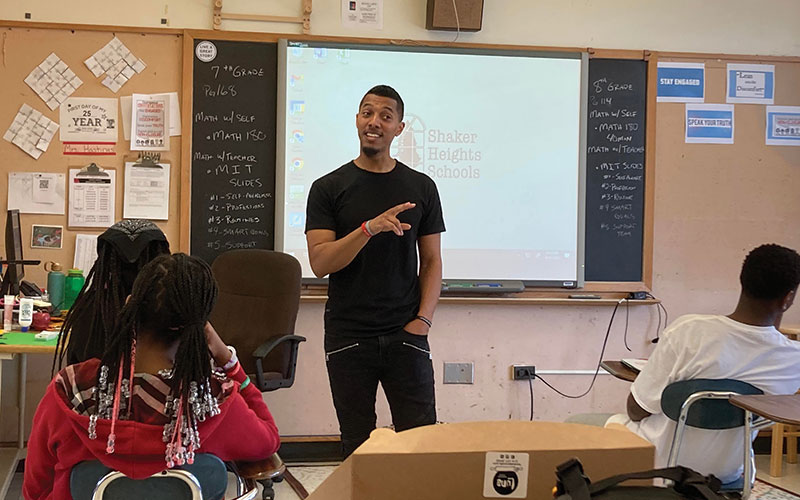
Keith Langford, the District’s Family and Community Engagement Coordinator, helped create the middle school’s “M.I.T.: Motivate, Inspire, Teach” mentoring program.
Students, staff, and families can also fill out an electronic referral form online any time they have a concern they would like to address. Whenever a form is submitted, the SEL team meets to triage and discuss the best way to meet the needs that have been identified. (That form, along with resources, coping skills, and strategies for parents, can be found on the District’s website.
Layers of Support
Having the right staffing and resources in place meant that each building could then develop effective strategies to meet their students’ needs. The High School implemented a weekly meeting period, called Crew Time, where students could meet with a trusted adult for a check-in on their social and emotional well-being.
“Crew is a safety net to ensure that every single student has at least one person to go to, such as a teacher, coach, or guidance counselor,” says High School Principal Eric Juli. “Our goal is to ensure there are layers of support for every student. When you add our security monitors, paraprofessionals, school psychologists, and school nurse into the mix, we have a collaborative and robust support system in place.”
Using funding from the Shaker Schools Foundation, the Middle School added two mentoring programs designed to increase students’ self-confidence and social-emotional skills – Gilmore Girls and M.I.T. (Motivate, Inspire, Teach). A weekly Breakfast Club led by teachers Beth Casey and Erika Pfeiffer provides a safe discussion space for LGBTQ+ students and allies. And the three Middle School guidance counselors provide a quiet, caring place for students to land throughout the day when they need a friendly ear. Says Middle School guidance counselor Kristina Longino, “Sometimes students just need a place to decompress. They can play with fidgets, draw, complete a coloring page, talk,
or just be quiet.”
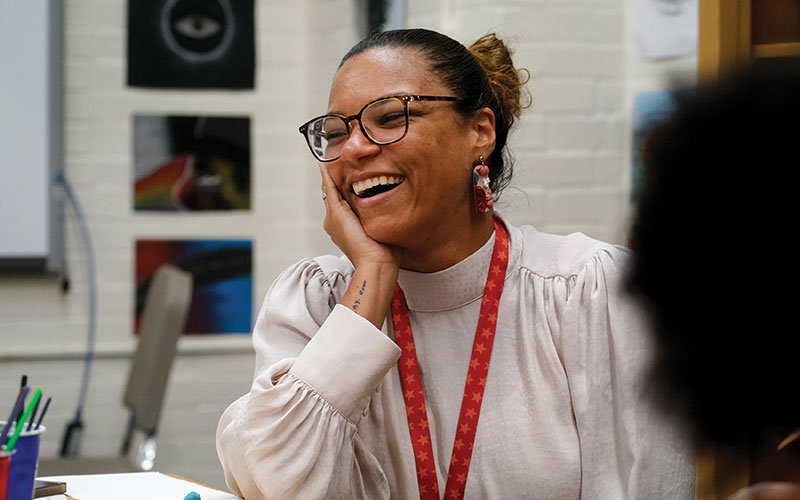
Licensed counselor Margaret Whitmore enjoys helping Woodbury students express their emotions through art.
At Woodbury, Principal Tiffany Joseph says, “At the beginning of the year, we had eight days of SEL embedded into our daily schedule. During our WIN (What I Need) period in January, we changed our building schedule to align lunch periods, so that students had more opportunitie to interact with one another.”
Woodbury also added a licensed professional counselor and art therapist to the staff, Margaret Whitmore, to help students learn productive ways to cope and express their emotions.
Nurturing Young Learners
Back at Lomond, Elisabeth Bates is most grateful for a school-wide social/ emotional program called Caring Schools Community. The program was initially funded by a donation from the Shaker Heights High Class of ‘50/’51 and was piloted at Lomond prior to the pandemic. The program is now offered at all the K-4 buildings. It involves a brief daily meeting where students can reflect and share on a universal prompt, such as, How did my actions affect someone today? What went well? How could it go better?
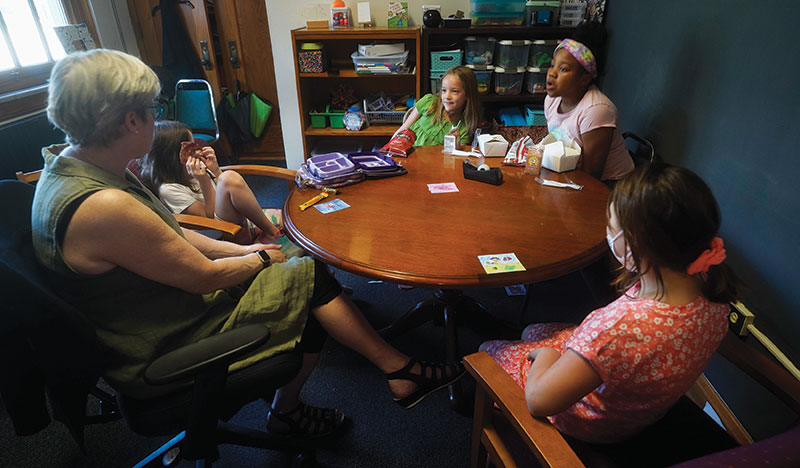
Lomond school counselor Mary Bourisseau teaches students techniques they can use to feel calm and focused throughout the day.
“The kids take it very seriously,” says Bates. “I love that we’re using the same language throughout the school so they’re all hearing the same thing.”
Students at the elementary buildings are also learning important self soothing techniques, like this one taught by Lomond school counselor Mary Bourisseau: she has them draw a pattern on a card, such as a star, flower, or water drop. Next, they trace the item in the air with their finger, as they breathe in and out. No card? No problem. They can also trace their five fingers up and down in the same manner. “It’s very tactile and calming, which refocuses them,” says Bourisseau. “After they do it a few times, it becomes automatic for them.”
While the academic curriculum is unquestionably full, teachers have embraced the extra time spent on social/emotional learning. “We need to meet those needs first, or no other learning can happen,” says Bates. “Students need to feel loved, valued, and cared for before I can
teach them anything.”
Advice for Parents from the Shaker SEL Team
“If you are struggling with issues related to social/emotional regulation, help is available. The social worker is he first line of support in every building. Check the District website or call your child’s building to be connected with them.”
– Liz Massey, Supervisor of Student Wellness & Succes
“Any school year is like a marathon. Our students need to build up their stamina and skills to handle the rigors
of in-person learning, which can be stressful for many students.”
– Eric Juli, High School Principal
“During middle school, they’re trying to manage life’s ups and downs. They’re going to make mistakes and sometimes feelings will be hurt, and that’s okay. Be their cheerleader, and reach out to the SEL team when support is needed.”
– Kristina Longino, Middle School Guidance Counselor
“We need to reframe the way we look at hard emotions. Yes, they are hard to feel, but they are not bad. They are there to tell us
things. Naming our emotions and modeling productive ways to express anger, anxiety, or sadness are very beneficial to children.”
– Margaret Whitmore, Student Care Specialist at Woodbury
“Try to be a vessel for your child. They need to feel they can open up to us without fear of negative consequences. Positive reinforcement is always better than negative reinforcement. Find out what motivates your child, and work from there. ”
– Desmond Yanamayu, Clinical Director, Black Mental Health Corporation
For more information and resources on social/emotional skills and strategies by age group, visit shaker.org/SocialandEmotional