In her new memoir, athor Kathryn Schulz writes about love, loss and finding.
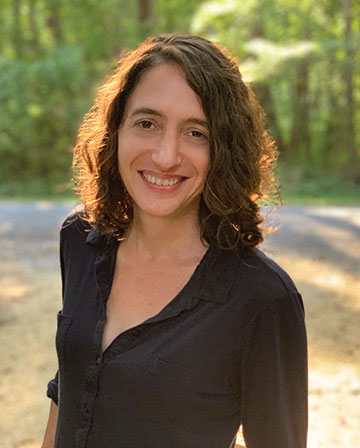
Author Kathryn Schulz is a Shaker native and a 1992 graduate of Shaker Heights High School. She is a staff writer at The New Yorker and the author of Being Wrong: Adventures in the Margin of Error. She won a National Magazine Award
and a Pulitzer Prize in 2015 for “The Really Big One,” an article about earthquake risk in the Pacific Northwest. She lives with her wife, writer Casey Cep, and their daughter on the Eastern Shore of Maryland.
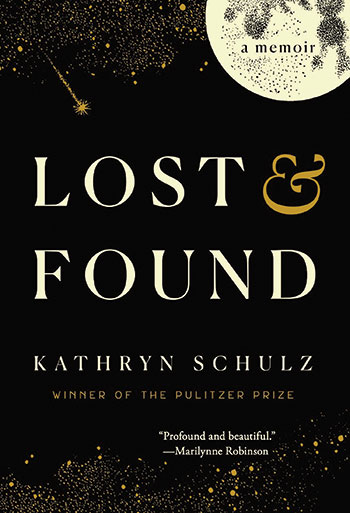
Shortly after she fell in love with Cep, her father, Isaac Schulz, died. Isaac was a lawyer who served for eight years on the Shaker Heights School Board and for four years with the Shaker Schools Foundation. In her new memoir, Lost & Found – originally published as an essay in The New Yorker – Schulz interweaves her two stories of joy and grief and considers the ways that they shape a life. Margaret Simon has been the public relations manager for the Shaker Library for more than 30 years. Early this year, her husband of 50 years died. Last spring, Schulz took the time to speak with her about her book and answer her questions about love, loss, and finding.
Margaret Simon: How did you come to write your book? And how did you choose the names for your chapters?
Kathryn Schulz: This is a three-part book. The first two parts are self-explanatory – “Lost” and “Found.” The third one –“And” – is strange, but it’s also the reason I wrote the book. After my father died, I wrote an essay for The New Yorker that was partly an elegy for him, and also an exploration of this very strange category of loss and the question of why on earth we would put someone we loved and lost into the same category as a sock we never fi nd in the washing machine, or a lost wallet or a set of car keys.
I had thought about that for a while, and a few people had asked me if I were interested in expanding my essay into a book. I loved my father and there’s an infinite amount I could say about him, but I didn’t want to spend two, three, or four years of my life thinking about grief. And then very late one night while driving on a back road in the middle of nowhere, Alabama, my partner and I were talking about whether I would ever turn my essay into a book. I thought there was a flip side of the story I could tell – an exploration of the equally strange category of discovery that would be grounded in the greatest thing I ever found, which was the woman I love.
The idea of telling our love story seemed exciting to me. While we were talking about this, my partner used the totally everyday phrase – “lost and found.” The mind at 2 a.m. on a back road in Alabama is a strange thing. I heard the word “and” echo throughout the car. Because I had the experience of finding my partner and losing my father in quick succession and had been thinking about that conjunction, about the fact that we all love to be in love, but sometimes we’re in love and also grieving. And that’s what life is like. There are always many things going on at once. I was interested in this link between these two seemingly very different experiences in my life and how we go about living with this endless emotional conjunction. Literally, right there in the car, that was the moment my essay became a book that I very much wanted to write. In that sense, the “And” section – although it’s clearly the strangest and most surprising – is the reason the book came about.
MS: When you write about loss, you make an association with losing everyday objects. Was that part of your grieving process or did you make that association right away?
KS: Surprisingly, I made it right away and even before my dad died. I had been thinking for a long time about the weirdness of the category of loss. I had toyed with writing about it and it never went anywhere, but when my father died it was immediately apparent to me why I hadn’t been able to write it before. It just did not have the gravitas or emotional stake it needed. And then as soon as he died, it did. That felt liberating.
I think my father would have been happy to lend himself to this particular kind of writing project. And, of course, by chance, my father exemplifies the whole category of loss, and his death gave it its emotional anchor. My father had a history of the most extreme historical kinds of loss, which was the nature of his childhood – losses he experienced through the Holocaust and exile.
But he also embodied the comic and trivial side of the category of loss, because for the life of him he could not hold on to his glasses or his shoes. It felt natural that this elegy for him should come together as an exploration of this larger category. Was it easy to go from writing the essay to writing the book? Or was it harder to write because your essay was complete?
It’s such a great question. It’s a real writer’s question. And the answer is it was absolutely harder. In other respects, this book was not as hard to write as I might have thought, partly because I already had the structure. I knew from the beginning that it would be a book in three parts, and I had a broad sense of how they worked.
“Found” was a delight to write because it was a love story, but “Lost,” which is the section about grief, was hard – not for the reason a reader might guess, but as you intuited. I had already written this very personal essay. Then I basically had to take a sledgehammer to it because it wouldn’t work intact in the book. It was hard to dismantle the essay and let go of certain things that I liked. So absolutely. It was the single hardest thing about writing the book.
MS: Grief is a messy emotion. Was it hard to write about your vibrant father in the past tense?
 KS: That’s an interesting question. One of the things I really liked about my essay was that it was hard to let go of it when I was writing the book. In a sense, in the essay, my father dies almost in real-time. It begins on a comic note when he is alive and losing his wallet and keys. And I structured it so that we get the love story after the loss, so the overall trajectory is towards joy.
MS: Were there rules in writing this memoir? Did you feel you had to ask permission from your family and your partner as you were writing? What was your process?
KS: I certainly wouldn’t say there were rules. I’m not a very rule-oriented person. Fundamentally, this is a memoir about happy families – my family of origin, my partner’s family of origin, and the very happy family that we’re making together. I didn’t have some of the tensions that come with many contemporary memoirs because I wasn’t writing about dysfunction. Any story you tell is inevitably many other peoples’ story. I was mindful of that. I talked to my family before I wrote the essay published in The New Yorker after my dad died. And I talked to them when I thought maybe I do want to write a book. I checked in to make sure they were comfortable with that.
I’m grateful to my mother and sister for letting me write about such a tender thing as the death of a beloved family member and helping me at every step of the way – filling in my memories and fact-checking and generally championing it. And I’m grateful to my in-laws, who embraced the fact that this interloper was going to tell some of their stories.
My partner was incredible. She is a much more private person than I am, but she never wavered about the project, and she’s been an incredible champion of it. Plus, she is always my first and best reader. During the writing of the “Found” section, I would write all day and then bring the pages up to her at night and read them to her like a bedtime story. So she had a front-row seat to the process as it unfolded.
MS: You don’t really tell much about yourself in the book. How did you choose to be a writer? Was there a moment in your Shaker education when that happened, or a particular teacher who inspired you?
KS: Readers accompany me through two momentous experiences of falling in love and grieving for my dad, so I think they get a sense of being with me, but it certainly is not a chronology of my life in any way, shape, or form. I think it’s always a little mysterious how anyone becomes who they are. I grew up in a family of literary-minded people surrounded by books. My father and mother both love to read. I grew up with my father telling me stories in an environment where reading was the natural pastime.
My home front was formative, but absolutely the Shaker schools were, too, and the Shaker libraries as well. I cannot begin to describe how fortunate I feel to have had the education I did. My teachers were remarkable from elementary school on. I worshipped my teachers and they were so generous. They took the time to recognize what interested me and nurtured it. I wrote an enormous amount in elementary school and had these fabulous teachers at Moreland School who just let me write, read, gave me feedback, and made sure I had access to any kind of literary offerings that were available. Whether it was Young Authors Conferences I attended with teachers in elementary school or just making sure I had time to go to the library and get new books and people to talk to about reading. So my teachers were incredible and that continued all the way through junior high and high school. I had exceptional teachers across all subjects, but I’m especially grateful to the English teachers who understood that I had a passion for writing.
MS: Are there places in Shaker that are hard to go back to, or do you seek out particular places for comfort?

Kathryn Schulz and her father, Isaac Schulz.
KS: I find going home pretty wonderful with respect to thinking about my dad. I can’t go to my actual home on Falmouth Road. We moved my parents out before my dad died, but there’s so much of him and our old house in the condo where my mom lives now. My dad was a wonderfully gregarious guy. He served on the Shaker School Board and did a ton of pro-bono law work, so it’s really gratifying for me to go home and just be with people who knew him. It’s always a little bit bittersweet, which I think is true of returning to your childhood home, even when everyone is alive and well. But mostly it lands on the side of sweet and I have a lot of friends who stayed in town. It’s wonderful to get to go home and connect with them. And of course, with my mom, who’s my fundamental and deepest connection to my dad.
MS: Have you received feedback about the book from your father’s friends?
KS: A fun part of the process is what’s happening now that the book is out in the world. I occasionally get emails from complete strangers who knew my father who say how wonderful it was to encounter him on the page or to tell me a story I didn’t know about him. And that is delightful. And I send them immediately on to my mother.
MS< Throughout your book, you cite different poets, Elizabeth Bishop and Robert Frost among them. Who do you suggest readers choose for comfort?
KS: I do find consolation in poetry. It was striking to me how in the immediate aftermath of my father’s death, that was really all I could read. On the other hand, to some extent, this book came about because I didn’t quite fi nd the book I wanted to read. I think I ultimately tried to write the book. It’s difficult to recommend a poet to fi nd comfort in because most of the poets I love write about wildly disparate things. But the contemporary poet Kevin Young did us all the great favor of putting together an anthology of poems, The Art of Losing: Poems of Grief. I would certainly encourage people to start there. I am a huge Robert Frost fan and I quote him on grief, but I also quote him on love.
MS: When you finished your book did it feel like another loss because it was over?
KS: Oh, my goodness, no. I felt satisfaction and relief. I was so happy when it was done. As a writer, it’s always a real relief when a project of that length is finished. I hope readers feel both satisfied and a little bit sorry it doesn’t go on and on.

Kathryn Schulz and Casey Cep
MS: What was it like to record your audiobook?
KS: When the publishing house approached me about reading my book, my immediate reaction was, “Aren’t there professionals who do
this kind of thing?” I don’t think of myself as a great reader or having a particularly great voice, and I have absolutely no acting experience or training. But they said that readers like it when authors read their own books. It was all a bit comic because it was recorded during the pandemic when they weren’t bringing people into studios. I recorded it in my house in a tiny closet with a chair and a million pillows and blankets to try to soundproof it with my wife very patiently taking care of our child throughout. It was kind of an odd experience, and I hope it sounds okay. But if it doesn’t, don’t tell me.
MS: Now that you have a daughter who never met your father, what will you tell her about him?
KS: We tell her about him all the time, actually. She’s only eight months old, but we show her pictures and talk to her about her grandpa. I’m terribly sad she’ll never get to meet him and that he never got to meet her, but it’s interesting how generations pass themselves along to the next one. When my daughter was around two months old, she went down for a nap one day, having never laughed a day in her life. She woke up from that nap laughing and she’s never stopped. My father’s name was Isaac, which means laughter in Hebrew. But my father never turned his back on the suffering in life. His childhood was such that he was intimately familiar with it, and yet somehow he always took the side of joy and the side of laughter. That’s what I want my daughter to know about him.
MS: When will your book come out in paperback, and will you celebrate its release at Shaker Library?
KS: It is due for publication in paperback in January, and it would be my pleasure to come to Shaker Library.