
For the volunteers behind the scenes, Shaker Library book sales are a place to find connection and express their love for their community.
By Lyndsey Brennan
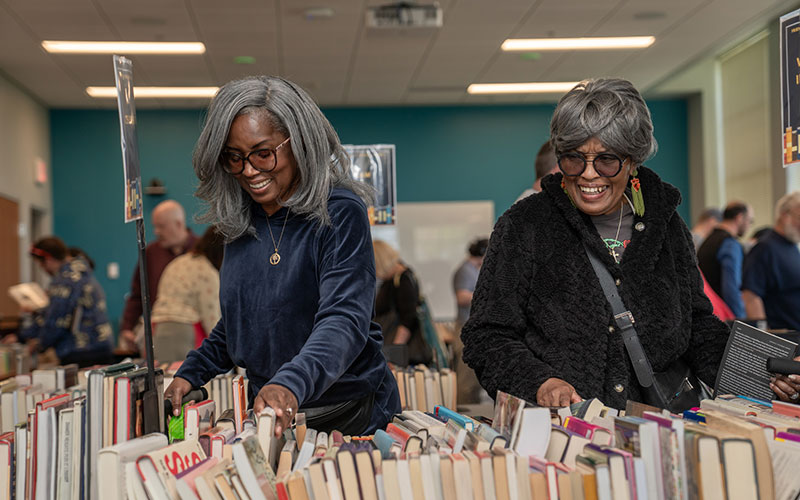
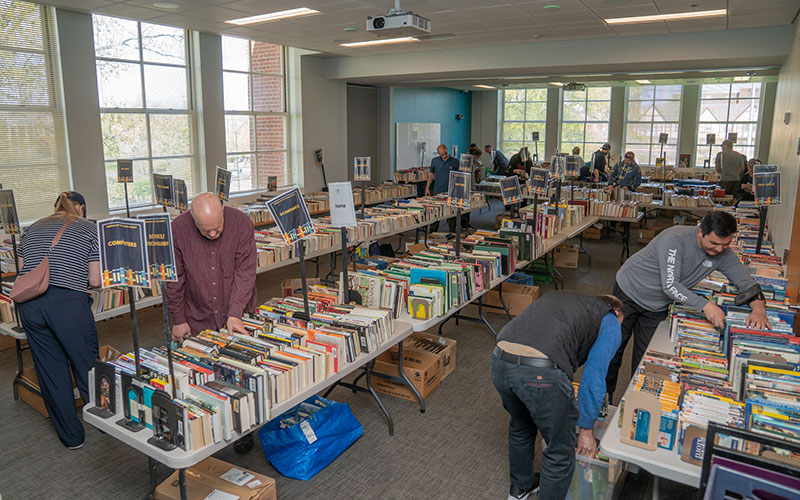
The Friends of the Shaker Library book sale is a biannual fundraiser that takes over the entire second floor of Main Library for a week.
The sale has a reputation in the book dealer community for being impeccably run: It offers tens of thousands of clean materials in well-organized categories. In recent years, each sale has raised anywhere from $5,000 to $8,000 that the Friends of the Library then donate to the library to support programming.
But the sale doesn’t just materialize out of thin air. The planning and work begin months in advance in the basement of Main Library, quarterbacked by spunky Sussex resident Stephanie Jonas.
Jonas has been volunteering with library book sales for the last 26 years, 18 of them at Shaker Library.
When she started sorting books in 2007, it was a tiny two-person operation. Four years later, Jonas took the reins and recruited four other regulars to join her on Wednesdays.
For Jonas’ dedicated crew, work for the next book sale begins the week after the previous one ends. Jonas and her team spend the week cleaning and resetting the Book Sorting Room and labeling all the sale equipment, which they pack and put away in storage.
Then, the book sorting begins in earnest – and continues over the course of 24 weeks as donations come in from throughout the community. They receive hundreds of donations to sort through each week.
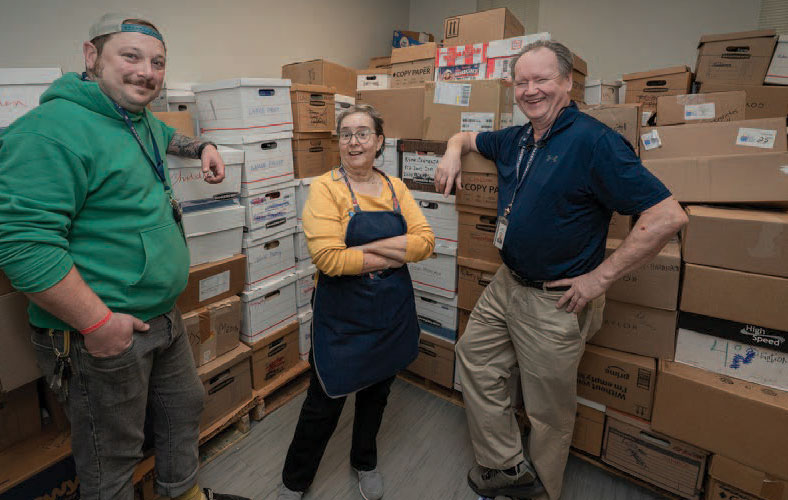
Stephanie Jonas stands in the book sale storage room with Shaker Library maintenance crew members Dave Hein (left) and Scott Robertson (right), who help volunteers palletize books.
The team discards damaged books and cleans the ones they will sell, sorting them onto shelves according to category.
Every span of shelving in the Book Sorting Room is labeled and color coded. History (ancient, world, U.S.) is cornflower blue. Fiction and its subgenres (mystery, fantasy, science fiction, romance) is lavender.
Children’s books – all the way from board books for babies up through middle grades – are seafoam green.
Once a shelf is full, the volunteers box up those books, label the box with that category name, and send them to storage where they’re kept on pallets until the sale. Each pallet holds about fifty boxes. Fourteen pallets make a sale.
I love seeing the diversity of the community reflected in the donations
Over the course of a three-hour volunteer session, the group packs an average of 25 boxes.
“I love seeing the diversity of the community reflected in the donations,” Jonas says. “We have such an amazing spread of interests here – all kinds of hobbies, religions, and viewpoints are represented. This community is well-read on so many topics.”
Stopping in at a recent book sorting session, I can’t immediately see Jonas, who, at just five feet tall, is completely hidden behind a pile of donated puzzles. But I can hear her bright, animated voice over the chatter of the other volunteers. She’s explaining to someone her plan for storing the next wave of donations.
Jonas doesn’t stay in the same spot for long. Throughout my visit, she buzzes around the room, moving between conversations and tasks, answering questions and offering suggestions, all the while schooling me on the history of the sale.
“Some people, when they start volunteering here, don’t know much about books: what’s popular, what will sell,” says long-time volunteer Beverly Dahms, who Jonas recruited to sort books years ago. “Stephanie’s taught us all how to do this. She’s an excellent teacher.”
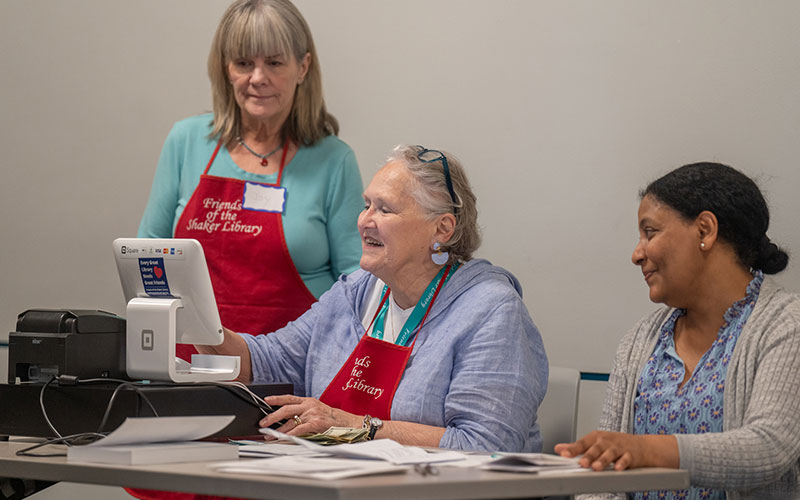
Left: Friends President Margaret Simon operates the cash register (center), as Joy Whitman, a book sale volunteer (left), and Membership Chair Woinshet Zenebe (right), look on.
Every once in a while, as they’re sorting books, the volunteers will find an older book that they suspect is worth something and set it aside.
That’s part of the excitement of book sorting, says Dahms. “Every box you open could contain a potential treasure.”
A few times a year, two volunteer book specialists come in to evaluate the books, which are then priced and packed up to sell in the specials room during the sale.
During our interview, Jonas sets a leather-bound volume in front of me. Across the cover is Robert Louis Stevenson’s name, embossed in gold. There is no publication date, but it looks like it could be 100 years old.
What was the highest value item Jonas recalls being donated? “It was a first edition copy of some classic book — I can’t remember the title,” Jonas says, waving her arm casually, as though she was recalling what she’d eaten for breakfast. “They priced it at $1,000.”
Jonas keeps an inventory tally sheet of how many boxes they have from each category. After the sale, she marks down how many boxes are left.
One category that has consistently sold well is true crime. “I’ll put out six cartons of them, and by the end of the sale, we only have one or two books left.”
Of course, the Friends have no control over their inventory, which is strictly composed of items the public donates. “If we don’t get it in, we can’t put it out,” Jonas says. But knowing what categories sell best helps her know what to look for.
Another category that sells out every year is banned books. “We set those up, and they’re usually gone by the first public day of the sale,” Jonas says.
For her, the section is a great opportunity to raise awareness. “Some customers can’t believe the books end up in that section. It gives us an opportunity to talk about why books are censored.”
A month out from the sale, the Friends send out calls to the community for volunteers to run the sale. People sign up for one or more shifts.
The Friends of the Library sets the prices, which haven’t increased in years.
“It’s a balance between making as much money as we can for the library and keeping prices equitable for the community,” Jonas says. “We want to give access to information and the ability to build a home library.”
The research shows how important this is.
It’s estimated that over the years, the sale has brought in at least $180,000. Proceeds go to support library programming.
One international study conducted in thousands of households across 31 countries showed that growing up in a house with a home library of 80 books or more was a strong predictor of superior literacy, numeracy, and technology skills in adolescents.
Easy access to books has been linked to better vocabulary and literacy outcomes for grade school and middle school students.
One study found that children who had books available at home at age three and read with their parents often were more likely to read for pleasure by ages seven and eight than their peers.
Owning books is also about convenience. “We have some people who come in and say, ‘I need three books I can take with me on vacation and leave there for the next person to enjoy.’ That’s an attitude we absolutely love here and promote,” says Jonas.
She knows of several people who do their holiday shopping at the book sale. One person does a white elephant gift exchange where each wrapped book has a synopsis on the package. Another buys books to hand out at Halloween instead of candy.
On the Monday before the sale, all the palletized boxes are brought up from storage and dispatched to their specific room and table, which Jonas has laid out on a detailed map.
Volunteers set up the cash register, merchandise, and directional signs, so that shoppers can easily find what they’re looking for. The volunteer book specialists return to walk through the sale, pulling out any higher value items they see, pricing them, and adding them to the Specials room.
Then the sale begins, with volunteers tidying the tables, assisting with checkout, and helping shoppers wheel out their purchases to their cars.
After the sale, the volunteers pack up the remaining books and donate them to the Association for Continuing Learning (ACE) Book Sale at Case Western Reserve University, one of the region’s largest sales.
Then they take a week off and start all over again.
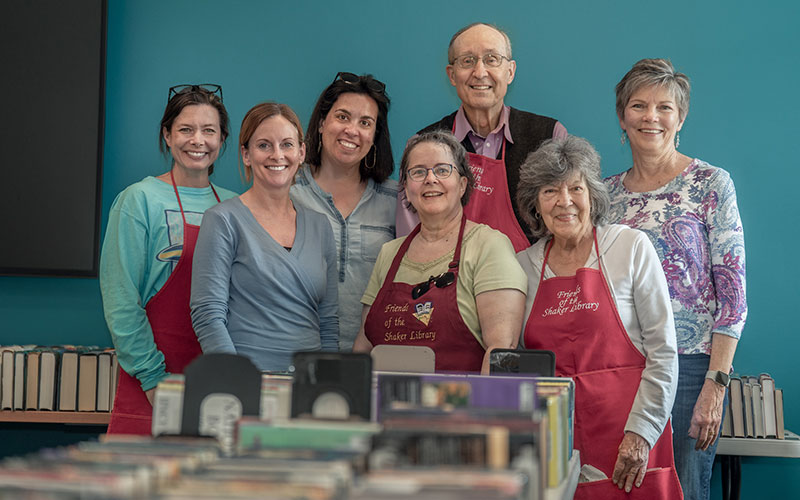
Jonas and some of the many book sale volunteers.
Over the years, a number of volunteers have told me that when you’re part of the book sale, it feels like you’re very much part of the community. I’m curious why that is.
There is an energy about it, Jonas tells me. Kind of like when you’re at the polls on Election Day. It almost feels festive. People are in high spirits, excited to be out with neighbors, doing their part for the community.
I ask Jonas what working on this sale has meant to her on a personal level. Over 18 years, she’s contributed thousands of hours of volunteer labor and helped the Friends rake in at least $180,000 (likely more, though the data has been lost to time) for library programming.
She thinks for a minute, then tells me this: In 2007, when Jonas and her husband Gregory moved to Shaker for his job as a professor, she didn’t have a community. “We made many friends at Case,” she told me, “but academics tend to be a transient bunch.”
The friends Jonas has made through the book sale have become her community, the people she calls on in a pinch. “Earlier this year, I broke my foot and was in recovery. They came over to take care of me. They gave me rides when I couldn’t drive. When I’ve gone out of town, they’ve fed my cat and picked up my mail.”
“You’ve got to be able to trust people, you know? I can’t tell you how much it’s meant to me to find friends I can trust,” she says.
How to donate
The Friends of the Library accepts clean, gently used books, DVDs, CDs, audiobooks, and puzzles (with all pieces intact). They do not accept books that are in poor condition, musty, or missing pages. They do not accept textbooks, computer and technology books, or travel books older than two years.
You may drop off donations at Main Library on Mondays through Thursdays between 9am and 5pm and Fridays and Saturdays between 9am and 2pm. Park in the Library Staff and Deliveries lot off Van Aken. Bring your donations to the door marked “Deliveries.” You may have to ring the bell or call the phone number posted on the door.
Books donated to the Friends are tax-deductible, and the Friends will provide a receipt upon request. However, they’re prohibited by the IRS from assigning a value for the donation.
Lyndsey Brennan is communications and marketing manager at Shaker Library