Animal visits and humane education help young Shaker Library users expand their horizons, grow as readers, and develop a deeper understanding of the story.
By Lyndsey Brennan
Photos by Robert Muller
On the day of the Summer Reading Midpoint Party this July, a group of children and their adults form a line in the hallway outside of the Main Library Boulevard Room, tickets in hand. Some of the kids titter with excitement. Others squirm impatiently, bouncing at their caregiver’s side. What are they here for? The opportunity to meet a miniature horse.
I meet the eye of the little boy at the front of the line, swinging his father’s hand. He looks about six.
“Is this your first time meeting a horse?” I ask. His nod and body language are shy, but his eyes are bright and excited. He knows today is a special day.
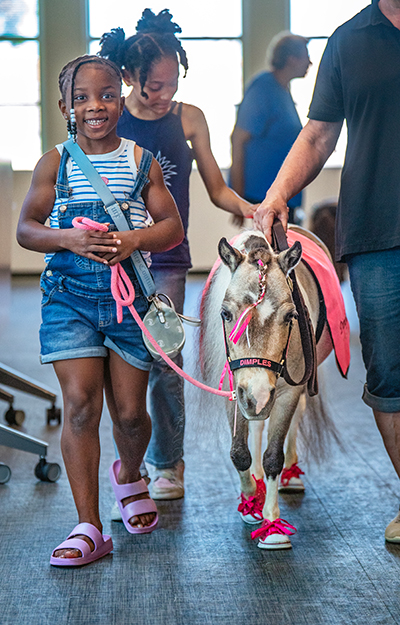
A little girl bravely steps forward to tell me she is almost four and has horse stuffed animals at home. In a few minutes, she’ll enter the room, meet therapy horses Stella and Dimples, and develop affection for the real-life versions of her toys. The girl giggles with the other children when the horses yawn or sneeze. She takes her turn walking Dimples around the room using a bright pink lead, her shoes softly clopping next to the horse’s sparkly ones. When the session ends, her mom asks if she’s ready to go home.
“No,” she says quietly, lingering near the horses, giving Dimples one last pat.
It’s a testament to the new bond she’s made: She doesn’t want to leave.
Build background knowledge for reading
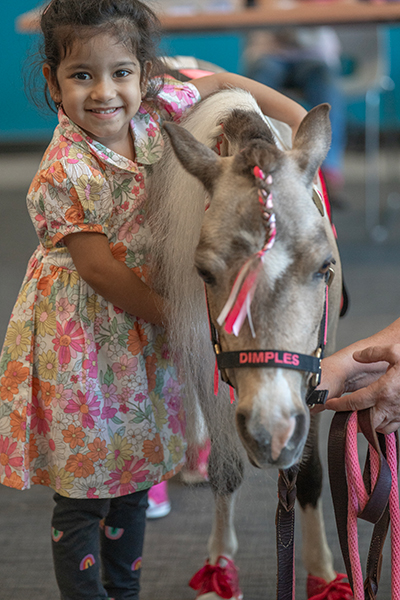
Attendees at the Summer Reading
Midpoint Party meet miniature therapy horses from Tender Touch Equine, a non-profit organization in Valley View, Ohio, that brings therapy horses to meet-and-greets in hospitals, nursing homes, schools, and more.
Over the past two years, Shaker Library has hosted a parade of animal visitors in its Children’s Room: A hen owned by a local library user. A turtle from the Nature Center at Shaker Lakes. Licensed therapy dogs for the library’s longest running children’s series, Read to a Dog. Snakes, frogs, and other reptiles and amphibians handled by a local animal educator.
What draws families to the library for these visits, some parents told me, is the novelty – seeing an animal you wouldn’t expect to see in the library – and the chance to give their child an experience they wouldn’t have otherwise.
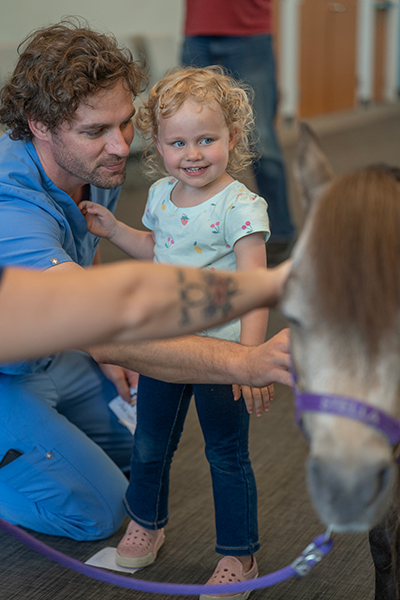
Shaker resident Antoinette Hillian, who has lived in Mercer with her family since 2011, brought her six-year-old son Harrison to the therapy horses event. “I try to expose him to as many different experiences as I can, to show him what’s possible and figure out what’s good for him. It was great to see Harrison so energized after the visit with the horses,” she says. “When he returned home, he excitedly told his dad about leading Dimples and playing with her hair.”
Shaker Library’s Deputy Director Jessica Smith says the library tries to bring in experiences that kids might not be able to participate in because of their living situations or location.
“For a kid living in the suburbs to be able to see horses – that’s not something everyone has the opportunity to do,” Smith says.
While not every animal visit has a therapeutic component, every experience builds on a budding reader’s background knowledge.
“We know from the research that the more exploration of the world a child has, the easier it is for them to visualize what’s happening in a book,” says Smith.
“So if a child is reading about an iguana, and they’ve seen one in person, their brain connects the dots a little better than a child who has never seen one. That’s what makes these animal visits equalizing opportunities,” she says.
In an era when kids don’t consume the same media, celebrate the same holidays, or navigate the same social spheres, a shared experience creates a connection point, promotes a sense of belonging, and forms lasting memories of the city and community.
Why read to a dog?
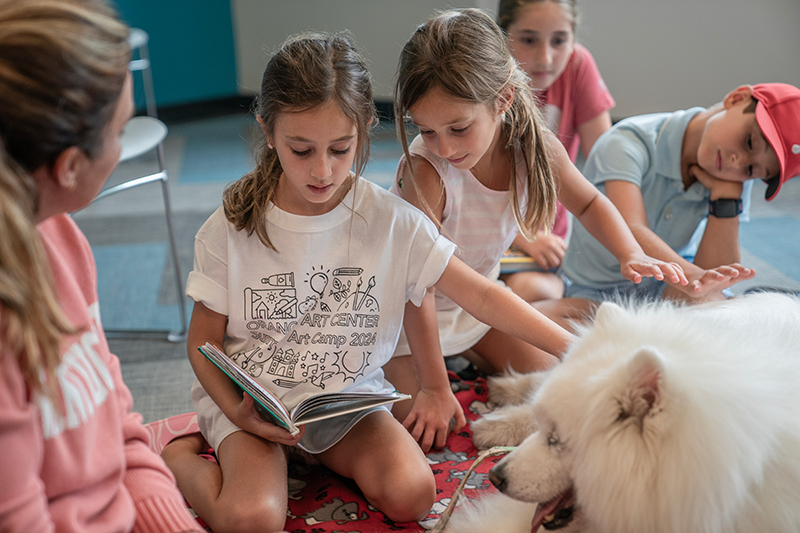
One of the longest-running programs for kids at Shaker Library is Read to a Dog, developed and launched by Youth Services Associate Nicolette Petrone in 2011.
School-age children can sign up for a 15-minute timeslot to read to a certified therapy dog, who won’t mind if the child needs to slowly sound out a word or repeat the same sentence over and over.
Because learning to read can sometimes be a challenging and stress-inducing task, reading to a therapy dog while petting its coat can counteract any anxiety brewing in children and lower their stress level and heart rate.
Petrone, who went through the therapy dog licensing process with her dog, says she regularly sees the positive academic impact reading to a dog has on students.
The data backs this up. One 2017 study conducted by the Animals & Society Institute found that reading to therapy dogs tended to increase children’s scores when reading aloud, more than reading with a peer.
Other studies found that reading to a dog increased students’ sense of achievement, enthusiasm, and motivation, and in certain instances, decreased problematic behavior.
 “I’ve had kids come who were super shy, but around the dog, their personalities came forward,” says Petrone.
When Shaker resident Harriet Miling brought her four children to Read to a Dog last summer, she had been looking at the library calendar for an activity they could all do together. This fit the bill.
“Our dog might sit for a story, but he’s not a therapy dog. He’s curious and can get distracted. He likes to run and jump, and it can take a while to get him calm.”
Miling liked that Sochi, the therapy dog her kids read with, exuded calming energy from the get-go, which set the tone for the entire session. All four kids settled in to read and remained on task through the session.
She noticed her youngest child, who was a new reader set to start kindergarten that fall, felt confident enough to read aloud without embarrassment. And the oldest child felt that the activity was “cool enough” to participate in too.
“It’s great that we have these opportunities” at the library, she says. “We need an abundance of them – maybe during testing weeks or another stressful time at school. If it was something we did more of, I think we’d see different outcomes.”
The program’s longevity speaks for itself, says Petrone. “It’s still popular, well over 10 years later. And nowadays, with so many kids using devices, they’re not interacting with the natural world as much. So any opportunity to interact with another living, breathing being is valuable.”
Humane education
Shaker Library recently introduced a new series for school-age children called RedRover Readers, hosted one Monday afternoon per month by Petrone.
Even though Petrone has developed a reputation of being “the storytime lady” who specializes in early literacy, RedRover Readers is specially designed for school-age kids to teach them compassion for all animals and respect for their habitats.
 During a typical session, Petrone will read one book with the group, such as Buddy Unchained, a powerful story told from the dog’s perspective about being chained up without food or water, getting rescued by Humane Society employees, and finding his forever family.
Petrone leads the group asking guided questions about the illustrations, like “What do you think the dog’s body language is saying here?” Or “What do you sense he is feeling in this moment?”
Afterward, the group participates in an activity based on the book, like drawing or describing a dog’s best day. Or the group might meet an animal, as they did after reading Hens for Friends, when they met a hen named Goldie.
Not every book is as weighty as Buddy Unchained, but each offers the opportunity for attendees to think through scenarios and arrive at their own conclusions.
Petrone’s desire to add a humane education series to the library’s offerings stems from her belief that books are a powerful tool for helping kids develop empathy.
“Even if the kids who attend aren’t ‘animal people,’ they will leave the sessions with an awareness of others. Other beings, human or not, have feelings. It matters how I treat others. Awareness and empathy are great tools for learning to live in community.”
The next RedRover Readers sessions will be October 13 and November 10 at 4pm, at Shaker Main Library. Save your seat at events.shakerlibrary.org.
Lyndsey Brennan is the communications and marketing manager at Shaker Library.