City leaders and Moreland residents come together for a cornerstone commemoration at Shaker Main Library
By Lyndsey Brennan
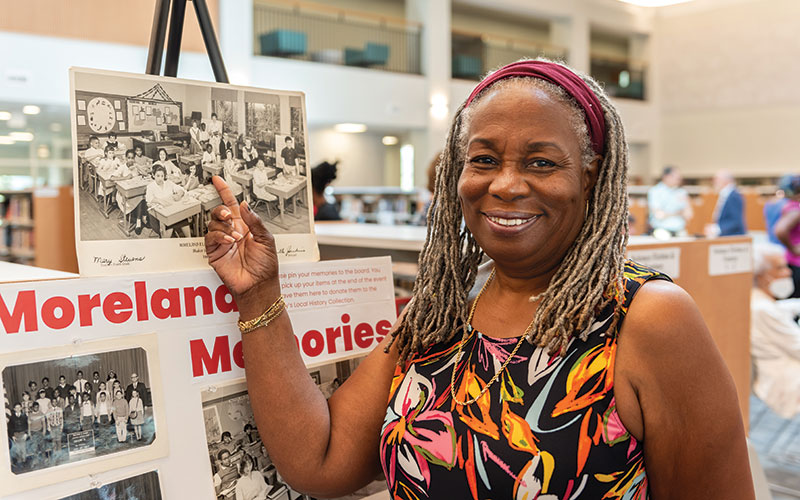
Belinda West O’Neal points to herself in her 4th grade picture from 1963. Photos by Asha Blake
For most people, the experience of being in elementary school is a pivotal one. You remember your favorite (and not-so-favorite) teachers, your classmates, the hallways, the field days – and how they formed you.
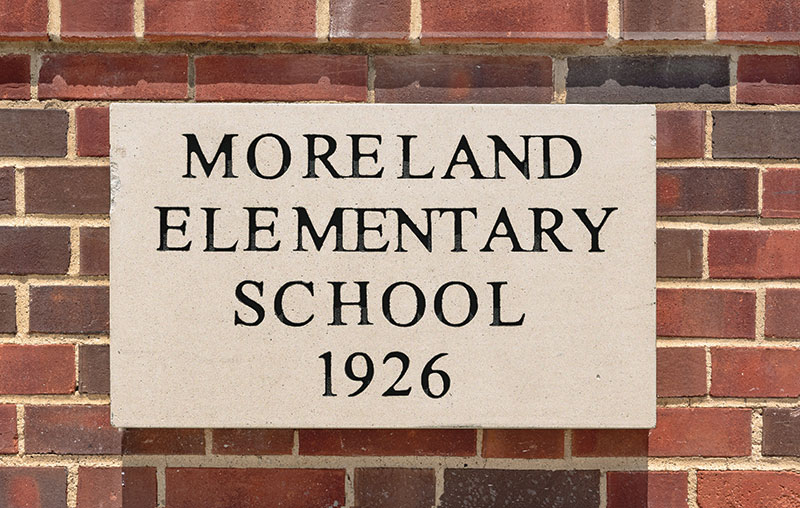
It was important to Moreland’s residents to acknowledge that before the building at the corner of Lee and Van Aken was Shaker Library’s Main Branch, it was their elementary school. So a group of residents worked together with library staff to create a cornerstone and bronze plaque for the building.
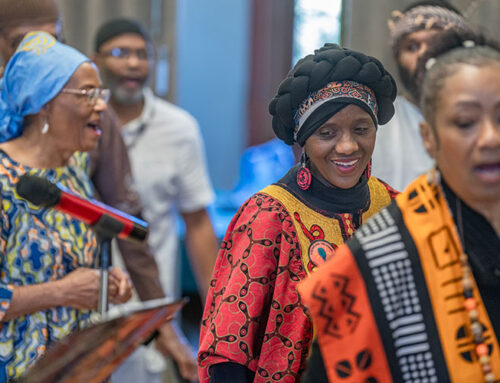
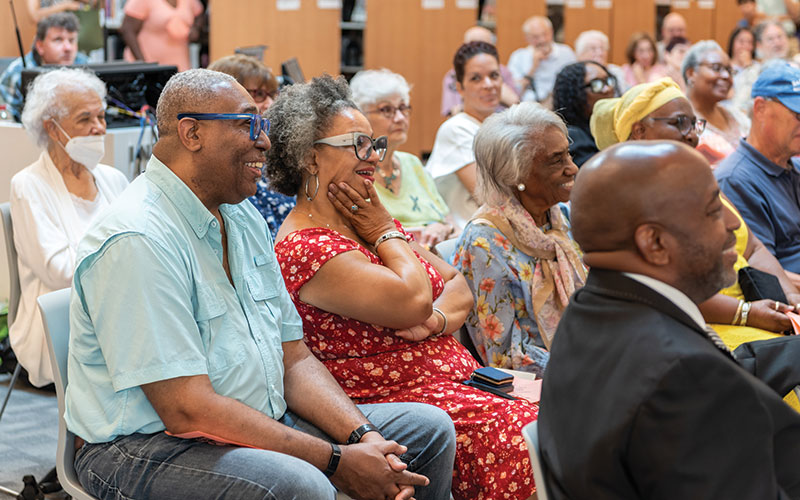
On Sunday, August 4, over 100 people gathered to commemorate the laying of the cornerstone and hanging of a plaque, which lists the dates the school was open and the principals who led the school.
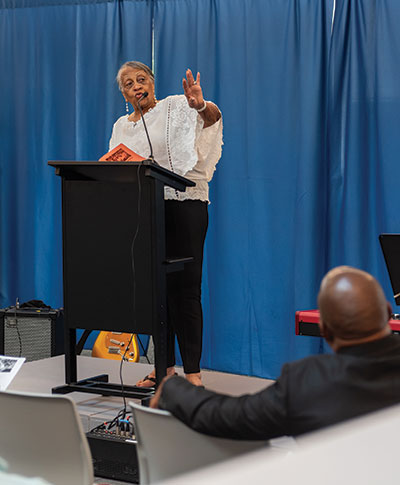
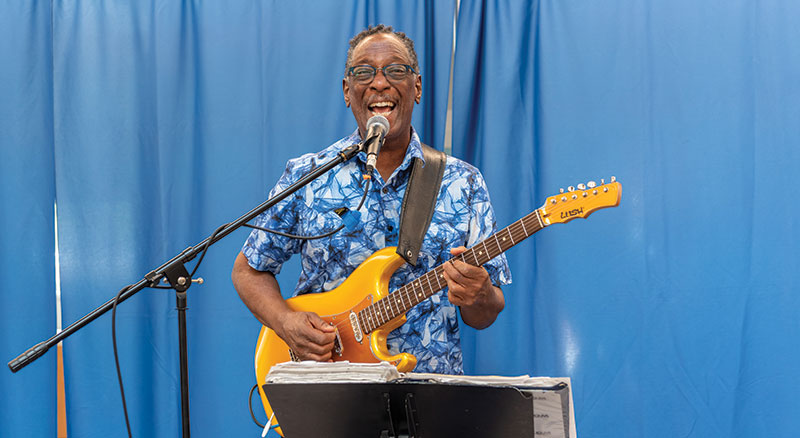
Attendees enjoyed refreshments and music from Moreland native Sam Hooper, as well as remarks from former students and Delores Groves, who was the principal at Moreland Elementary from 1980 – 1987, when the school closed.
Attendees also had the opportunity to contribute old photos to a memory board and hear from Shaker Mayor David Weiss and Shaker Schools Superintendent Dr. David Glasner.
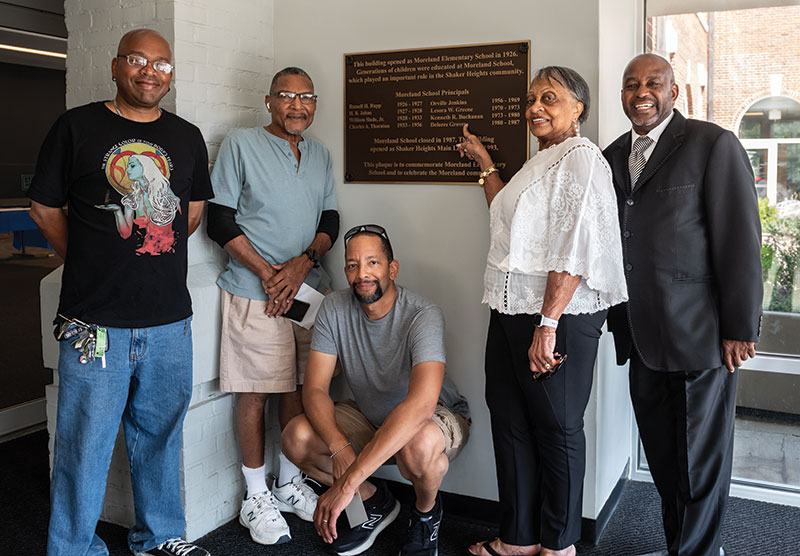
Delores Groves (second from the right) poses with her former students, including Darryl Bell (far right).
The Call for a Cornerstone
The School District closed Moreland and three other elementary schools in 1987 due to declining enrollment. All four buildings – Ludlow, Malvern, Moreland, and Sussex – were repurposed, and the boundaries for the elementary schools were redrawn to increase diversity. Since then, Moreland neighborhood students have been bused to Mercer Elementary.
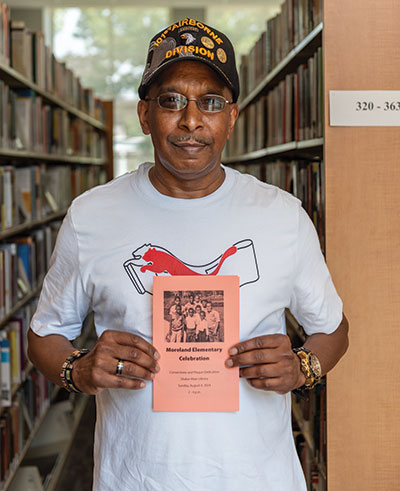
Darryl Bell, a 1975 graduate of Moreland Elementary School, is one of the residents who requested that the library install a cornerstone.
“It’s important to me that people know what this building was, because it molded us in childhood. I want people to know the story of our city, and Moreland is part of that, even though the building no longer has that name.”
He adds, “If someone years from now is asking questions about the neighborhood – ‘Who lived here? What did they look like? Why were they bused?’ – we want to give them the pieces to put it together. The cornerstone is one of the pieces.”
Shaker Library Director Amy Switzer says, “Moreland Elementary was a very important part of our city’s history. We don’t want to erase what came before. We want to incorporate it into our legacy, into how we tell our story.
I appreciate the Moreland residents who suggested the cornerstone and the plaque. They were the catalysts for helping us recognize what came before.”
Reminding New Generations
Moreland Elementary School was opened in 1926. It served mainly Jewish families in its early years and African American families in its later ones. In the 1960s, many Black families moved out of Cleveland, with its overcrowded schools, and into Shaker Heights, so that by 1969, 95% of the students at Moreland were Black.
“When I started kindergarten at Moreland in 1961, I was the first Black student,” says Walter Ratcliffe, a current Fernway resident who graduated from Moreland Elementary in 1967.
“My mother was a spitfire. She was a nurse, the first in her family to go to college, and she always felt education was the key. So she moved our family from Cleveland to Shaker.”
Ratcliffe recalls that in his first years, as one of only a few Black students, he felt a little out of place. “But then more students who looked like me enrolled, and I became more comfortable, because I had people who looked like me, talked like me, came from the same background as me,” he says.
He recalls the camaraderie he and his classmates had, stopping at Glen’s on the way home from school to buy candy or playing basketball in the school parking lot on Sunday mornings.
Ratcliffe finds the placing of a cornerstone significant. “In a couple decades, we will all be gone, but the cornerstone will still be here, reminding the new generations this was Moreland Elementary. We just hope that the stories about how great it was will continue on.”
Meghan Hays, Local History Librarian at Shaker Library, says that at work, she regularly meets people who went to Moreland Elementary. “They have very good memories of this place, and they want to talk about it. They want to tell me what their teachers’ names were, where their classrooms were.”
When she takes groups on tours of the building, they point out spots they remember. “The physical space helps to draw those memories out and get them back into active use in a way that pictures can’t,” she says.
“I think for some people, it’s hard to walk into this building and see that it’s no longer a school. And that’s OK. They’re entitled to feel that way.”
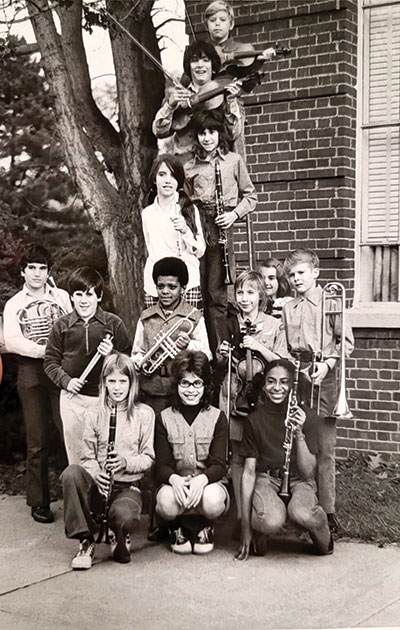

The school was closed as part of a very challenging set of decisions with many people involved.
“At the time, the library was over in the Stephanie Tubbs Jones Community Building and bursting at the seams. This building sat empty, and for six years, people tried to figure out what reuse it could have. Then the library came in and gave it new life. The building continues to be a center for the entire community. It’s not the same as a school, but it does serve a purpose as a community center – and as a community anchor,” Hays says.
Bell, the 1975 graduate, agreed. “I think it’s great that our school became a library. That’s the uniqueness of the situation – the building is still a learning institution.”
That’s not to say that we should sweep what happened under the rug, says Hays. “I recognize what closing this school meant to this neighborhood. I want to honor that.”
She continues, “The Moreland Celebration we hosted is an example of how this community remembers. I’m sure you’ve heard the saying, ‘No, Shaker doesn’t have it figured out. But we’re willing to talk about it.’ We’ll never stop talking about it. And that’s what makes us different. It’s what makes us who we are.”