Members of Cook the Book find connection and community at Shaker Library
By Lyndsey Brennan | Photogtaphy by Robert Muller
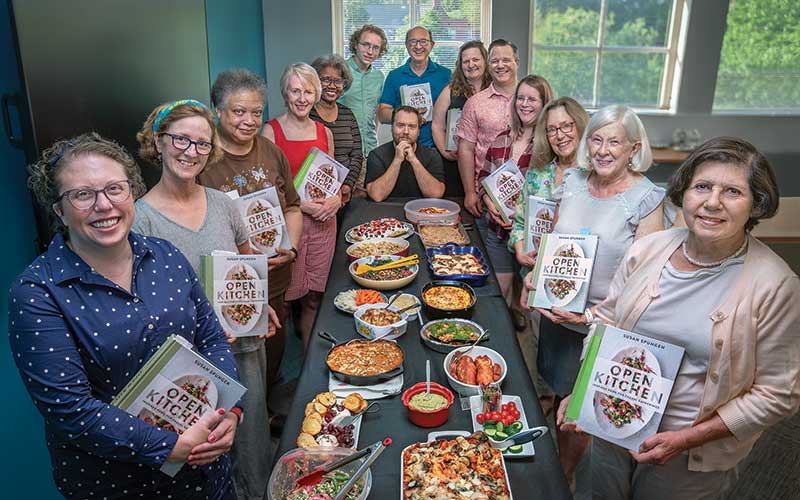
“Would you buy this cookbook, accept it as a donation or light it on fire?”
That’s the question that often opens discussion at Shaker Library’s Cook the Book, a book club that meets monthly to discuss a cookbook and share a meal together. Bertram Woods Manager Lynne Miller and Circulation Manager Jim Bagwell started Cook the Book in October 2016 after hearing about other libraries that had success hosting similar groups.
The concept for Cook the Book is simple: Bagwell selects a cookbook, with input from the group. Members check out a copy to take home and peruse, cooking recipes that appeal to them as they go. A month later, they convene to discuss the book. Each brings a recipe from the book to share, and they eat dinner together, potluck style, on dishes they’ve brought from home (to save waste). But what began as a space for people to come together over a common interest in cooking has become so much more. In a post-pandemic age where Americans are feeling a deepened sense of isolation, this group
serves as a case study in how to build and maintain genuine connections.
During interviews, group members repeatedly referred to each other as “family” and used words like “sanctuary” and “sacred” to describe the meetings. Spending time with the group members, it’s clear that their connection is genuine.
This month marks seven years that the group has been meeting together — something that dumbfounds Bagwell.
“I don’t know what the secret to the group’s longevity is. I just try to make people feel welcome. But the attendees, they make it what it is. There’s just some sort of magic with this group that maybe they don’t fully see,” he says.
A core group of a dozen attendees hails from different generations and backgrounds. There is Debbie, a professional genealogist, who talks about her grandma’s experience as a Black chef working for white Shaker families.
There is Anne, the granddaughter of Italian immigrants, who describes her mother’s pizza rustica with the same reverence some people reserve for religion.
Then there’s Pete, who made that infamous loaf of rosemary bread that people still can’t stop talking about two years later. And there’s Henry, the recent college grad with math and philosophy degrees, who describes a recipe as “needlessly finicky” to a chorus of nods.
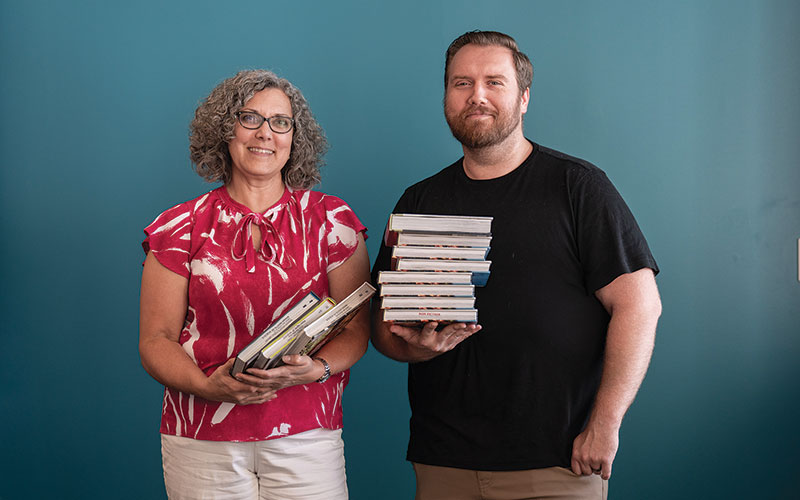
Bertram Woods Manager Lynne Miller and Circulation Manager Jim Bagwell started Cook the Book.
When I enter the room on a Wednesday evening this summer, I am struck with two immediate thoughts: “Holy cow, something smells amazing,” and “How long have these people known each other? They’re greeting each other like old friends.”
Throughout the meal, I observe the attendees falling into easy conversation with each other, their laughter ringing through the room. During the discussion, they take turns talking about what they made and offering their candid thoughts on the cookbook.
“Did I like the book? No,” says one attendee. “Are any of us surprised?” pipes another attendee. “Also no.”
Everyone laughs. “Would I grab this book if I were drowning?” one participant muses. “Yes.” After a pause, she adds, “Otherwise, it’s a no for me.”
Another participant is aghast. “I love it. Out of all the cookbooks we’ve done in this group, I’ve only purchased two, but I’m seriously considering adding this
one as a third.”
Everyone from cooking novices to professionals has found a way to challenge themselves in the group.
They also tell stories about preparing this month’s recipes. One person describes a recipe that sent her on a journey across town, into several grocery stores, in search of something called squash blossoms. Another spent $50 on her winter vegetable lasagna, and brought the receipt to prove it.
The tone is light-hearted, wholesome, and warm, similar to the camaraderie you’d observe in an episode of “The Great British Baking Show,” with Bagwell stepping in as the group’s Noel Fielding to host and crack jokes.
We learned early on that a serious approach wasn’t going to work,” Bagwell said. “Some book club leaders will throw out serious, almost-academic questions
like, ‘On page 64, paragraph 3, the author says this. Why?’ And some of our participants do offer up those insights. But I try to keep it casual and light.”
Everyone from cooking novices to professionals has found a way to challenge themselves in the group.
“That’s the beauty of it,” Miller, the Bertram Woods manager, says. “There are a variety of skill levels, but the advanced people don’t make the beginners feel bad. They’re very accepting.”
Ruth Pettker, a Canadian transplant to Shaker Heights, is one of the more advanced attendees, having received culinary training.
“When I get the book for the month, I try to cook different recipes from it to get a feel for the style of the book and the range of recipes.”
She says bringing something to share is an equalizer that allows everyone to try dishes from the book they may not have had the resources to make otherwise.
When she first moved to Shaker Heights, Pettker couldn’t work due to her visa status and was seeking other ways to connect socially. She described her first
time attending Cook the Book as “nerve-wracking — just because it always is when you’re striking out on your own and you don’t know anyone. But Jim is a great host.
From the first meeting, he made me feel welcome. He made me want to keep coming back. “Being part of a community means making connections with other people, discovering common ground, and finding a place where you belong. That’s Cook the Book for me,” says Pettker.Over the years, Bagwell watched the group’s focus shift from the cookbook to the community itself.
“Walking out of a meeting, you just feel rejuvenated. It’s not just the food, though it’s delicious. But there is so much genuine love in that group.” Miller observes that the group’s chemistry and dedication to each other are rare.
“There is another group that’s been meeting here at the library for just as long, but I don’t think they’d call each other ‘family.’ There’s just something about sharing a meal and breaking bread together — it binds you.”
The group became even tighter during the pandemic, when they pivoted to meeting over Zoom. “During those meetings, it was less about the cookbook and more about how we were doing. Just checking in with each other,” Pettker says. “It was really nice to be able to sit down and connect with people over a meal still.”
What did it mean to Bagwell to meet during the pandemic? “Everything.”
“During COVID, everything was uncertain, so it was important to me to know that I had a community that wasn’t going anywhere. And knowing that we were providing that as a library? Priceless.”
To learn more about Cook the Book and other discussion groups offered at Shaker Library, visit events.shakerlibrary.org.
Lyndsey Brennan is the Communications and Marketing Manager at Shaker Library.