A look at Shaker Library’s $3M Bertram Woods Branch renovation.
By Lyndsey Brennan
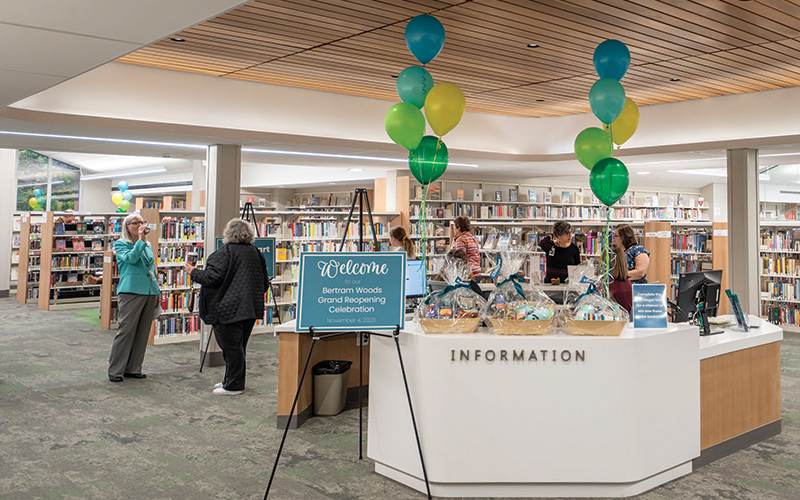
Upon entering, visitors can immediately connect with staff members at the strategically-placed reference and circulation desks. Photos by Robert Muller
In the late 1950s, architects drew up a plan for a branch library, funded in part by the local farm-boy-turned-railroad-engineer, Bertram Woods. Their plans were quickly derailed, however, when then-director Virginia Robinson (SHHS Class of 1924) took a trip to Menlo Park, California and fell in love with the California ranch-style library there. She brought back photos and a magazine article about the building, and the architects pivoted, settling on the structure we now have.
“We wanted to honor the existing architecture – the high ceilings and the tremendous natural light coming in from the windows – by creating openness and visibility through the space.”
“It was really Miss Robinson who was responsible for the design of the building, though I wouldn’t want that to get all around town,” Robinson overheard one of the architects saying at the branch’s dedication ceremony in June 1960.
The branch has had four renovations over the course of its 60-plus year life. The first two added a dedicated children’s area, more space for the fiction collection, and a basement. This most recent renovation, designed by architecture firm Bialosky Cleveland and executed by Turner Construction, was all about preserving what was useful and beautiful about the initial design – and reclaiming space that had been lost in previous renovations.
“We wanted to honor the existing architecture – the high ceilings and the tremendous natural light coming in from the windows – by creating openness and visibility through the space,” says Ben Crabtree, the Bialosky senior architect who served as project manager and architectural design lead for the project.
The challenge was opening up lines of sight through the building in a way that didn’t compromise the collection, Crabtree says. Library administrators worked closely with the Bialosky team to devise a shelving plan that would allow for unobscured views of both wings of the building while maintaining the wide-ranging collection customers were accustomed to browsing.
“That was something we heard loud and clear from Shaker Heights residents – they don’t want to see a library that doesn’t have books in it,” Crabtree says.
For the look, feel, and function of the space, Bialosky senior interior designer Sandy Tilberg says she wanted to build on the success they’d had in renovating Main Library without replicating it.
“People seemed to love the design approach and fun wall graphics at Main Library, which are about neighborhoods and the Shaker community. But we didn’t want Bertram Woods to be a mini-Main Library. We wanted it to have its own identity and personality,” says Tilberg, who served as the interior design lead for the project.
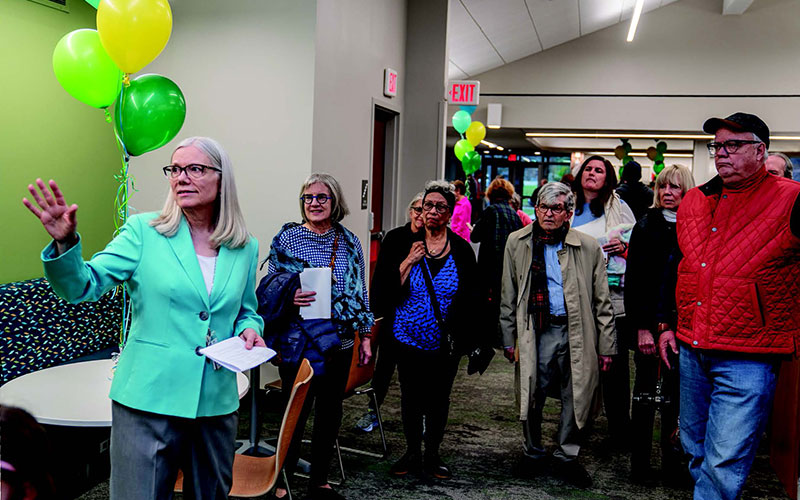
Library Deputy Director Maureen Brodar leads a tour of the newly renovated building.
Tilberg and her team took inspiration from the branch’s wooded location, choosing design features that played well with views of the reading garden and the surrounding neighborhood.
“It’s kind of a cheeky play on the name Bertram Woods, who we know is a real person. But the name, in addition to the setting, really gave us some inspiration,” she says.
Bertram Woods Branch Manager Lynne Miller has been in her position since 2003 and has become well acquainted with the building over the years.
The Board of Trustees wanted something uniquely Shaker. They wanted the buildings to be open and inviting places for people to gather.
“The thing I’ve always loved about Bertram Woods – which has been accented now by lowering the shelves and popping up the ceiling – is the outdoor space. And how the windows bring the outside indoors,” says Miller. “I was talking to someone the other day who said, ‘Wow, are those the same windows?’ Yes, they are. But they’re so much more obvious now – and such a feature, without shelves blocking the way. The building had good bones to begin with, it was just a matter of rediscovering them.”
Shaker Library Director Amy Switzer says the board of trustees played a pivotal role in producing the design we have today. “After they hired Bialosky, they gave guidance to the design team that applied to both branches: They wanted something uniquely Shaker. They wanted the buildings to be open and inviting places for people to gather,” Switzer says. They also gave specific directives for Bertram Woods. “We knew we needed study rooms, because customers were always requesting them. And we knew we needed to reconfigure the meeting room so it was equipped with the right tools for hosting meetings.”
The renovation has made the space more efficient for both customers and staff, Miller says.
“We have so much more to offer customers now – two study rooms, a passport office, and a meeting room with up-to-date technology. I think people are going to appreciate having access to these features, moving forward.”
The $3 million allocated for the renovation wasn’t spent solely on cosmetics, Crabtree says. “There were roofing repairs, a new skylight, and a full replacement of mechanical and electrical systems that will allow this building to keep serving the community for years to come.
“People don’t always see that money being spent,” he adds, “but it was a critical part of this project.”
Entryway
Prior to the renovation, when you entered the building, you were met with bookshelves and a large checkout counter. Now, thanks to strategically-placed reference and circulation desks, visitors can immediately connect with a staff member. The ceiling above the desks also incorporates acoustic panels, so if someone is speaking with staff about materials or their account, the panels will absorb some of the conversation. The designers took the opportunity to introduce warm wood tones at each of the desks.
“There was plenty of wood in the building before, but it had darker finishes – what you would have seen in the ‘80s or ‘90s,” Tilberg says. “We wanted to incorporate some of that texture but do it in a lighter color that brightened the space and fit better with the palette we were using.”
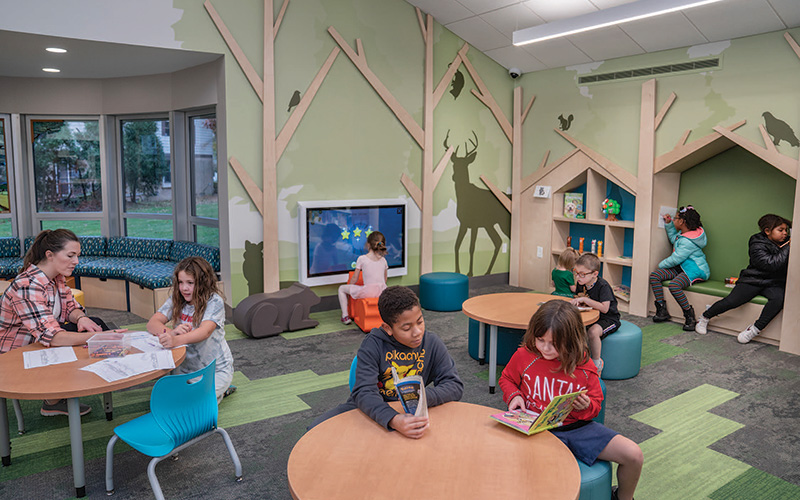
Children play, read, and color in the newly renovated children’s room at the Bertram Woods Branch.
Children’s Area
In the first hour that Bertram Woods was open to the public on Wednesday, October 11, four children and their caretakers made a beeline to the children’s area, without having to stop for directions. Crabtree says there’s a name for what happened there: “the payoff moment” when you walk into a space and “immediately feel a connection with an area.”
Right away, the kids began playing. They climbed on the fox- and bear-shaped animal stools. They took turns playing a coloring game on the touch screen. One of the children walked slowly through the stacks, taking it all in, then selected a book and sat down to read it with her caregiver on the window seat.
To create the woodland animal art featured on the children’s area wall, the Bialosky team brought in Chelsey Finnimore, the firm’s graphic designer who won a 2022 American Graphic Design Award for her graphics in the Main Library atrium and children’s room. Finnimore’s mural features a deer, a raccoon, bats, birds, and other animals you could find in any Shaker Heights backyard.
“That was intentional,” Crabtree said. “We wanted the design to be very Shaker-specific and prompt kids to become curious about the nature around them.”
The design complements the area’s stained-glass window, which resident Lucille Winston donated in 1996 in honor of her parents, who were longtime branch regulars.
South Reading Room
Crabtree’s favorite part of the redesign, hands down, is the south reading room. Prior to the renovation, shelving blocked natural light. Swapping in shorter shelves in the center of the room and relocating taller shelving to the perimeter brightened the space considerably. Now when you move from the entryway and walk toward the south window, “you get this compression and release – those are the architectural terms for it – that allow the south reading room to feel all the more grand. Like something worth celebrating,” Crabtree says.
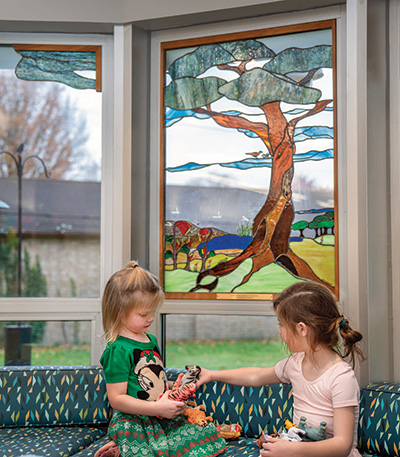
Girls play in front of the stained glass window in the children’s area. The windows were donated by resident Lucille Winston in 1996 in honor of her parents, who were longtime branch regulars.
Then there’s the view out the south window: “If you saw that cool view and walked down there but had nowhere to sit, that [design] wouldn’t have been successful,” he says. “It was really important to us that customers be able to sit with a book in front of that view – that’s the experience we wanted to create.”
Who Was Bertram Woods?
Not much is known about the farm boy who would become the namesake of Shaker’s branch library, but one thing is clear: he knew how to get a ball rolling on a vision. When he died in 1948, he left a wish in his will that there be a library for people in his farm community to visit. He also left $15,000 (roughly $190,000 in today’s dollars) to ensure it happened. Since Woods didn’t name a recipient for the funding, his will wound up in probate court for two years until finally, a judge granted the money to Shaker Library to build a new branch.
Census data and other public records tell us Bertram Woods grew up as one of eight children on a farm at the corner of Warrensville Center Road and Fairmount Boulevard. He worked on the farm until he was 22, then took a job with a railroad as a “fireman” (a person who runs the boiler on a steam engine). In his 40s, he married a woman named Sadie. They did not have children. After a 47-year career with the railroad, he retired to Florida where, apparently, he never forgot his childhood home.
Lyndsey Brennan is the communication and marketing manager at Shaker Library.