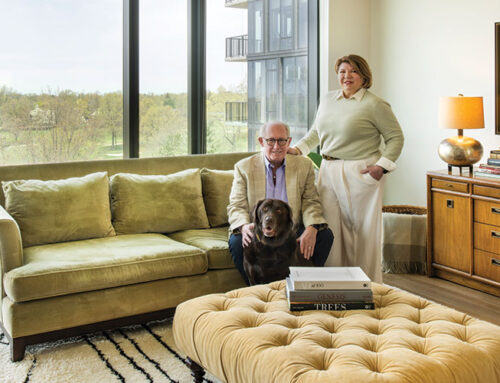
The George G.G. Peckham House on South Park Boulevard is undergoing a massive renovation to continue its tradition of delighting guests into its second century.
By Michael Peters

Photos by Kevin G. Reeves
Almost forgotten today, many Clevelanders – including several Shaker Heights residents – played a significant role in the creation of the American automotive industry. One prominent Shaker Heights home, at the corner where the two branches of South Park Boulevard meet, has numerous connections to this car-related gold rush through several owners who shaped the industry for generations.

Local artist Patrick Funke created a new mural on the music room’s second-floor staircase walls.
In the 1910s, Cleveland was second only to Detroit in its focus on this new industry. The introduction of lower-priced cars, especially the Model T, and innovations like installment payments and used car trade-in programs, fueled ever increasing demand for cars. While the developers of Shaker Heights, Oris and Mantis Van Sweringen, went to enormous lengths to create the Rapid train line (including buying an entire railroad for the last piece of track they needed), when it was completed in the early 1920s, cars already dominated the roads.
One of the early automobile entrepreneurs was George G.G. Peckham, known as “3G,” who started the Peckham Motor Car Company in 1899 in Dayton. By 1903, when his only child Phyllis was born, he was selling Pope-Toledo, Packard, White Steamer, Cadillac, and Waverly electrics – cars manufactured in Toledo, Warren, Cleveland, Detroit, and Indianapolis. Business was booming a decade later, only to be destroyed when the Great Dayton Flood swept 20 feet of water through the city’s downtown.
Rather than rebuild he moved the family to Cleveland in 1914, initially renting a house on East Overlook Road in Cleveland Heights. Detroit had not yet cemented its place as the Motor City, and Cleveland was buzzing with automotive activity – from White, Winton, Baker, and others. With a loan from Central National Bank, 3G bought the Cleveland Buick dealership, which he would rename Ohio Buick and eventually grow into the largest Buick dealership in the state.
With this success also came the opportunity to join in with the cultural activities of Cleveland’s prominent families. This was the decade when the Cleveland Museum of Art opened, the Music House Settlement and the Musical Arts Association (and its Cleveland Orchestra) were founded, and the Playhouse Settlement (later Karamu House) and Cleveland Play House were established.
Families like the Peckhams supported these efforts and attended their events together, and the impression that left on young Phyllis eventually led to a life supporting the arts in Cleveland.

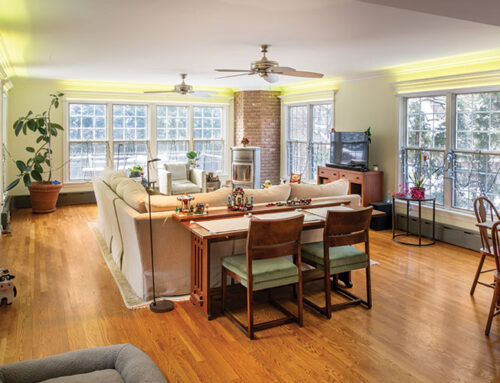
The living room with a view into the sunroom.
Ownership Change
The Peckhams moved to Shaker Heights in 1916. They bought a large parcel on South Park Boulevard and hired Harry Shupe to design a house. Shupe had been working with Carl White at their firm White & Shupe since 1907. White’s grandfather was the founder of the White Sewing Machine Company, and his uncle Rollin founded the White Motor Company in 1906. Carl White’s wife, Cornelia Packard White, was the sister of the founders of Packard Motor Car Company in Warren in 1902. The Peckhams, Whites, and Packards were certainly likely to have mingled in the same social circles.
Harry Shupe’s work for the Peckhams may have grown out of commissions to design homes on South Woodland Road. A syndicate of Cleveland business leaders, led by Frederick Green and T.T. Long, had purchased 213 acres along South Woodland in 1911 for residential development. The acreage ran along the Doan Brook ravine from the Shaker Heights Country Club to Shaker Heights High School. The syndicate dammed the brook at Lee Road, creating Green and Marshall lakes. Shupe would design houses for each member of the syndicate, along with several others in the area.

Located across from the ballroom, was a smoking porch where guests of yesteryear could gather. It now serves as an office for the present owners.
In addition to the prestige of living in Shaker Heights, the South Park location was also convenient for Phyllis to attend Laurel School. By the time she graduated in 1920 her parents had already started work on a new house, again working with Shupe. It was directly next to the first one, which they sold to Carl Hanna, who owned the Hanna Building on Playhouse Square.
While they share a similar style, the second house sits prominently on the corner and is nearly one-third larger at nearly 16,000 square feet. The construction took two years and was completed in 1921. The Peckhams hired the local design firm Rorimer-Brooks, whose clients also included the Van Sweringens and the venerable Greenbrier Hotel in West Virginia, to outfit the home with custom-made furniture. Each summer, when the Peckhams were away on holiday, the firm would return to the house to refresh the interiors, including ensuring all of the lampshades were straight by using a level.
Peckham died of a heart attack in 1945; his widow Elizabeth sold the house to her daughter Phyllis in 1948, and Phyllis lived there until 1984.
Phyllis Primrose Peckham was not only a much-loved Cleveland arts patron, but like many of her peers, a fashionista. She had a fondness for French couture. Several of her Lanvin dresses are in the Western Reserve Historical Society’s Chisholm Halle Costume Wing.
And she was an eye-catcher. In the summer of 1917, Peckham, his wife Elizabeth, and 14-year-old Phyllis were in the fashionable summer resort of Eagles Mere, in Northeast Pennsylvania. Its grand hotels hosted prominent families and attracted actors and artists. Among these was the Austrian-born artist Emil Fuchs, then living in New York.
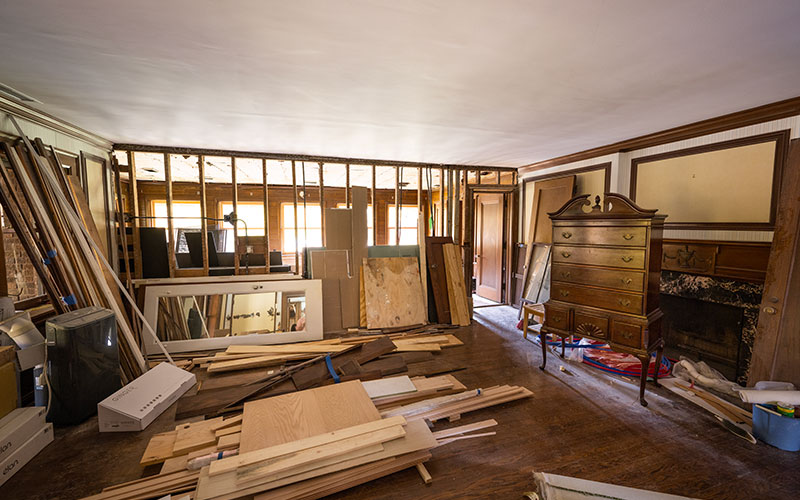
The primary bedroom suite awaits its transformation.
Emil Fuchs was well known in society circles, painting the portraits of many prominent socialites. That he had also painted portraits of Queen Victoria and her son, King Edward VII, only added to his cache. So it was probably an easy answer when Fuchs approached 3G in Eagles Mere offering to paint Phyllis’s portrait. The artist had a show in Cleveland a year earlier, at the Korner and Wood gallery on Euclid Avenue. In October 1917, a subsequent show at the same gallery would feature Phyllis’s portrait – along with that of Mrs. Frank Seiberling, wife of the founder of Goodyear Tire & Rubber Company.
Phyllis was the last member of the family to own the house. She sold the pool house and gardener’s cottage at the rear of the property, but otherwise the main house and its greenhouse and six-car garage – with two apartments above – remain intact.
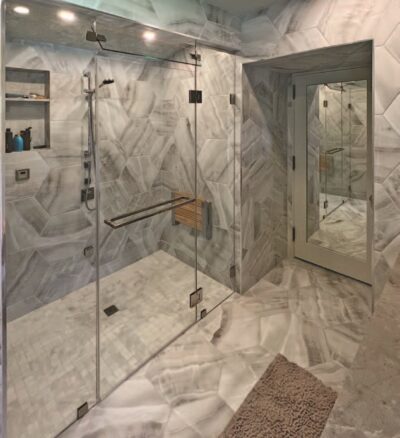
A vintage bathroom transformed into a modern space.
In 1984, Phyllis sold this property to a buyer who was, like 3G, connected to the automotive industry. Joseph Gorman was then assistant president of TRW, the industrial powerhouse born out of Cleveland’s Thompson Products. Thompson first found success with a new process for manufacturing engine valves. The company’s expertise expanded to include satellites, rocket engines, and advanced weapons systems. The next year, 1985, Gorman became president and eventually CEO before retiring in 2001. An avid rider and hunter, he sold the house in 2004 and bought the Moxahela estate in Hunting Valley.
The new buyers were Mark and Susan Hollingsworth, who saw the house turn 100 years old before selling in early 2022. They were good stewards who made some updates such as geothermal heating and cooling, while opening up the house to many social events and fundraisers.
Now taking the house into its second century, current owners James Graham (who works for a major supplier to – yes – the automotive industry) and David Dusek are re-interpreting and honoring the legacy of the house with guidance from interior designer and project manager Donald Bingham Schmitt, who says the full renovation will take most of this year.
A Brief Tour
Many home designs from this period, especially the Tudor Revivals, have ostentatious appearances, while the design of the Peckham house is more subtle – with the significant exception of its sheer size. The social complexities of the early 20th century are foreign to us today, but the design of the house may have sought to balance social prestige (size, location, landscape design), architectural fashion (influences of the developing Prairie style), and the insularity of the social circles in which the Peckhams moved.
The design influences of the period are particularly notable in areas like the central music room, the large entertaining spaces, and the third-floor ballroom, complete with stage and dressing rooms.

The third-floor ballroom, compete with stage and dressing rooms.
The flow of visitors is carefully managed through these public areas, starting at the main entrance – an understated side door. Unlike Georgian and Tudor Revival houses with framed or stone-arched entryways on the front of the house, this choice may have been a Prairie style influence, because it preserves the horizontal lines of the façade. It’s an uncommon feature in Shaker Heights, but it was a feature Frank Lloyd Wright used extensively, notably with his Frederick C. Robie House in Chicago, where the entrance is nearly hidden at the rear of the house.
Once inside, guests are escorted through a hall with a barrel vault ceiling shining with new silver leaf. On the right is 3G’s original office, where the wood paneling has been painstakingly restored, using reclaimed and new wood so the updates are unnoticeable – including the hidden door to the bar (Prohibition having started in 1920).
On the left is the dining room, with new plaster relief ceiling decoration from Cleveland’s Fischer & Jirouch, who likely produced many of the original plaster decorative elements in this and many other Shaker Heights homes.

A whimsical service button in George G.G. Peckham’s office.
A breakfast room off the dining room retains the original windows – as is the case throughout the house – while the kitchen wing has been updated. As with many houses designed in this period, the original kitchen was the domain of the cook and other household staff. (The Peckhams had a butler, cook, three maids, a laundress, a driver, two groundskeepers, and a gardener.) The update takes advantage of the large windows on either side of the wing and includes a wheelchair accessible powder room.
The entry hall dramatically ends at the center of the house, where guests are led into the music room. A grand staircase to the second level results in a room that is partially double-height and where the Peckhams, who were supporters of the Musical Arts Association, had their grand piano. The room also had a built-in player-pipe organ. A marble-floored loggia looks over the rear manicured garden, while the front has quarter-sawn oak paneling – and was where the Emil Fuchs portrait of Phyllis hung for decades.
A large living room, with fireplace and built-in bookcases, is off the music room along with a glassed-in sunroom that also overlooks the rear garden. But the public areas extend up the main staircase to a mezzanine and then through another staircase to the third-floor ballroom. The paneled ceiling of the main stair has been restored and repainted with accent colors that complement the new mural on the second-floor staircase walls by artist Patrick Funke. Portraying scenes from some of the new owners’ favorite locales, the mural enlivens the space and weaves together the elements of Schmitt’s design.
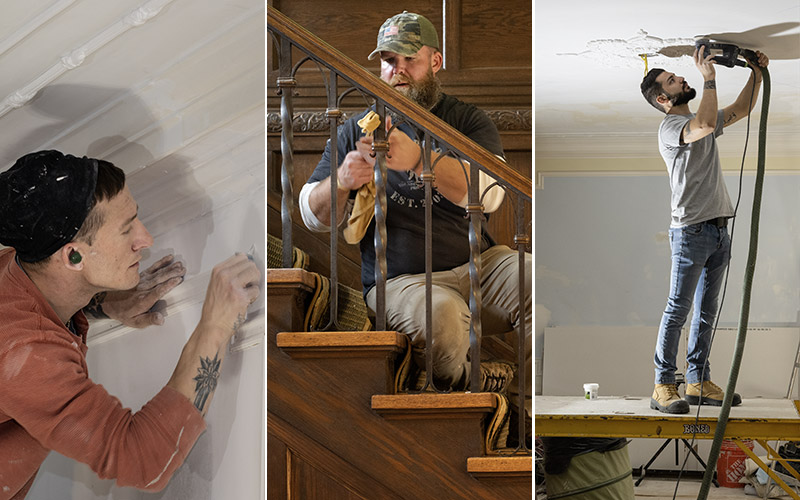
Crafts- and tradespeople attend to every aspect of the house’s restoration.
The renovation work stays true to the original plan for the public spaces while updating and personalizing the décor. The private spaces consist of several groupings throughout the house. The main owners’ suite is off the mezzanine and reconfigures the original dressing rooms and sleeping porch into a cohesive suite with two baths, dressing rooms, and a washer and dryer. On the opposite side of the mezzanine are three guest rooms, all with new en suite bathrooms. Here the design elements use classic materials but in modern and striking proportions to create warm and inviting spaces. A third grouping of guest rooms is on the third floor, adjacent to the ballroom and former billiard room, and originally referred to as a “bachelor suite” for guests who may not make it home after the festivities. Finally, what would have been staff quarters above the garages is now a self-contained apartment.
The garage serves as one side of a frame to the rear garden, making the garden a private space within the larger grounds. These grounds, which blend into the surrounding woods of Southerly Park and The Nature Center at Shaker Lakes, cover nearly two and a half acres, much of which is the expansive front lawn of the corner lot. The main house and garage share the same style and materials, and along with the pergola that joins them, have been restored and repainted. The trim and detail are painted in green, blue, and pink – organic colors to lighten the overall effect and highlight the gardens.
As it welcomes its second century, the home on South Park is well positioned to continue the legacy started by George Peckham, maintained by his daughter Phyllis for decades, and now in the accomplished hands of Graham and Dusek. Designed by Harry Shupe as a showpiece as well as a home, it is ready to welcome new generations of visitors and guests – some of whom may just need that bachelor’s suite….
Donald Bingham Schmitt: In His Own Words

Lead designer and project manager, Donald Bingham Schmitt (seated), confers with general contractor Curtis Manns.
This is the third historic home restoration in the Cleveland area that I’ve had the great fortune of working on with these clients. The potential for challenges moving forward was a given. But after visiting the home on multiple occasions, its potential for grandeur was undeniable. I knew that my team could make the spaces both beautiful and functional for my clients’ lifestyle.
Years ago I had the pleasure of meeting Phyllis Peckham and would frequently see her out and about socially, dressed to the nines in Parisian couture. She was charming and dynamic and I enjoyed our conversations. I think that if she could see what we are doing, not only to the interior but the exterior and the landscaping, she would be delighted that her home is in good hands that respect the history of a great Shaker home.
It’s wonderful that over 100 years after its construction we have the opportunity to bring this landmark home up to a standard of fine design that pays homage to the original while being updated in ways that allow for the more modern living of the new ’20s.