An extraordinary collaboration – and donations of time and talent – brought the 2022 St. Jude Dream Home to Shaker Heights.
By Sharon Holbrook
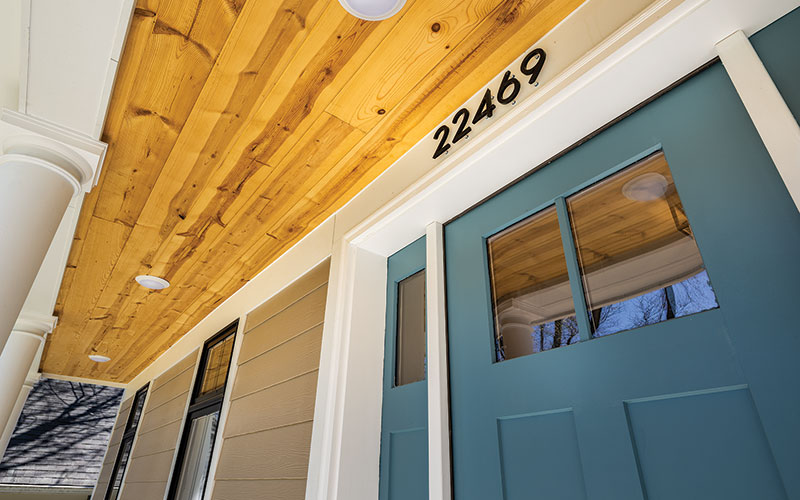
Like many homes in Shaker Heights, the thoughtfully crafted house at 22469 Fairmount Boulevard has built-in bookshelves, beautiful moldings, window seats, and hardwood floors. It also has typical 1920s features like a third floor living space, a laundry chute, and even a “milk door” for deliveries. But this house is not part of Shaker’s historic housing stock: it’s a brand-new modern-farmhouse style home.
The “milk door” in the garage wall isn’t for the milk delivery – it’s a keypad-locked compartment for Amazon and other delivery people to safely leave packages. The laundry chute doesn’t lead to a typical basement washer and dryer – it leads to a first-floor laundry room just off a mudroom. And while the third floor can be reached by stairs, you can also reach it by an elevator that serves the basement and the first, second, and third floors.
The combination of new construction with classic Shaker touches isn’t the only noteworthy feature of the house: It’s also Shaker Heights’ first St. Jude Dream Home. St. Jude Children’s Research Hospital in Memphis provides free care to children with cancer and other serious illnesses, and it raises funds in part by raffling off Dream Homes around the country. In November, after sales of raffle tickets for the Shaker home raised over $2 million, Akron resident Kevin Hopson won the Fairmount Boulevard house.
 Why Shaker?
The Fairmount Boulevard house was a collaboration of many professionals. There were more than 50 sponsors and donors. But the driving force behind the St. Jude Dream Home was the building team at Keystate Homes. Keystate is a family- owned custom home and construction business founded in 1979 by Avner and Mina Gotlieb, and their son Andrew leads much of the day-to-day work these days.
Andrew Gotlieb says he approached the City of Shaker Heights five or six years ago about Keystate becoming an approved builder for infill lots in Shaker. Infill lots are vacant parcels within established neighborhoods, affording buyers a unique opportunity to purchase a newly constructed home. More recently, the St. Jude’s team approached Keystate about heading up the Dream Home project, and Gotlieb saw the chance to bring this opportunity to an infill lot in Shaker Heights. (To find out more about purchasing and building on an infill lot in Shaker, visit shakeronline.com/843/Infill-Housing.)
Typically, builders undertake the St. Jude’s Dream Home as a sort of model home in a new development, hoping that the publicity will help the builder sell additional houses that are similar to it. The Fairmount house, by contrast, is a custom home built specifically for the unique requirements of the existing lot and
to fit with the surrounding homes and Shaker’s standards of design. This additional complexity of the build may be the reason that the Fairmount house is St. Jude’s first-ever infill house in Cleveland, but those details didn’t scare off Keystate. Custom homes, says Gotlieb, are what Keystate has done for years.
Gotlieb knew this lot would be perfect for the Dream Home, and Shaker Heights, which owned the parcel, agreed and donated it. Neither the Gotliebs, their company, the City of Shaker Heights, nor most of the professionals who made the Dream Home happen were compensated for their work on the project.
Homegrown Collaborators
Once Keystate and Shaker Heights agreed to move forward, Keystate worked with architect Gary Neola of Cornerstone Architecture and began the approvals process with Shaker Heights. As building began, Keystate did run into some of the common issues of the pandemic economy: labor shortages and supply chain delays. Nevertheless, the home was ultimately completed in about 12 months.
Early in the process, Gotlieb reached out for help from his friend, Shaker Heights resident Kate Stuart of Catherine Stuart Design. Stuart, an interior designer, agreed to work on a design for a family fun area in the home. She, in turn, reached out to fellow designer and Shaker resident Jacqueline Prude of Jacqueline Interiors, and invited her to collaborate on the project. Stuart and Prude each have two children in Shaker Schools, and the two met years ago when they were room parents at Fernway Elementary School.

Avner and Andrew Gotlieb
While other designers donated their services for other parts of the home (see QR code for a list of contributors), Stuart and Prude were tasked with transforming the large, sunny third floor into a family-friendly hangout. Together, they planned the space which, if a future owner desires, can be converted to add one or two more bedrooms to the three-bedroom house. For now, it’s a flexible space built for fun.
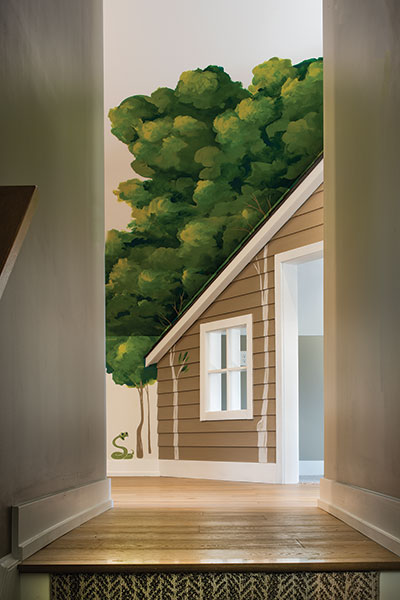
On one side of the third floor, there’s a colorful rock-climbing wall that Prude hand-stamped with a geometric design in navy blue paint. (Shaker Heights business Shaker Rocks donated some of the materials for the rock- climbing setup.) There’s also a built-in playhouse with a slide and real siding that echoes the siding on the outside of the house. Its doorway is wide enough to admit a child in a wheelchair. In this play area, Stuart and Prude wanted to honor a local patient of St. Jude’s, so the hospital put them in touch with a Northeast Ohio family who had traveled to St. Jude’s for brain cancer treatment. That’s why the wall mural by local artist Kelle Schwab includes a friendly little snake – it’s 10-year-old Jaiden’s favorite animal. (Jaiden, who is back home again, also loves doing magic tricks and jumping on his trampoline.)
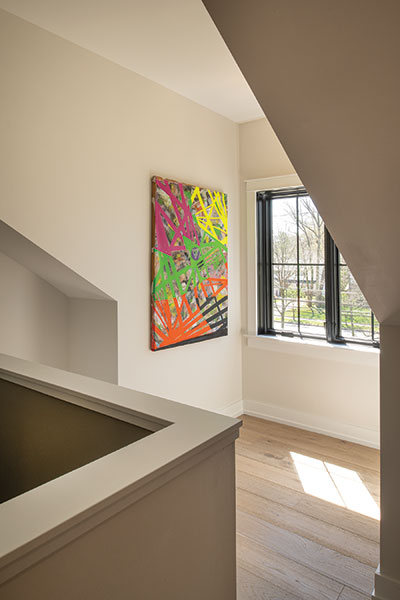
On the other side of the third floor, the centerpiece is a TV-ready custom bookcase. Add a comfy couch, and maybe a beverage fridge and snacks – there’s an area for
that – and the homeowner will be ready for casual entertaining. Shaker artist Julius Hannah (Shaker Life, Winter 2021) lent some of his colorful paintings to add to the décor.
Around the third floor are cozy nooks created by dormer windows, and Stuart and Prude fitted one of these out with a spacious, cushioned window seat. Anticipating that this will be a popular hangout space, there are even handy USB ports for charging phones and other devices. Just as they did for the play side, Stuart and Prude recruited and worked with additional collaborators who also donated their time and materials – from the shelving to the fabric and sewing for the window seats.
A Homeowner-Friendly (and Earth-Friendly) Design
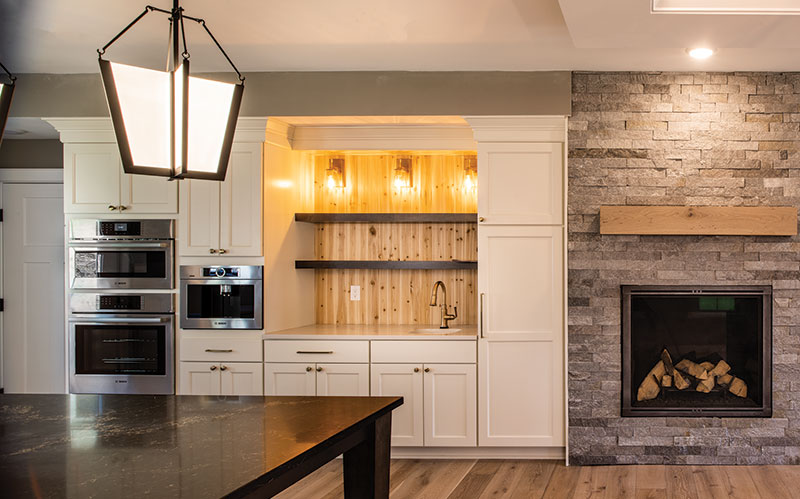
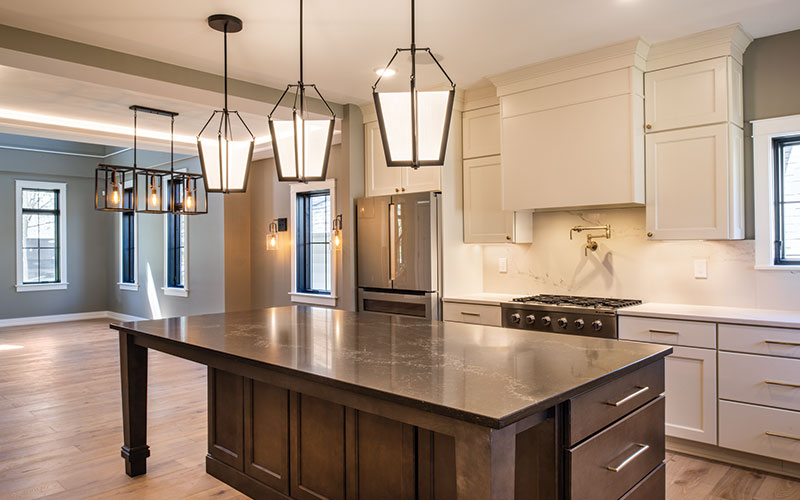
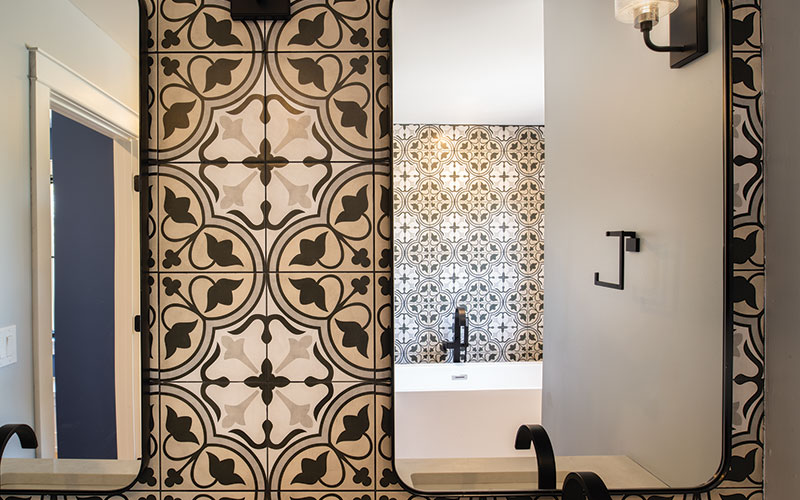
The second floor has three bedrooms and two full baths, including the primary suite with its walk-in closet and a bathroom featuring a show-stopping tile wall. A flexible, light-filled lofted space overlooks the first-floor great room. An open floor plan on the first floor means that the great room flows seamlessly into a dining space and a large, modern kitchen with additional counter-height seating at the island. Again, there’s a nod to historic Shaker homes here: a handsome bank of cabinets with its own extra sink says “butler’s pantry” while also saying “here’s where you’d set up the bar when you have folks over” and “here’s where you’d make the kids wash their hands before dinner so they won’t be underfoot in your cooking area.”
The attached two-car garage has a door that opens right into the kitchen, so grocery bags can easily be transported inside on shopping days. For everyday purposes, the garage also has a separate door into the home’s mudroom so outdoor mess and backpacks don’t wind up on the kitchen floor. It’s the kind of thoughtful design that considers not only what looks good, but also what day-to-day living will be like in the house.


Green building is always an aim of Keystate, so that thoughtful planning also extended to making the house earth-friendly. Keystate works to avoid waste and send less to the landfill, so it used an aggregate of limestone and crushed excess brick, porcelain, granite, and quartz to build the base under the driveway. The siding on the home (and the third-floor playhouse) is Hardie siding made from recycled wood mixed with cement.
Gotlieb said Keystate also works to stay as local as possible with vendors, like Sherwin Williams for paint, Kichler for lighting, and Lubrizol and Eaton for plumbing and electrical components. That helps support local jobs, but it also reduces carbon emissions from transportation. Even the trim in the house, which is all wood, was harvested within 200 miles of the site.
It doesn’t end there: All the lightbulbs in the house are LED, and in the basement, there’s a tankless water heater, which means hot water on demand instead of a bulky water heater working 24/7 to keep water hot. And the home – not just its appliances and windows – will be energy-star certified, which will mean fewer drafts and lower ongoing energy costs for the homeowner.
After pandemic delays and supply-chain shortages, the transformation of 22469 Fairmount is complete, and it’s ready for its next phase. If a vacant lot could have a dream for itself, it might have dreamed of this: a new home, meticulously constructed, and furnished with good deeds.