The City’s approach to sustainability is multi-faceted. Shaker Life looks at the various programs and services that impact our quality of life.
By Michael Peters

1913 map of Shaker Heights
Sustainability seems like a modern concept. But many of its ideas have been with us for as long as the City itself. Less than a decade after the 1902 book Garden Cities of To-morrow was published in England, the engineering firm hired by the developers of Shaker Heights Village went there to study the concept. The resulting master plan – with green spaces, the Doan Brook, and “rapid transit” within walking distance – largely survives today. This integrated approach to sustainability, originally designed to attract homebuyers, remains the basis and inspiration for Shaker Heights’ programs.
Skipping ahead just over 100 years from the City’s founding takes us to the rainstorm of July 2014. This severe weather event led a group of concerned citizens to work with the City to form the Climate Change Task Force. Over the next several years a growing number of residents lent their time and expertise to help the
City think about how to best prepare for the impacts of climate change.
Building on the momentum of – and enthusiasm for – this work, Mayor David E. Weiss elevated the task force into the City’s Sustainability Committee in 2019. This standing committee consists of three City Council members and three citizen members appointed by the Mayor. It leads the sustainability efforts for programs that impact residents as well as the City’s own operations. Shaker Heights was the first Cleveland suburb to have a sustainability program with dedicated staff support.
The Sustainability Committee has three subcommittees. Each has a specific focus area and is open to any interested member of the community.
- The Energy Subcommittee promotes energy efficiency, rooftop solar, and incentive programs for residents to reduce their energy use and source their electricity renewably.
- The Stormwater & Green Space Subcommittee created the City’s Grow Not Mow areas that return selected sites to native meadow (while also saving the City time and expense), has worked to expand composting programs in the City and schools, and most recently orchestrated an electric lawn mower rebate program to improve air quality and reduce noise pollution.
- The third subcommittee is named Shaker Youth LEEDs and consists solely of high school students in Shaker Heights. Originally created to solicit input on the City’s LEED for Cities certification (through the U.S. Green Building Council’s Leadership in Energy and Environmental Design program), and to make sure the City benefited from the insight of students, it has created the popular EcoChallenge contest each April and chooses a sustainability project each academic year. It is open to any high school student in the City and recruits new members each fall.
In order to focus its sustainability efforts, the City in 2021 was certified under the U.S. Green Building Council’s LEED for Cities program. The program is a collection of best practices from around the world, covering areas from greenhouse gas emissions to water use. Rather than start from scratch, participating in this program allowed the City to hone in on some of the highest impact areas in an organized fashion.
Thanks to the assistance of numerous City partners, including the Cleveland Department of Water, the Northeast Ohio Regional Sewer District, and the Cuyahoga County Planning Commission, the City achieved the Gold level of certification. There are four levels (Certified, Silver, Gold, and Platinum) and only two other cities in Ohio have certified: Cleveland and Cincinnati.
The City scored very well in numerous categories, particularly quality of life, while several areas were noted as areas of improvement. This served as the benchmark for prioritizing efforts by the sustainability committee and City administration. These efforts, managed by the City’s sustainability coordinator, are reviewed each year and currently include a broad mix of programs and services. Many are collaborations with City departments from Public Works and Recreation to the Fire Department and Diversity, Equity, and Inclusion.
Renewable Electricity
One of the most impactful areas has been transitioning the electricity supply to renewable sources. This is the largest source of greenhouse gas emissions for the City, since there is no heavy industry, and is the electricity used by the City itself and all of the households and small businesses. So in 2020, the City entered into a new electricity supply contract so that all City operations (including streetlights) were offset with Renewable Energy Credits, making it one of the first in the state to source renewable electricity.
The Sustainability Committee wanted to see how this could be expanded to residential electricity use – by far the largest contributor in the City to greenhouse gas emissions – and if the electricity could be sourced as close to Shaker Heights as possible. Fortunately there was a way to quickly and easily address the residential use, and it went back to a state law passed over 20 years ago.
In the fall of 2000, residents overwhelmingly voted to create a Community Choice Aggregation program under the new state law that allowed the City to purchase energy in bulk for its residents and small businesses. The City has long operated a natural gas aggregation program, locking in fixed long-term rates to help residents budget for their utility bills. Starting in June this year, this same benefit was provided for renewable electricity with a two-year fixed price; residents do not have to take any action to be included (but can opt out if they want to shop for an electricity supplier themselves). All electricity delivered through the program will be offset with Renewable Energy Credits.
One of the most impactful areas has been transitioning the electricity supply to renewable sources.
The direct benefit from the second part of the equation – sourcing the electricity as close to the City as possible – is cleaner air, as renewables replace the burning of fossil fuels. There were no new Ohio-based solar or wind projects available for the start of the program but the goal is to source at least a portion of the next contract from Ohio renewable sources.
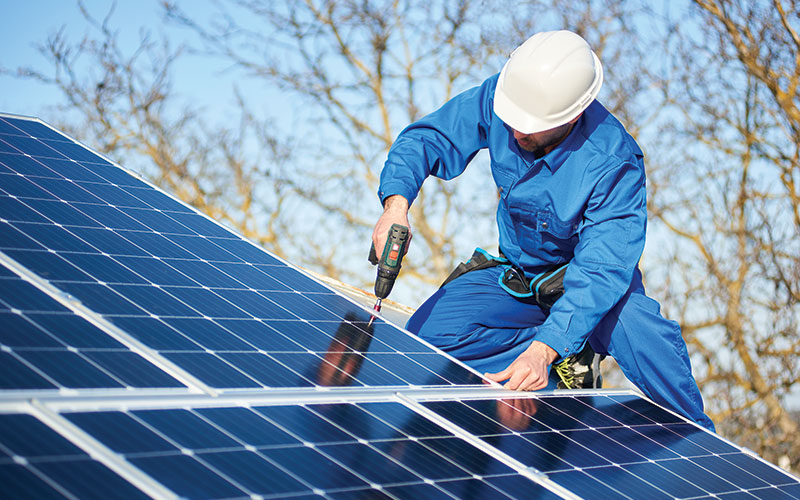
In the meantime there is a way for homeowners to generate renewable electricity as close to home as one could possibly get. Over the past several years residents and small businesses have been eligible to join the Cuyahoga County Solar Co-op. This no-cost and no-obligation program run by the non- profit Solar United Neighbors is essentially a buying club for rooftop solar. At last count, over 65 homes – at least one in every neighborhood – have solar. This includes all types of homes, even those with slate roofs, and the City has streamlined the approval process. Incentives included in the Inflation
Reduction Act can result in a federal tax credit to the homeowner of 30 percent or more.
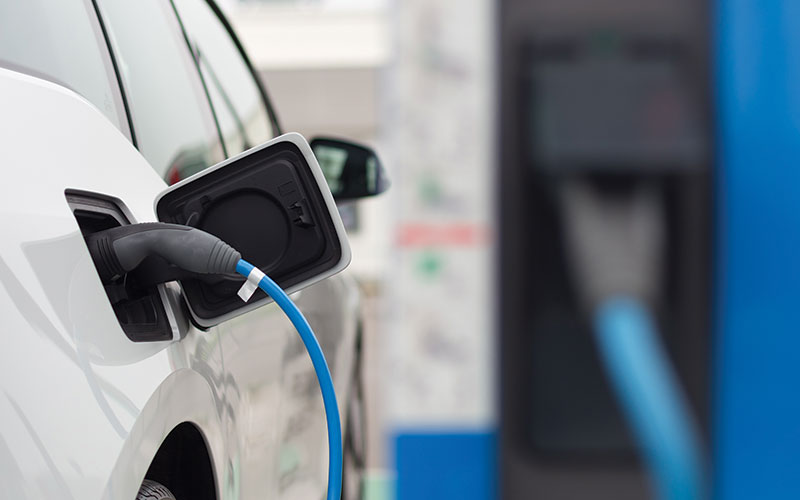
EV charging stations are sprouting up around the City.
Whether you are able to generate your own electricity or not, more and more residents are also driving electric vehicles. Currently, nearly 300 electric vehicles are registered in the City, reducing tailpipe emissions while benefitting their owners with lower operating and maintenance costs.
In 2021, through a grant from the Northeast Ohio Public Energy Council, the City installed seven charging ports at four locations: Thornton Park, City Hall, The Dealership on Lee Road, and the public parking lot on Larchmere Boulevard. The electricity delivered through the chargers is also offset with Renewable Energy Credits, further reducing the environmental impact of driving electric.
The availability of public charging allows everyone in the City to drive electric if they choose. It can be difficult for residents living in multi- family housing to get permission to install a charger, so access to public charging is important. Fortunately several additional sites are in process, including a Tesla Supercharger site at Shaker Plaza in The Van Aken District.
Solid Waste & Recycling
It s easy to see how using renewable energy in these ways reduces greenhouse gas emissions, but one other area of the Sustainability Committee’s focus – solid waste – has a surprisingly large impact on emissions too, particularly methane emissions.
Public Works crews collect the majority of solid waste in the City. This allows the City to accurately measure the waste so programs and alternatives can be created for diverting as much as possible from methane-generating landfills.
Shaker’s driveway program allows for the collection of landfill and recyclable material. The City’s new recycling contract allows for a wider range of recycled material, but we continue to experience the “wish-cycling” that leads residents to hope that more of what they throw out can be recycled. The unintended consequence is that if the recycling bucket contains too much contamination from non-recyclable materials, it has to be sent to a landfill to not compromise the whole program.
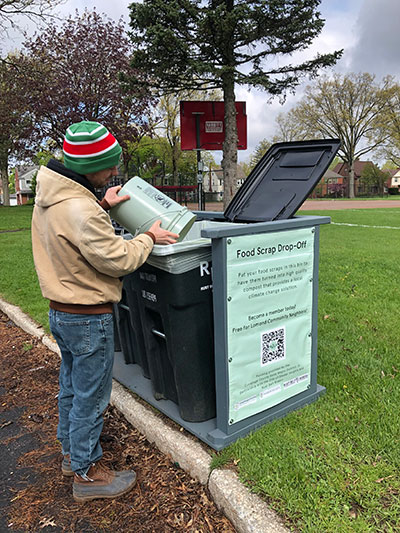
In 2023, the City launched a pilot drop-off composting program in the Lomond neighborhood.
There is an alternative to landfill and recycling and it has a tremendous impact. Typically more than 30 percent of municipal household waste is food waste, which generates methane in landfills. This is why the City also offers several opportunities to compost food waste.
Residents can divert their food waste from the landfill through three different options: backyard composting, drop-off sites, and a pick-up program.
For those with a backyard and the proper enclosure, a composting permit is available from the Public Works Department. (There is no cost but you must complete and return the form to the Service Center at 15600 Chagrin Boulevard.) Mixing a combination of leaves and food scraps (but not bones or meat – those require commercial composting) along with a little muscle to turn your pile results in rich soil for your garden or flower beds.
If this is too labor intensive, then for a small monthly fee you can sign up for Rust Belt Riders, the City ́s composting partner. There are drop-off sites at The Nature Center at Shaker Lakes, The Dealership on Lee Road, and the Unitarian Universalist campus on Shaker Boulevard. Just take your food scraps, which in this case can include meat and bones, to the nearest bin as often as you like, emptying your reusable container or using compostable bags – no plastic please!
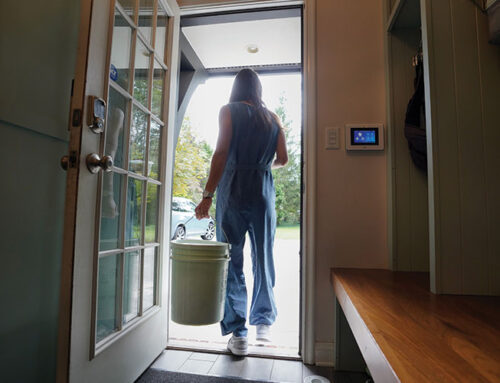
For even more convenience, sign up for the pick-up program where Rust Belt Riders will drop off a clean five-gallon bucket on your doorstep each week and take away the full one. You also receive discounts on the soil that is created from the composted material for your garden, potted plants, or flower beds.
The City and several schools also provide composting for staff, visitors, and students. The Fire Department operated an early pilot program that was so successful more City buildings were added to the program. Fernway School was the first public school to start a composting program, with Onaway School joining last year and additional schools in the works. (See story on page 46.) St. Dominic School’s composting program helped earn it Green Ribbon status from the Ohio Department of Education. Last year, nearly 600,000 pounds of food waste was diverted from the landfill in Shaker Heights through these programs, which also saved the City.
Solid waste has a surprisingly large impact on emissions too, particularly methane emissions.
Thousands of dollars in landfill costs. To expand upon this success, earlier this year the City received a Special Projects Grant from the Cuyahoga County Solid Waste District to pilot a neighborhood- based composting program. This will combine a drop-off site and a school program, and is taking place in the Lomond neighborhood. See the story on page 12 for details on how you can participate if you live in Lomond.
These are just some of the ways the City, schools, residents, and businesses are taking actions to combat climate change while also reducing energy costs, improving air quality, and turning food waste into garden soil. Visit the Sustainability pages on the City’s website to learn more, submit a comment or idea, or volunteer for an upcoming event.
Originally published in Shaker Life, Summer 2023.
Incentives Available to Residents
Several federal programs provide tax credits to help offset the costs of upgrading your home to make it more energy efficient. Many are included in the federal Inflation Reduction Act. Signed into law last summer, it encourages investing in domestic energy production, among other things.
Additional programs are expected soon through the State of Ohio. These include:
$150 towards a home energy audit. This is a great place to start as an energy professional will identify specific actions you can take to make your home more energy efficient and thus save money on utility bills.
30% of the cost – up to $2,000 – for installation of the insulation your home energy audit will probably recommend, energy efficient windows and doors, an
electric heat pump to provide more efficient heating and cooling, a heat pump water heaterheater, and electrical panel upgrades if needed for the heat pump.30% of the cost of rooftop solar, including options such as battery backup.
Up to $7,500 for new or $4,000 for used electric vehicles.
These credits are income-qualified so some drivers will not qualify for the full credit. Additional discounts on many of these upgrades will be available through rebate programs administered by state agencies. These are still being created and will provide low- and moderate-income households with additional incentives, including discounts of up to $8,000 toward electric heat pumps and up to $4,000 toward the upgrade of your electrical panel, if needed for the heat pump.
Resources:
The White House: Clean Energy for All
Learn more on how you or your family can save on utility bills, get support to purchase electric vehicles and energy-saving appliances, and access the economic opportunities of the clean energy future.
Find out more about which tax rebates and incentives you are eligible for.