Launched on Earth Day, the City’s unique partnership with Rust Belt Riders opens up a city-wide composting resource in each neighborhood.
By Sharon Broussard
Photos by Gus Chan and Steve n Springer
About seven years ago, some Shaker Heights residents who had learned about Rust Belt Riders (RBR), the local compost collection company, took to driving to RBR’s St. Clair Ave. office to drop off cracked eggs, moldy food, bones, and restaurant leftovers in the company’s bins.
In a circuitous way, it was that small band of dedicated Shakerites that gradually led to a full-fledged partnership with the city of Shaker Heights and RBR, which collects food scraps and turns them into deep rich soil used for gardening, says Zoe Apisdorf, the company’s hauling operations scope leader.
“The most important thing that made us bring composting to the City was the people of Shaker Heights,” says Apisdorf.
A lot of people are using it. They are happy about it. They think the bins are conveniently located.
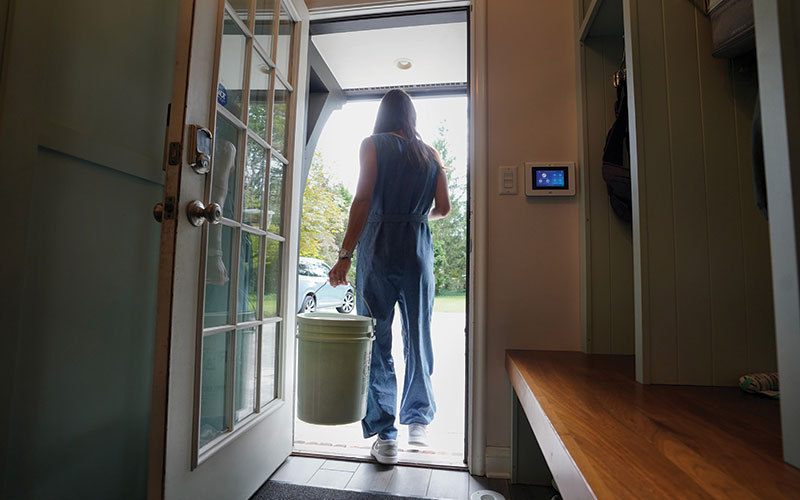
On April 22, 2025, Earth Day, RBR’s food waste collection service became available to all residents of the Shaker Heights City School District, thanks to Shaker City Council budgeting $80,567 for its use. The 18 locked and clean waste bins – expect more during the holiday season when food is abundant – are at every City elementary school, the City’s main library, and at some city buildings in Shaker.
The shift to a free citywide service for all – before residents had to make their own arrangements with RBR – is appropriate for Shaker, which was the first suburb in Cuyahoga County to allow Rust Belt Riders to offer residential food waste collection services within its city limits and only the second city in Cuyahoga County to pay for citywide food scraps collection. Beachwood was the first.
RBR was started in Cleveland by Daniel Brown and Michael Robinson in 2014, and the community hauler is the only food scrap collector in Cuyahoga County. Food waste collection and composting are in their infancy in the U.S., with just a handful of cities and states, the city of New York and the state of California among them, requiring residents to separate their food scraps for collection. Shaker’s program is voluntary.
Diverting from Landfills
Composting is an important step to limiting methane, a greenhouse gas generated by food waste that contributes to global warming. Nationally, about 30 to 40 percent of food ends up in a landfill, according to the U.S. Environmental Protection Agency.
Some Shaker residents appear dedicated to changing those numbers. Since April, Shaker’s paid municipal composting program has had about 946 sign ups and has diverted 33,197 pounds of food waste or 16.5 tons from the landfill.
“We pay a lot of money for landfills so if we could divert it, it would be a win,” says Michael Peters, the City’s sustainability coordinator who worked closely on the project with City Councilmember Kim Bixenstine, chair of the Sustainability Committee.
Bixenstine, a longtime home composter, says residents have been enthusiastic. “I have heard nothing but positive remarks. A lot of people are using it. They are happy about it. They think the bins are conveniently located.”
Scrap Collecting Tips
Set up an indoor/outdoor system: Keep a small container indoors for daily scraps and dump them into a larger, outdoor and covered receptacle periodically.
Freeze meat scraps and add them to your pail right before you drop off your compost at your local bin.
Repurpose brown bags as liners for your larger, outdoor bin.
She says the City’s partnership with RBR started out slowly but steadily with a pilot program at Fire Station One on Chagrin Blvd. in 2021. Two years later, the City got a one-year special project grant for about $15,000 from the Cuyahoga County Solid Waste District for a compost collection program at Lomond Elementary School “that was very, very successful,” signaling that the project could work. (Fernway and Onaway Schools already had RBR composting programs paid for by their PTOs in a separate school program.)
The Beauty of Scraps and Dirt
Just how does the 11-year-old employee-run cooperative turn a stinky mess into rich organic compost?
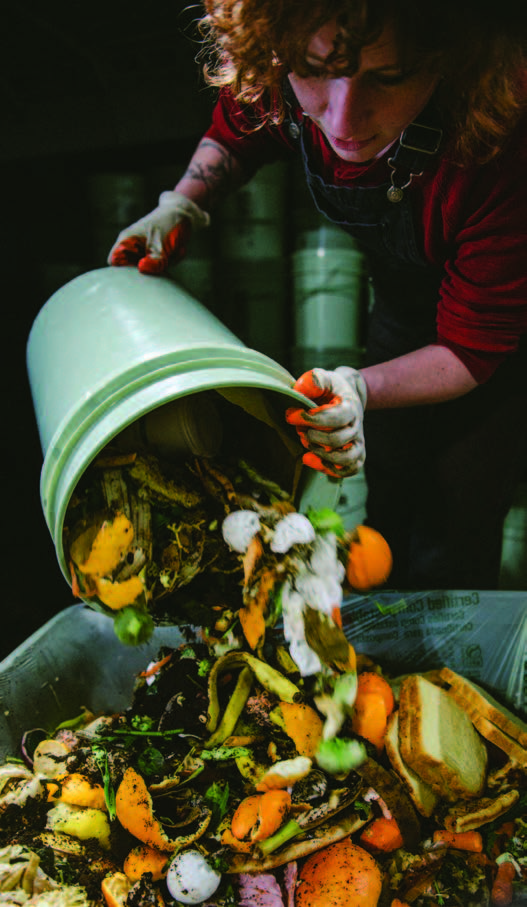
Once a week – sometimes more if it is a holiday – the company’s trucks collect food scraps from 64 gallon plastic totes in Shaker, Cleveland, Beachwood, and several companies including Heinen’s and haul it to Kurtz Brothers-owned Earth n’ Wood, a composting company in Canton, says Robert Kurtz, the commercial solutions worker owner at RBR (no relation). Some of the waste is also processed by Rid-All Green Partnership, a farm and educational center in Cleveland.
 RBR used to make compost at its site on St. Clair, says Apisdorf “but the volume of the material exceeded our capacity.” It plans to return to composting next year in a new facility.
Residents in Shaker, Cleveland, Beachwood, University Heights, and other cities aren’t the only ones that contribute food scraps to the totes. Miceli’s Dairy Products, all 19 Heinens, and Rocket Arena are just some of the 300 businesses that work with RBR, according to Kurtz.
Earth n’ Wood adds wood chips, leaves, and twigs to the giant mounds on the ground and allows microbes to eat the scraps, raising the temperature of the mound up to 160 degrees Fahrenheit, which breaks down the organic matter and turns it into compost. It takes six months for the mound to break down and become compost, prized by gardeners for its richness. The company adds amendments to make its own soil called Tilth, an Old English word, which means the quality of the soil. The company sells six different kinds of soil and compost. Enrolled members of any RBR program can get a 10 percent discount.
RBR plans to move next year from its St. Clair location to a seven-acre site on E. 79th St. where the worker-owned company will have its new headquarters, including a composting site. The long-term plan is to create a “brown necklace” of composting sites in the county that would help reduce trucking costs and emissions, says Kurtz.
“It will be an asset to the community and put Cleveland in a leadership role in composting,” says Kurtz.
“We want to talk tons, not pounds.”
A Thoughtful Business Model
The bold words on the white board in the makeshift meeting room for Rust Belt Riders on St. Clair Ave. proclaim the company’s organizational motto clearly: “No More Bosses.”
 It’s a “cheeky way to put what we are trying to do, shift the dynamics to make sure everyone is well taken care of,” explains Zoe Apisdorf, RBR’s hauling operations scope leader.
It’s also a great motto for this Cleveland-based company that started without any bosses – just two local men, Daniel Brown and Michael Robinson – who were so perturbed by the amount of food being tossed by restaurants that they rode a mountain bike and trailer around and started collecting food scraps and composting it. RBR now has 33 employees and will hire more as it expands. It is on track to divert 4,500 tons of food waste this year.
The 11-year-old cooperative has a non-hierarchical structure, meaning that their entry level employees start at the same pay, regardless of their role. People who engage in the work are considered experts in their field, so there is little need to consult a boss. “New ideas are always welcome,” says Apisdorf.
We want to talk tons, not pounds.
For instance, one of their truck drivers was so frustrated by the amount of water left in his RBR truck after it was cleaned that he asked Apisdorf if he could find a better way to clean the trucks. Apisdorf gave him the cash to experiment and he’s keeping the company up-to-date on the project. “It was self-prompted, self-directed,” she says.
There’s another perk: Workers can become worker owners who own a piece of the company if they work at least 3,000 hours on the job and pay $3,000, with the help of a company payment plan. Currently, RBR has 14 worker owners.
They get an opportunity to join the company’s seven member board of trustees and they can vote on new worker owner members. (Apisdorf is one of the board members). Profits are equally distributed as dividends or reinvested in the company, depending on what the worker owners choose to do, says Apisdorf.
It all shows that people can make decisions on daily operations, without being managed, she says. “At its core, they know the work best and they should be able to have the most impact.”