Northeast Ohio is one of the hot spots in the country to witness spring and fall bird migration, which puts the Shaker Parklands on a unique pathway to observe and understand bird populations.
By Sharon Holdbrook
Photos by Robert Muller
If your timing is right on a spring or fall morning at the Nature Center at Shaker Lakes, you may see a curious sight: Lightweight bird nets are strung up around the parklands, while volunteers stand guard to shoo larger animals and predator birds away from the nets. Other volunteers gently remove each bird from the nets. Finally, an expert bird bander weighs it, fluffs its belly feathers to examine its body fat, and adds a small, numbered band to one leg if it doesn’t already have one. All the data is recorded, and the bird is released. Only a few minutes have elapsed.
This process, which is part of a nationwide network that monitors the patterns and health of resident and migrating bird populations, is serious science taking place at the Nature Center. And since 2003, the area surrounding Doan Brook – including the 20 acres of the Nature Center – has been designated an Important Bird Area by the National Audubon Society. That means our own parklands are part of an international network of sites that are key to the conservation of bird populations.
As far back as the citizen “Freeway Fighters,” who successfully blocked the construction of a freeway through Shaker Heights and founded the Nature Center in the 1960s, locals have argued for the ecological value of the parklands here. But until bird banding began, there was no easy way to quantify the area’s importance as a key migration corridor. Now, about 1,000 birds a year are banded at the Nature Center, with about 300 in the spring and the remainder in the fall, and the key role of the Shaker Parklands in bird migration is well-established.
Migration Station
Julie West is the dedicated Nature Center volunteer who leads the bird banding program along with most other birding efforts at the Nature Center (see the full slate of offerings at shakerlakes.org/birding-programs). She, along with her late partner Gary, began her birding journey with bird walks at the Nature Center. In her case, this was in the late 1980s. By the mid-’90s, West had been trained in bird banding and had floated the idea of banding at the Nature Center. She and Gary had also begun leading some of the bird walks at the Nature Center.
In 2001, West initiated the bird banding program that she still runs today. Not just anyone can decide to band birds – bird banding requires both federal and state permits obtained after training and apprenticeship. West trained at the Black Swamp Bird Observatory in northwest Ohio, with which she still coordinates on data collection and reporting. The data is ultimately sent to and held by the federal government’s U.S. Geological Survey.
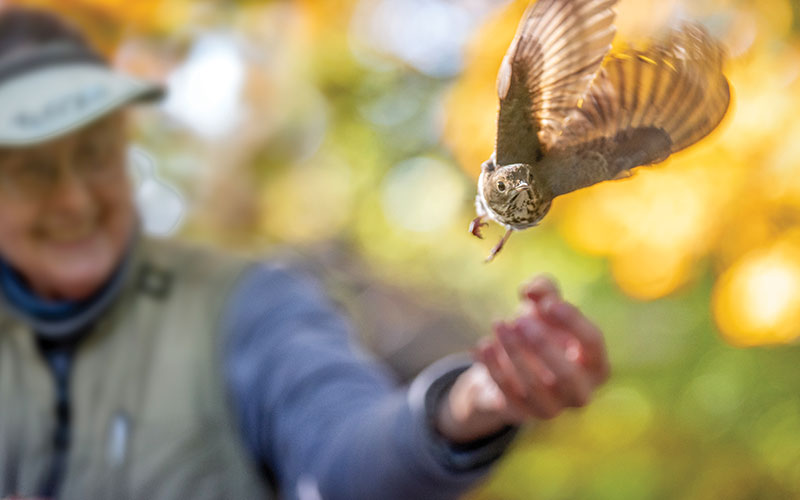
These days, West has a team of 15-20 volunteers who assist in the bird banding process as they are available. Volunteer Laura Gooch has also gone through the permitting process, so she sometimes leads banding, too. At any given time, about five volunteers are helping with extracting birds from the nets; keeping deer, chipmunks, and hawks from the nets; and bringing birds to West or Gooch for banding and data collection. In addition to banding, the volunteers also keep track of bird species they see and hear. It’s a collective effort, says West, and she and Gooch couldn’t do it without the help of these volunteers.
The Nature Center is a rich resource for migrating birds because of the variety of mini habitats it includes, says West. Between the marshlands, open areas, Doan Brook, and more densely treed areas, the park offers an attractive stopping point for a wide variety of birds. About 200 species of birds have been observed in the parklands, says West.
Birding here in the city’s unofficial backyard isn’t just for scientists, though – it’s also a choose-your-own-birding adventure with something for everyone from the diehard birder to the casual observer.
Exploring the Parklands
“Let’s meet at the Nature Center,” a friend and I will often text one another. It’s our home base for dozens of walks around the Shaker Parklands each year, as it is for scores of Shaker residents. Year-round, many of us enjoy the changes in seasons, the cycles of the trees and wildflowers, the comings and goings of our favorite turtles and birds and other critters. It turns out that being an Important Bird Area isn’t just ecologically valuable, it’s also fun to explore and observe.
Naturally, the Nature Center is where I meet up with longtime Shaker resident Doug Powell to talk all things birds and birding for this story. Powell had walked from his condominium near Shaker Square, where he lives with his wife and near his daughters and their families. He has his binoculars at the ready, and we both have good walking shoes on. As we walk and talk, we stop – many times – to listen and look, spying Lower Lake regulars such as belted kingfisher and redheaded woodpecker. I’m only a casual birder with limited knowledge, but Powell is all in, and he shows me the area close to South Park Boulevard where this species of woodpecker nests.
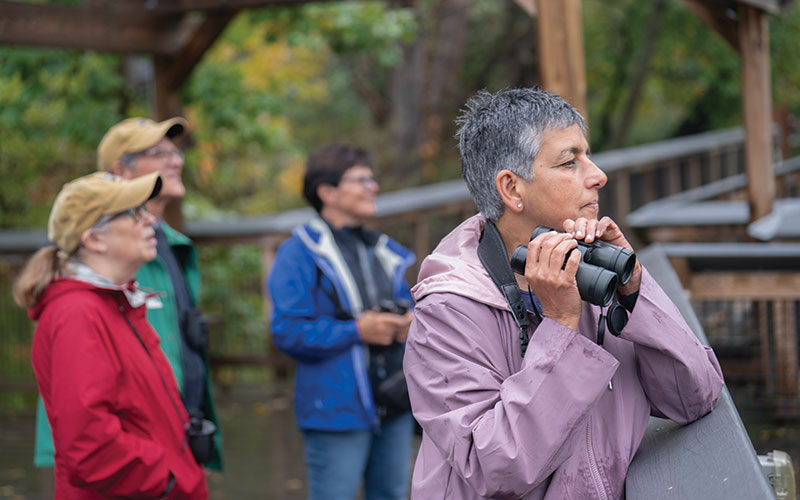
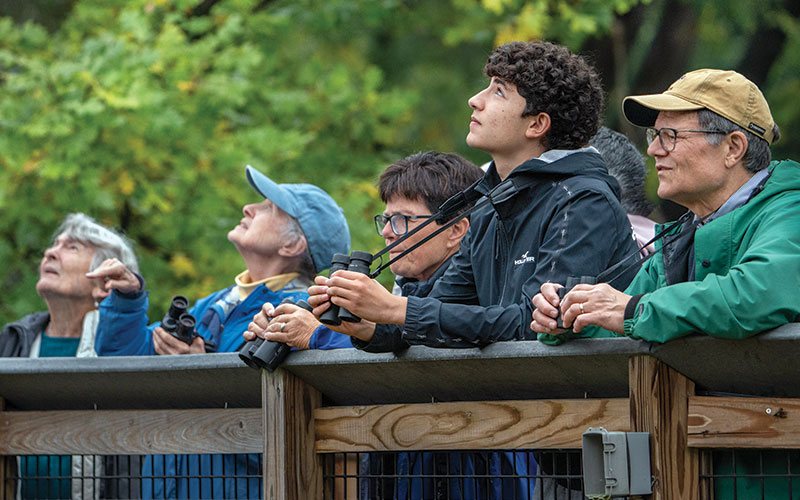
Birdwatchers at the Nature Center at Shaker Lakes.
Before he retired from his job as a physician and leaned into birding, Powell says he recognized few birds other than cardinals and crows. But he liked the idea of learning something new, enjoying outdoor time, and meeting the challenge of spotting more and more species. He keeps what avid birders call a lifetime list, a running tally of all the species he’s ever seen.
Powell’s birding adventures began with Nature Center programming. The Nature Center’s guided birding walks are a friendly way to learn a bit more about the birds in the area, says Powell. With a mix of experience levels among the walkers, newcomers get a chance to see birds that they might have missed if they had not been pointed out by veterans.
The Nature Center’s guided birding walks are a friendly way to learn a bit more about the birds in the area.
Many people, of course, enjoy the bird life around the parklands through their own unguided walks. As one of these regular visitors, I walk through the Nature Center grounds and around Lower Lake a few times each week. Like an old friend, there’s the great blue heron on Lower Lake again, not far from the North Woodland bridge. Now the kingfisher is startled out of the brush at the edge of the water, letting out its loud, rattling cry. At dusk, here come the Canada geese in raucous bands, settling down on Lower Lake for a sunset roosting.
Sometimes, if we walkers are very lucky, someone will spot a less common visitor – maybe an osprey or a bald eagle fishing around Lower Lake. When this happens, there’s instant camaraderie among the walkers around the parklands. “Did you see?” they will ask as we pass each other. “Right over there across the lake,” they’ll say, pointing to the spot.
Tourist Season (for the birds)
Each season brings its own revelations – in winter, sparse trees make it easier to spot year-round residents. The late-winter return of the red-winged blackbird to the marsh signals that spring is on the way. In summer, the wood ducks and their tiny babies paddle around Doan Brook, the marsh near the Nature Center, and Lower Lake.
Earlier in spring, somewhere among the trees – I wish I knew where – the mother wood ducks will have built nests far above the ground in hollow trees. When it’s time, the mother calls her babies to make the enormous leap to the earth and follow her to the water.
In spring and fall, the regulars are joined by hordes of travelers, migrants stopping by on their way north or south. Like a tourist town in peak season, there are suddenly crowds of visitors here in the Shaker Parklands, including dozens of warblers not seen here at other times of year.
When it comes to bird watching, the Nature Center and its surrounding parklands have been a go-to spot for decades. Now, with the data collected by banding, we can more plainly see what a go-to spot it is for migrating birds, too.
Download our guide to just some of the birds you can catch a sight of in the Shaker Parklands, including this Golden Crowned Kinglet.
West tells the story of the first day she banded birds at the Nature Center. That day, she caught and banded a song sparrow near the marsh. Every spring after that for seven or eight years, she caught the exact same bird in the same area of the marsh.
“If that had not been a good place for that bird, it wouldn’t have returned. I just think that’s so cool,” she says. “It tells you how important places like the Nature Center are.”
West’s Favorite Tools for Birding
Merlin: A free app that can help users identify birds. Users can upload photos for identification, but with the tap of a button birders can also ask the app to listen to a birdsong and suggest a species.
Ebird: A free app where users can record their own observations of species. The app can also show birders what birds other users have seen in their geographic “hotspot,” or where a particular species has been reported.
Bird walks: West, who often leads the Nature Center’s twice monthly bird walks (visit shakerlakes.org for details) herself, says these walks are a great way to see more birds and expand birding knowledge.
Bird guide books: West suggests The Sibley Guide to Birds. Sibley also offers an app that has helpful features, she says.
Native plants: If you want to attract birds to your own yard, West advocates for native plants and perhaps a water source.