As with all thriving cities, Shaker Heights is steeped in history. But with the passage of time, some facts can be forgotten – including the origins of street names.
By Nate Paige
Why are there no roads in Shaker that use the word ‘street’?
The Van Sweringen brothers – Oris Paxton and Mantis James – were followers of the theories of the Garden City Movement, initiated by Sir Ebenezer Howard, an English urban planner who designed elite residential communities surrounded by large swaths of green space and winding boulevards. Thoroughfares in Shaker Heights are referred to instead as roads, boulevards, drives, circles, lanes, and ovals. While the City of Shaker Heights doesn’t include any ‘streets’ or ‘avenues,’ the Shaker Heights school district does – as it includes sections of Cleveland.
Why do many streets have British names?
Harry F. Gallimore was employed by The F.A. Pease Engineering Company, served as the city engineer for Shaker Heights, and was infatuated with English literature. According to the research of former Shaker Heights city planner Patricia Forgac, this infatuation led Gallimore to using an English postal book as one of his sources for supplying street names, such as Sussex, Coventry, Lomond, Douglas, Warrington, Strathavon, Inverness, Weymouth, Glenmore, Aberdeen and Braemar.
Was Lee Road named after Mother Ann Lee?
There’s a longstanding local misconception that Lee Road was named after Mother Ann Lee, founder of the Shakers religious sect. Lee moved from England to America in 1774, settling in New York, and later, Harvard, Massachusetts where she was able to further organize and grow her following. In 1822 followers of Mother Ann Lee founded the North Union Shaker Colony, consisting of three large communal families, and until 1889 farmed the land that was subsequently developed by the Van Sweringen brothers as Shaker Village in 1912. Shaker Village (later Shaker Heights) was named for the Shakers. But Lee Road was not.
In actuality, the road was named after a farmer, Elias Lee, who moved from Connecticut in 1812. With his wife, Mercy, Lee settled land they purchased from the Connecticut Land Company, in the present-day vicinity of Cumberland Park in Cleveland Heights. In 1813 Lee was one of several local farmers who donated land and petitioned Cuyahoga County to widen and grade a north-south surveyor’s trail into a more passable road. As Elias Lee was the donor of the greatest amount of land to improve the road, by convention it was named Lee Road after him. Elias and Mercy Lee are buried in the East Cleveland Township Cemetery in University Circle.
Was Van Aken Blvd. named after a Shaker resident?
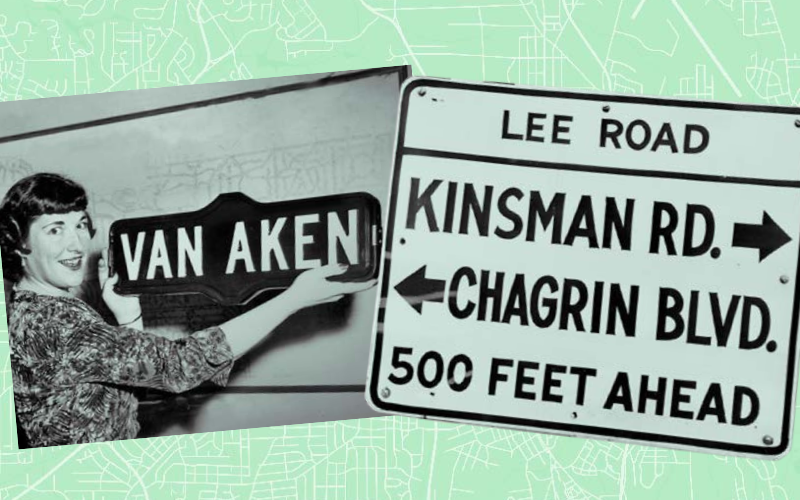
Yes, the section of South Moreland Blvd, stretching east from Shaker Square to Farnsleigh Road was renamed Van Aken Blvd. in 1951, after the death the previous December of William J. Van Aken, who served as the mayor of Shaker Heights for 35 years. He was often referred to as the ‘3rd Van’ because of his longtime friendship with the Van Sweringen brothers, and his avid support for their city planning vision.
Why does Kinsman Road change to Chagrin Blvd.?
Kinsman Road was improved in the mid-1800s as a wood plank road and was built to connect farming communities to the city of Cleveland. Originally known as the South Highway, Kinsman Road ran east to Kinsman, Ohio, which is near the Pennsylvania border. After several events in the lower sections of Kinsman Road, including a racially charged murder in the late 1950s, steps were taken to differentiate Shaker Heights from Cleveland, and the section of Kinsman running east from the western border of Shaker to Chagrin Falls was renamed Chagrin Blvd.
How did Warrensville Center Road get its name?
Warrensville Township and by extension, Warrensville Center Road, were named after Daniel and Margaret Warren. The Warrens were among a group of settlers who came from New England in the early 1800s. In 1810, Daniel Warren and his family relocated to Ohio from New Hampshire and built a cabin, and later a tavern, near Milverton and Chagrin Blvd.
According to historian Caroline Piercy, it is commonly understood that during their housewarming party, Margaret suggested naming the township after her husband. In 1811, the Warrens’ two-year-old daughter, Louisa, died and her grave was the first burial on land that became the Warrensville West Cemetery beside the Heinen’s parking lot.
Warrensville Township has since been completely incorporated into towns, cities, and other municipalities, and no part of the township currently exists in any governing sense. However, the Warrensville name persists in the Warrensville West and Warrensville East Cemeteries, and Warrensville Center Road.
If you’ve had a burning question about Shaker’s beginnings, transitions, or unique landmarks, let us know at shaker.mag@shakerheightsoh.gov. We might not be able to answer all questions, but your curiosity will help us start the digging.
Shaker Life appreciates research assistance for this article from staff of the Shaker Historical Society and the Shaker Heights Public Library. Additional sources: Cleveland Historical; Cleveland Memory; and The Encyclopedia of Cleveland History; The Physical Development of Shaker Heights (Patricia Forgac); The Forest Primeval, 1807-1817 (Carolyn Piercy).