Public transportation has and continues to be at the heart of new development in Shaker Heights.
By Diana Simeon
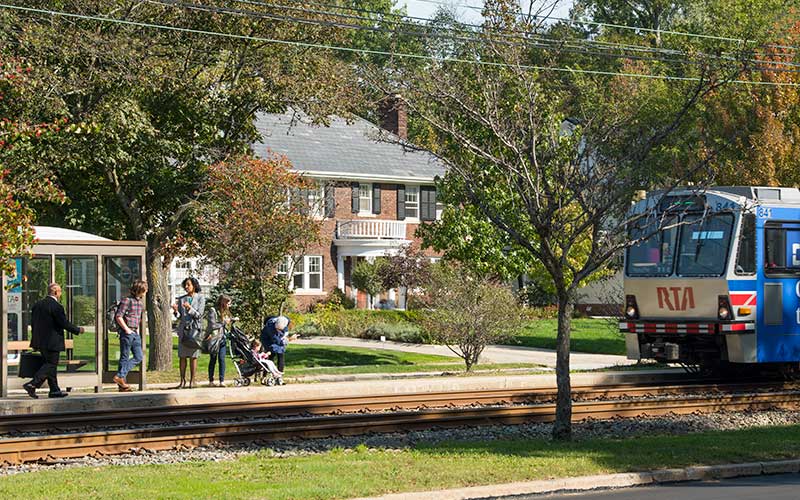
Public transportation has been at the heart of Shaker Heights from its earliest days.
“When the Van Sweringens developed the city, the street plan was woven in with rapid transit,” explains Joyce Braverman, the City’s planning director. “The neighborhood stops on the Rapid are positioned to maximize how many residents could get to those stops. No house in Shaker is more than quarter mile from a Rapid stop.”
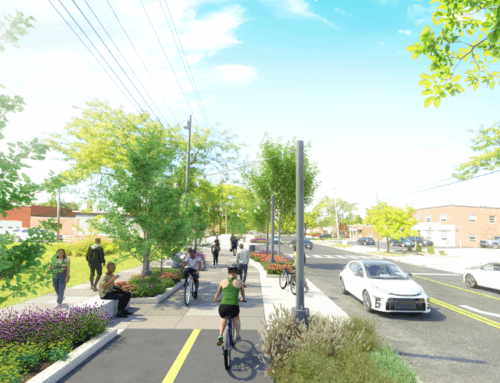
Jump ahead 100-plus years and public transportation is still at the core of the City’s development efforts. Today, there’s a name for this approach. It’s called Transit Oriented Development, or TOD, and its goal is to create vibrant neighborhoods with a mix of uses — residential, retail, entertainment, office — that are also pedestrian and bicycle-friendly and, importantly, in close proximity to public transportation. In short, neighborhoods that draw people in to live, work, or just hang out.
“The idea is you’re creating, in a relatively small place, a very vibrant, dense neighborhood that is full of everything you would need, including public transit,” explains Braverman.
If this sounds familiar, it’s because the Van Aken District is a prime example of TOD. Phase 1, developed by RMS and completed in 2019 after more than 20 years of thoughtful planning and infrastructure improvements by the City, includes retail, residential, and office with access to public transit. Phase 2, now under construction, includes a new 228-unit apartment building — also developed by RMS — on Farnsleigh Road. On its heels will be Arcadia, a mixed-use development planned for the southeast corner of the intersection of Farnsleigh and Warrensville Center roads. Arcadia will feature 140 residential units, including townhomes and a mix of market- and affordable-rate apartments. Columbus-based developer Metropolitan Holdings plans to start construction in 2024.
When the Van Sweringens developed the city, the street plan was woven in with rapid transit.
This kind of density is key to the success of TOD projects like the Van Aken District, says Braverman. “This density creates a real sense of place.” she notes. Residents emerge from their apartments and feel enclosed by the buildings. You’re in a vibrant neighborhood.”
Adds City Councilmember Sean Malone: “These kinds of neighborhoods are interesting and enjoyable and also safer when residents and visitors are out on the sidewalks, biking and strolling to desirable, convenient destinations. This is even more important as people work from home.”
Further investments in the public transit areas of the District are now also underway. The City has been working with the Greater Cleveland Regional Transit Authority to upgrade the District’s Rapid station and busway. In the same area, the City will construct a new public plaza with public art thanks to a $1.5 million grant from the Northeast Ohio Areawide Coordinating Agency (NOACA). With another $1.5 million grant, also from NOACA, the City will install a new bikeway on Van Aken Boulevard to connect the District to Lee Road, which will also get a bikeway as part of the Lee Road Action Plan, and to the multi-purpose paths on Warrensville and Farnsleigh.
The Van Aken District is the city’s first truly mixed-use, transit-oriented neighborhood — the zoning code was amended in 1995 to allow for mixed use. Many of the same TOD principals will be used in redeveloping Lee Road.
“The Lee Road Plan offers a unique opportunity to create a new Shaker destination,” notes Malone. “We can improve connections to Chelton Park and adjoining neighborhoods, including in Cleveland, increase our supply of modern office space along Lee Road, and attract new housing, restaurants, and retail to the Chagrin/Lee District. Just like the Van Aken District, we hope to see people biking or strolling to these new gathering spots to meet up with friends and neighbors.”
What About All the Cars?
With two new residential developments in the works for the Van Aken District, some residents have expressed concern
that there will be a lot more traffic — too much traffic — and not enough parking. Not so, says Joyce Braverman, the City’s longtime planning director.
“For any new residential development, the zoning code requires a traffic study,” she says. “The studies for this area show that if you live in the Van Aken District, you might see five percent more traffic from these new developments.”
Traffic studies allow traffic engineers to understand how projects like Arcadia and the Farnsleigh Road apartments will impact traffic in the surrounding neighborhood and more broadly. These studies are routine in communities across the country and use proven methodologies.
In the 1990s, an average of 65,000 cars came through the Warrensville-Chagrin intersection. Today, it’s closer to 45,000.
“Typically, they start with traffic counts,” says Braverman. “They see how much traffic there is at different times of day, but also where the traffic is going in the area.”
This data is imported into sophisticated models, which enables engineers to forecast local and regional impacts of new developments including detailed analyses of traffic patterns.
“So we know that for the new apartment building on Farnsleigh, for example, about 17 percent of the added traffic will go west on Chagrin, 22 percent will go west on Farnsleigh, 24 percent will go north on Warrensville. So we’re not going to see all this traffic that some residents are concerned they’re going to see all at once.”
Braverman also notes that the number of cars in the District overall has steadily declined for the last 30 years. In the 1990s, an average of 65,000 cars came through the Warrensville-Chagrin intersection. Today, it’s closer to 45,000. Both developments will also include additional parking. Arcadia’s plans call for a parking garage in the center of the development with 140 spaces, plus a surface lot at the side of the building. The Farnsleigh apartments will include a parking garage at the side of the building with 260 spaces.