Among its gravestones and plots, Shaker’s Warrensville West Cemetery holds the early history of the City. Now it’s getting much needed care to restore that visual history and return the space to its original meadowland.
By Joe Miller
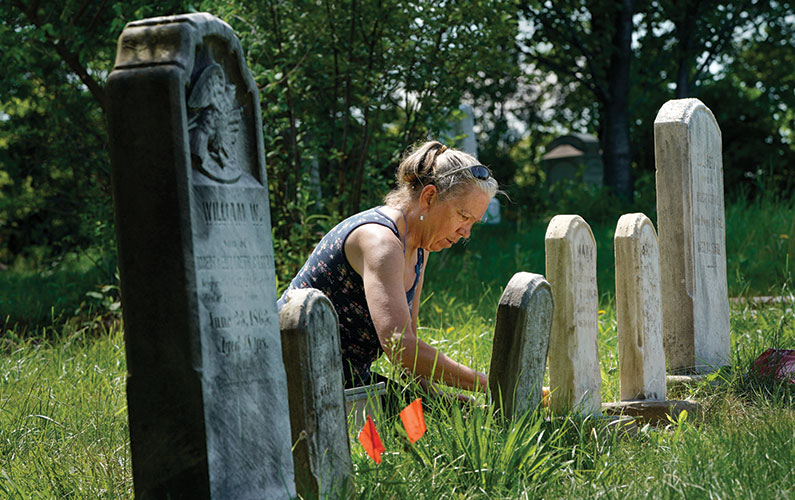
Massachusetts-based cemetery restoration expert TaMara Conde at work restoring gravestones in Warrensville West Cemetery. Photos by HGus Chan.
An ambitious plan to revitalize Shaker Heights’ only graveyard – the 213-year-old Warrensville West Cemetery on Lee Road – is putting TaMara Conde on a first-name basis with some of the area’s earliest residents.
Over the summer, the Massachusetts-based cemetery restoration expert meticulously pieced together and reset some 57 neglected gravestones at the one-acre burial ground. For each of the deceased, Conde goes about her mostly solitary work as if she were taking care of an old friend, often referring to a gravestone by the person’s first name.
“They say you die three times – when your heart stops, when they put you in the ground, and when somebody says your name out loud for the last time,” Conde explains in front of the granite memorial for Moses Warren Jr., who settled here in 1815 and died in 1888.
“I don’t know how many relatives are coming back to find him. So if you say ‘Moses,’ you keep him alive,” she says.
Few visit the little cemetery wedged in between the Kingsbury Building and Heinen’s and hidden from view by overgrown hedges and stone retaining walls. But that could change soon under a master plan adopted by the City in 2022 that seeks to restore this important historical site and bring it back into public view. The plan was developed in partnership with the Shaker Historical Society and Shaker Heights Public Library.
A cemetery is such a unique project. It’s landscape. It’s sculpture. It’s architecture. It’s history.
So far, Shaker Heights has committed about $35,000 to the project with another $37,000 coming from two federal grants awarded by Ohio’s State Historic Preservation Office. This has paid for Conde’s work plus a Historic Preservation Master Plan that included a complete assessment of the property and an inventory of 170 gravestones by Mannik & Smith Group Inc. (MSG), a landscape architecture firm. The City’s Public Works Department has also been working to remove non-native plants from the cemetery and turn the space into a low-maintenance wild flower meadow with mowed pathways.
Future goals include increasing the graveyard’s visibility from the street – ornamental fencing with formal entrances will replace the hedges – and finding visitor-friendly ways to tell the stories of the more than 200 people buried here. Kara Hamley O’Donnell, principal planner in the Shaker Heights Planning Department, says the City concluded that investment and focus was needed for some of these earliest inhabitants of the community.
“A cemetery is such a unique project,” says Hamley O’Donnell, who was the City’s project manager for the restoration plan. “It’s a landscape. It’s sculpture. It’s architecture. It’s history. All of that together. It really is a very special historic location.”
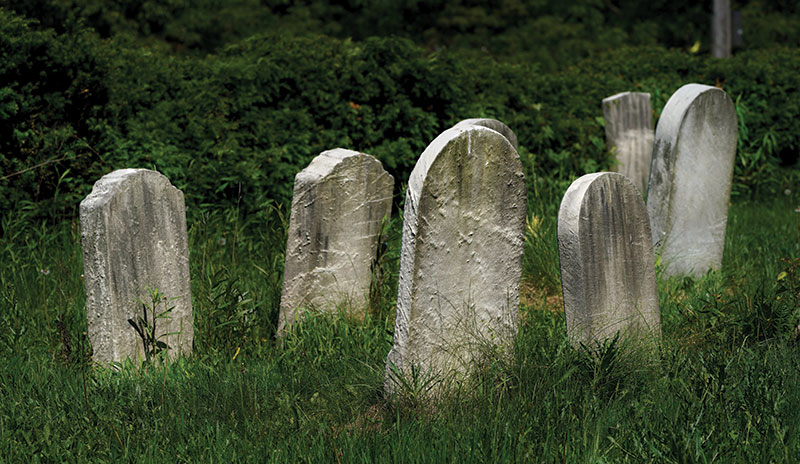
Walking through History
A stroll through the Warrensville West Cemetery – Cuyahoga County’s oldest extant burial ground – is a two-century voyage back in time. At one end are the graves of members of the Warren family, the area’s first permanent white settlers and the namesakes for what was originally called Warrensville Township. At another end is a mass burial site and marker for members of the North Union Shaker community, a religious group who lived here until 1889 and for which Shaker Heights is named.
Also buried here are veterans of five U.S. wars, including several from the Revolutionary War (see side story about Veterans Day tour), and a large group of Manx immigrants who started arriving from the Isle of Man in the 1820s. The cemetery’s last burial was in 1955.
“That’s one of the things that’s so interesting about this cemetery,” says Brianna Treleven, executive director of the Shaker Historical Society. “It has such a unique mix you would expect to find at a larger cemetery, not at this tiny one tucked in next to a grocery store.”
Conde, who has 26 years’ experience working in some of New England’s oldest cemeteries, sees the history of Shaker Heights in the stones themselves. As she walks through the graveyard, she points out some of the original hand-carved sandstone and limestone markers that came from local quarries. Later gravestones, made from more durable marble and granite, arrived by boat or rail from as far away as Georgia, she says.
Delicate Work
On this summer day, Conde works to uncover the marble gravestone of Frances Radcliff, who died in 1884. The stone lies flat and partially buried in dirt and grass. She pierces the ground around “Frances” with a stiff wire to see what’s there without causing damage to the stone, and then clears away dirt with a small shovel.
Eventually she will raise the heavy stone with a tripod crane that she’s dubbed “Tiny Tim” and is capable of lifting up to a ton. If the headstone is a match for the nearest base, she’ll use a special lime mortar to reattach it. On her next trip back to Shaker, she plans on bringing her two-ton tripod crane, “Big Bertha,” to take on some of the larger monuments that are in danger of toppling over.
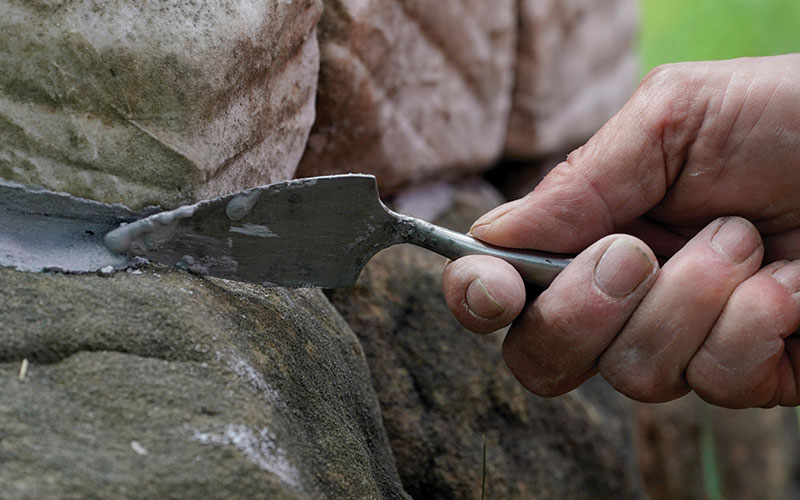
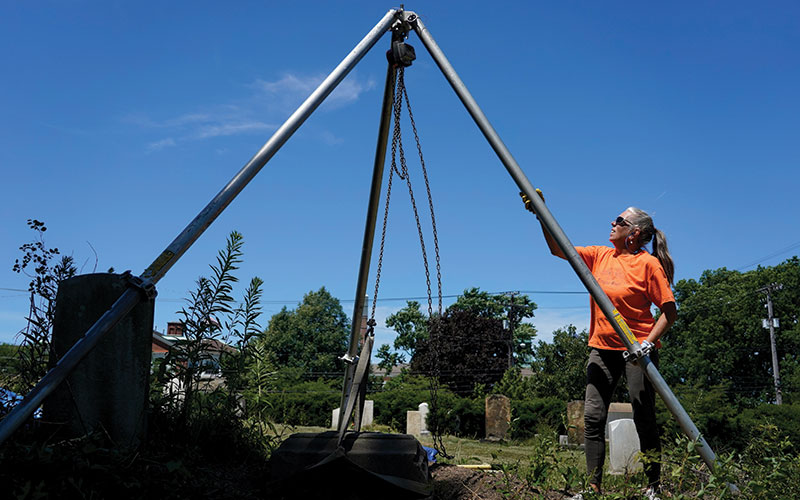
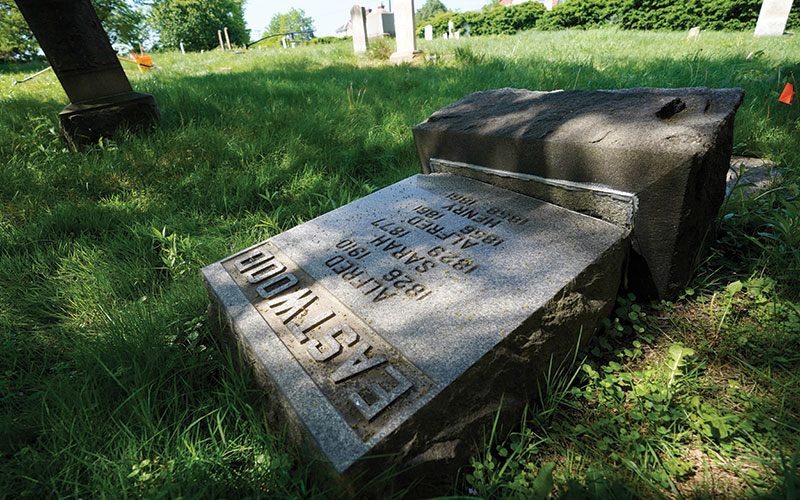
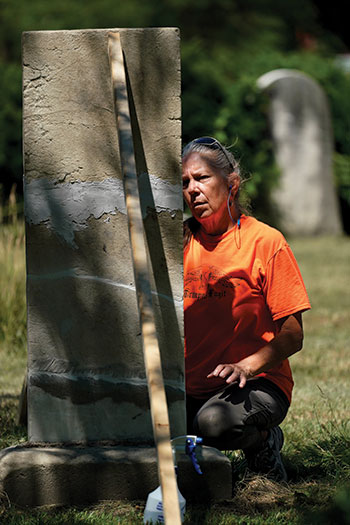
Conde tackles what she can. Some repairs are made more difficult if not impossible because of restoration work done years ago by amateurs.
“You find all kinds of repairs. Here it’s bathroom caulk. Or somebody came through and put in concrete which is the kiss of death,” Conde says. Gravestones are “living things” and an improper repair can eventually cause more damage than good, she says.
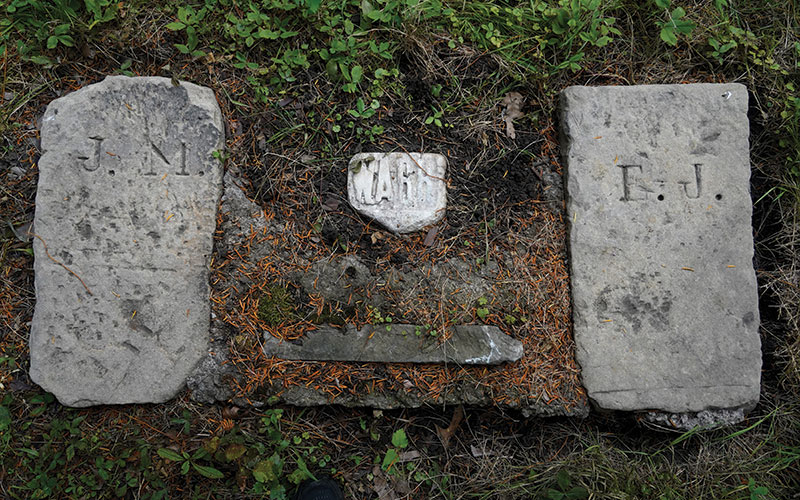
Much of the cemetery is a puzzle begging to be solved, with some gravestones laying in pieces on the ground and others wiped clean of their lettering by time. Some markers are out of reach under the border hedges. Others are just gone. In fact, using ground penetrating radar, MSG determined that a large grassy section that appeared to be empty actually has a number of possible burial sites but no markers.
And sometimes a piece shows up in the wrong place. Conde displays a tiny part of a headstone that was found partially buried near the Shaker mass grave. Featuring only the letters “WARR,” it is likely for a member of the Warren family in a different part of the cemetery, but she can’t find where.
“I have no idea where it goes,” she admits. For now, she will put it back where she found it, most likely treating the lost stone as carefully as she treated the larger gravestones of Moses and Frances.
“People ask me if I’m afraid of ghosts. And I’m like ‘no, all of these people are taking care of me,’” she says. “I feel like they appreciate me being here.”
Originally published in Shaker Life, Fall 2024.