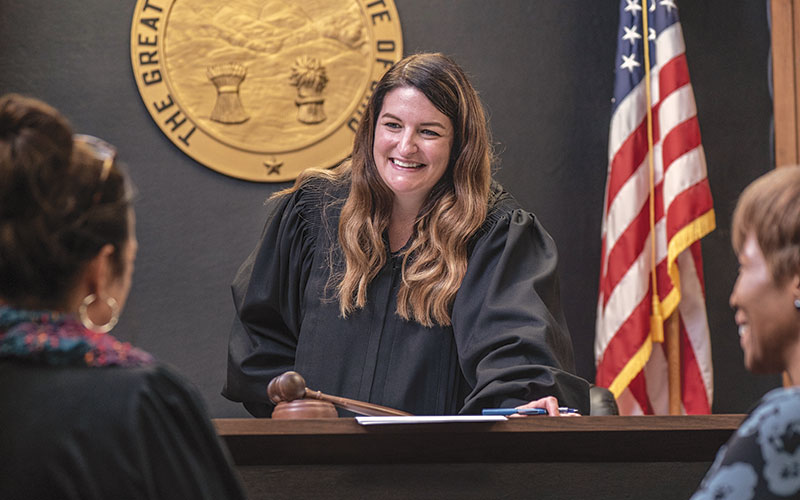
Shaker Heights Municipal Court Judge Anne Walton Keller works tirelessly to create the most fair and efficient court possible.
Interview by Sharon Holbrook

Photography by Rob Muller
Tell us a little bit about the court and the types of cases it handles.
The Shaker Heights jurisdiction is actually five municipalities, so the court handles cases from Shaker, Beachwood, University Heights, Hunting Valley, and Pepper Pike. And we’re a pretty busy court. I am the only judge, but I have magistrates who assist me with some of the cases.
We hear criminal cases, misdemeanors, traffic cases, eviction cases, housing cases, small claims, and civil cases with a jurisdictional limit of up to $15,000. So quite a few types of cases are addressed in municipal court.
Why does Shaker Heights Municipal Court include these other municipalities?
Municipal courts are creatures of statute; the state legislature set up this court for this specific jurisdiction. In this court jurisdiction, there are over 60,000 people.
Explain the difference between a judge and a magistrate.
A judge is elected to the position, and a magistrate is a lawyer appointed by the judge to hear cases. Prior to being elected, I was a magistrate and then an acting judge in this court for five years. An acting judge is a judge who fills in when the elected judge is otherwise unavailable.
I have one full-time magistrate, and there are two other magistrates who come in one afternoon per week for a couple hours to assist with traffic dockets. I hear 100 percent of the criminal cases that come through the court as part of my regular docket, in addition to the other cases that I hear.
You were elected in 2021. Tell us about your path to becoming a magistrate and then to getting elected judge.
I started working in private practice at a criminal defense firm. I represented people who were charged with crimes in state and federal court. I was very interested in litigation, criminal law in particular. When the opportunity to become a magistrate opened up in this court in 2016, I applied for the position. I met with Judge K.J. Montgomery, whom I had known from practicing in front of her as a lawyer, and was hired for that position.
Over time, she began to rely on me when she was unavailable, so I was appointed an acting judge, which gave me a lot of good experience. I then ran for judge last year when Judge Montgomery retired and have really been enjoying the work that I’ve been doing ever since.
When you ran for judge, you talked about some initiatives you’d like to put into place.
One of my initiatives was to make sure that we have more people represented by lawyers. So, I have a court-appointed public defender in court during criminal proceedings. That means that a lawyer is available the first time someone comes to court. People generally don’t understand what’s going on in court. In many cases, they’ve never been in court before. They’re scared.
People just want to get their case over with. It’s very difficult for people to address court proceedings while also having employment and childcare issues. I’m trying to make everything more convenient in a way that also protects people’s rights. When I have a lawyer here the first day of court, the defendant can meet him or her in person. A lot of the proceedings after the first day might be virtual, but the defendants have had that in-person meeting. Instead of coming in and just entering a plea to the charge, they’ve had representation.
If the person qualifies for court- appointed counsel, then there is no cost to them. Many people who appear in my court qualify for a court-appointed lawyer.
Another thing you wanted was to create a dedicated domestic violence docket. What was the reason behind that, and how has it been working?
Domestic violence is one of the most serious issues that I handle as a municipal court judge.
I started that special docket in February 2022. I had been on the bench for years, but I began to see a huge increase in domestic violence, part of a national trend. And the pandemic just made things worse. Not just intimate partner violence, but violence in families. I am a member of the Cuyahoga County Domestic Violence Task Force, so I’d been receiving education and training related to domestic violence, and I wanted to bring any resources I could to these cases.
Separating these cases on a special docket allows for a lot more resources to be brought. There’s a probation officer present as well as a victim’s advocate, and the accused and their lawyer. A prosecutor can be there if needed. And I’ve continued to reach out to additional resources through the contacts that I’ve made to make sure that we have as many resources available as possible to assist people.
Another initiative you talked about was having a fully functioning online docket. Were you finding that there were issues with that the way it was set up?
Domestic violence is one of the most serious issues that I handle as a municipal court judge.
Yes. So our website is undergoing a renovation. It was very difficult to read the docket. This summer I received a grant from the Ohio Supreme Court for a technology update, so that grant is paying for the renovation. It’s user friendly and also mobile phone accessible. It’s an easy way to view what’s going on in your case. We have never had images before, but it has every publicly available document so that someone meeting with their lawyer can review the case file. It’s all about providing more information to the public about their cases.
Have you seen any change in your cases since the Shaker police added their Mental Health Response Team program for calls that require help other than from police officers?
It is groundbreaking. One of the issues that we have in municipal court is when people who are dealing with mental illness get caught up in the criminal justice system. That is not where they need to be. And if this program is able to help the police with addressing those issues before the case is ever in the court, that’ll be really helpful.
One of the areas I’m very interested in is assisting with cases involving mental health when they do come to the court. I’ve been working with the county’s Alcohol, Drug Addiction and Mental Health Services board and other agencies to make sure that I have the resources available to help those people.
Shaker is absolutely doing important work by starting this program. I think that I’m going to see the impact of it more and more each year.
Let’s talk about your initiatives with respect to evictions. You had mentioned establishing a mediation docket.
We came up with new forms, which are intended to help resolve more cases by way of settlement instead of trial. In most of the cases that come before the court, it’s an issue of whether rent has been paid. So there is the option to mediate, and there’s also the option for the parties to use the forms to work out a resolution. It’s been very successful for the cases where we’ve set up payment plans. I think only one has defaulted, and we’ve done many of them.
You’ve said that the court was making some efforts towards bail reform that you wanted to continue.
This court is in line with bail reform. In a domestic violence case, there’s an actual bond hearing. But in a nonviolent misdemeanor case, a person will be cited, receive a copy of their charge, and then be released with the date that they’re told to come to court. That’s what’s known as a personal bond. Bond is not supposed to be a mechanism for people who don’t have money to be kept in jail. It is meant to ensure someone’s appearance in court.
The court has 12,000 to 14,000 cases a year. Doing some quick math, that’s about 50 cases a weekday. Does that sound right to you?
A lot of those cases are traffic cases where you might get a ticket and pay it before you come to court. So those don’t take up the court’s time. The magistrates assist with traffic dockets. I also have a special docket for driving under suspension cases, and the magistrate who hears those cases will spend time with people to help them come back to court with a valid driver’s license.
You still have thousands of cases even after accounting for traffic tickets and traffic appearances. What’s a typical day or week at work like for you?
The first three days of the week are the regular criminal dockets, and I’m in court from before nine until the docket is done for the day. Thursdays and Fridays are reserved for jury trials, hearings, and bench trials. I also address anybody who’s been arrested and is in jail on a felony or a violent misdemeanor where a bond is needed. So I’m definitely in court a large part of every day.
What would you like people to know about the court that they might not know?
One of the things I’m trying to focus on is procedural fairness. I can have an impact in terms of how people feel the system treated them. How I engage with the public, how long people wait in court – those things are important in terms of how they interpret their interaction with the justice system.
I’ve been partnering with a group called Court Community Service to allow people to sign up for community service as an alternative punishment in some cases. It’s been a successful partnership. I’m trying to increase our connection with the Cleveland Municipal Court dockets. There’s a specialized military veterans docket there. There’s also a mental health court and drug court. The drug court has a whole team of people to address substance use issues.
We’ve applied for a grant to pay for a pretrial services officer – that would help expand our probation department. Probation is generally after the case is over, but while the case is pending some people could immediately benefit from some help from a probation department representative. I have a lot of cases where people are struggling with housing issues, and a lot of times I make those phone calls to try and locate shelters or housing options. I would like the court to be able to provide more assistance with that.
Anything else on your wish list?
Oh, my wish list would be long. But my real wish is to make sure that the court is as fair and efficient as possible, and I think that I will forever be trying to implement new changes in order to make sure that happens.