Everyone has a story. These foster neighborhood pride and connection.
Stories by Sharon Holbrook
Photographs by Jason Miller
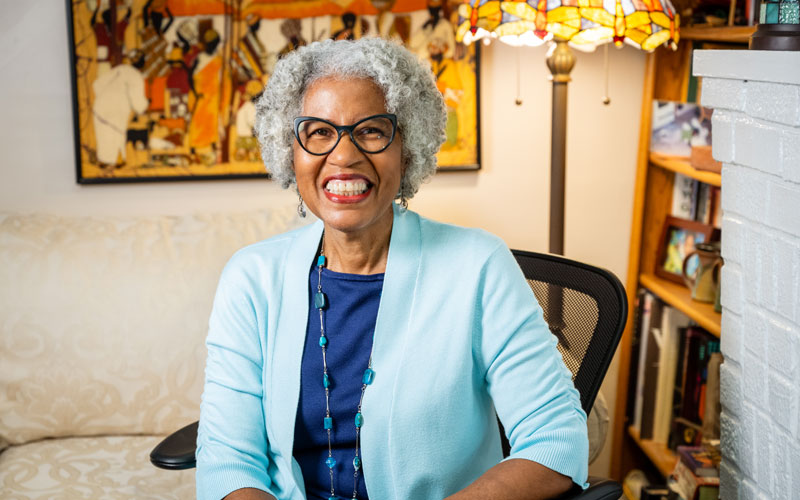
Donna Whyte
The Moreland neighborhood has a long history of community connection and activities – everything from putting on a community production of the play “Our Town” to hosting movie nights and clean-ups.
In the isolating, confusing early months of the COVID-19 pandemic, two people were dreaming up a new way for folks in Moreland to connect with each other. The idea: Interview senior residents of the neighborhood about their life experiences, and broadcast the interviews live on Zoom and then post them on YouTube. Now known as Witness to History, this would be the latest (and, importantly, a pandemic-friendly) way to build on that neighborhood pride and connection.
The show is the brainstorm of Donna Whyte, a longtime Moreland resident and history professor at Cleveland State University, and resident Kevin Kay, a community relations specialist who works under contract with the City.
Says Donna: “We were having a conversation one day on the telephone and Kevin said, ‘Wouldn’t it be nice to capture the stories of our seniors in the Moreland community? Because they have witnessed history to such an extent.’ And I said, ‘That’s it, there it is: witness to history.’ And that’s how it all came about.”
Donna was a natural choice to host the new show, which she thought might last just a few months. It’s been going for well over a year. Rounding out the Witness to History team is John Dutton, a Moreland resident who designed the logo, receives and queues up the personal photos that accompany the stories, manages the Zoom, and updates the Witness to History YouTube playlist.
“We were having a conversation one day on the telephone and Kevin said, ‘Wouldn’t it be nice to capture the stories of our seniors in the Moreland community? Because they have witnessed history to such an extent.’”
Then there is Meghan Hays, the local history librarian at Shaker Heights Public Library, who took the initiative to include the recordings in the Library’s archives and website.
It’s clear from watching the Witness to History interviews that Donna is having a good time. “Oh, my goodness, yes,” says Donna. ”I grew up in a household where my parents told stories from my birth. They were wonderful storytellers. Everybody is – absolutely everybody. When people talk about their lives, they’re telling their story.”
Donna says people often protest that they haven’t done anything major in their lives, but she is adamant that it doesn’t matter. Everyone has a story to tell.
That, of course, includes Donna herself. Growing up in the nearby Mt. Pleasant neighborhood of Cleveland, she was familiar with Shaker Heights, but she never thought she’d live here. It was a place her father would take the family for a drive to look at the beautiful houses, but she assumed, without thinking much about it, that it wouldn’t be a welcoming place for her.
Many years later, while shopping at Heinen’s in Shaker, Donna, by then a mother of two elementary-age daughters, ran into a Cleveland friend and neighbor, Iris Anderson. She and Iris had attended elementary, junior high, and high school together, but hadn’t seen one another since graduation. No matter. When Donna heard that Iris, also a mom, lived in Shaker Heights and was happy with the schools, she knew that it could be a place for her family too.
Shortly after this chance meeting, Donna moved to Shaker Heights. After renting for a time, she bought a house in 1990. That house is on Chelton Road, next door to none other than Iris Anderson. More than 30 years later, the friends are still next-door neighbors.
That’s the kind of story that Witness to History brings out, although Donna herself hasn’t yet been interviewed for the program. She brushes off the idea, reiterating how much she loves to be in her seat as host, how she loves talking to neighbors and eliciting their stories.
“The beauty of Witness to History, the beauty of neighborhood networking, happens because we’re communicating with each other,” says Donna. “We’re community, and we’re neighbors, and it’s just absolutely wonderful.”
To view the YouTube playlist for Witness to History: bit.ly/shakerwitnesstohistory
A Can-do Spirit

Branda and Larry Ford
Moreland resident Brenda Ford makes things work. For many years, she worked second shift at the Cleveland Clinic, which meant she left for work just before her kids arrived home from school. Fortunately, husband Larry was home for the evening after his day as a postal carrier, but how does a mom get to see her kids with a tricky schedule like hers?
Brenda figured it out: She showed up at school during the day, again and again. She worked as a lunch aide at all four of the Ford kids’ schools (all attended Shaker schools), even when her kids might rather have pretended parents don’t exist. Anytime there was a chance to be involved with her kids’ school lives – PTO, choir, Ropes of Thunder jump rope, drama – Brenda made sure she was there whenever she could be. Larry teases, though, that Brenda was banned from watching their late-blooming son play football. He was small, and the other kids were big. A mother might cry out at a game for all to hear, “Don’t hurt my baby!”
Brenda and Larry’s story starts long before middle school football games. They both graduated from Glenville High School, but were a few years apart – Larry was older – and did not know one another. It was the 1960s, and the Vietnam War was underway. Brenda, quick to take action as always, volunteered to write to soldiers she didn’t know, some of whom got no mail. She’d send chatty letters, comics clipped from the newspaper, and sometimes even records of the latest hit songs. Brenda’s uncle knew Larry, who was in the Marines, and she wrote to him too.
Anytime there was a chance to be involved with her kids’ school lives – PTO, choir, Ropes of Thunder jump rope, drama – Brenda made sure she was there whenever she could be.
By the time Larry came home, they were friends. Larry took her to her senior prom. To his surprise, Brenda’s cousin congratulated him. “For what?” Brenda’s cousin had heard that Larry was marrying Brenda. Where had he heard that? Well, from Brenda. So imagine Larry’s surprise when he proposed, and she said no. A few more tries later, Brenda did say yes, and they were married later that year.
That was 1970. Before becoming engaged, Brenda had planned to go to Kent State University. She believes that her family said yes to her marriage in part because Kent State made them nervous for Brenda’s safety after the tragic events of May 4, 1970.
In 1980, Brenda and Larry moved to their Chelton Road home, where they have lived ever since. Like so many Shaker families, they came in search of good schools.
Always ready to pitch in, Larry has served as president of the Moreland on the Move Community Association, and he was also the longtime hot-dog griller at the annual Chelton Park picnic. Brenda, too, always stayed involved, especially when the neighbors got together and worked to re-do Chelton Park for younger children in the early 2000s in collaboration with the City.
The Fords are retired now and busy with their 11 grandchildren. For them, Witness to History was another enjoyable way to connect with neighbors, just as they have always done. “I was glad I was able to tell my story,” says Brenda.
For the full Witness to History interview with Larry and Brenda Ford: bit.ly/larryandbrendaford
A Passion for Education
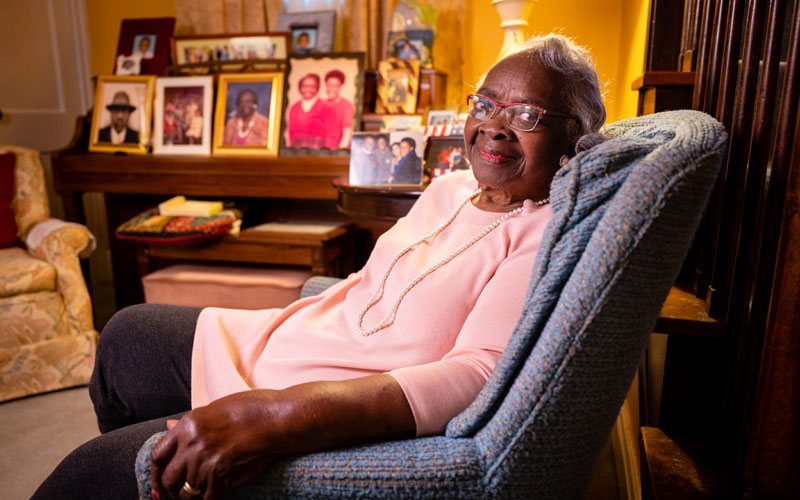
Earline Hooper
It was always about schools.
Twice in her life, 92-year-old Earline Hooper moved houses in search of better education. In 1946, when she was a teenager, it was a move from Birmingham, Alabama to Cleveland. Her grandfather had been unhappy with the caliber of the education in Birmingham schools, which were still segregated, and the family followed him to Cleveland. After catching up with the curriculum – as suspected, her Birmingham school had been behind – Earline graduated from Glenville High School in 1948.
Mrs. Hooper’s dedication to education began before she even left Birmingham. Even then, she wanted to be a teacher.
Almost two decades later, Earline moved again in search of good schools. This time, it was to Shaker Heights because she’d heard about the high quality of the schools. By then, Earline had become Mrs. Hooper, and she and her late husband had two children, Sam and Paula. Daughter Emily would arrive soon after, and all three children attended Shaker schools.
For over 50 years now, long after her youngest graduated, Mrs. Hooper has lived in that first Shaker Heights home on Pennington Road in the Moreland neighborhood. Mrs. Hooper’s dedication to education began before she even left Birmingham. Even then, she wanted to be a teacher. The teacher at her one-room schoolhouse, Anna May Owens, encouraged her and even drove her the long distance to school every day.
Because she didn’t have enough money for college when she graduated from Glenville High School, Earline worked for a year before enrolling at Ohio State, earning a degree in elementary education. She taught in Cleveland schools for 33 years.
But she wasn’t done yet. Mrs. Hooper is modest about her accomplishments, but Witness to History interviewer Donna Whyte made sure to address them. Mrs. Hooper has a longstanding passion for parent involvement in schools, and strongly believes in cultivating parent-teacher relationships. She has served as president of the Education Committee of the Moreland on the Move Community Association, and was also instrumental in creating a mentoring program for neighborhood students. For her service and dedication to education, Mrs. Hooper won the City’s Dr. Martin Luther King, Jr. Award for Human Relations in 2005.
Mrs. Hooper continues to stay engaged in Shaker Heights, the Moreland neighborhood, and opportunities for children.
“This neighborhood means a lot to us, and it means a lot to our children,” she reflects. “We still have children coming along, and it’s important to encourage them. Give them a little pat on the back and tell them when they’re doing right and not just when they’re doing wrong.”
For the full Witness to History interview with Earline Hooper: bit.ly/earlinehooper
Embracing a Higher Faith

Pat and George Eaton
There’s a handsome new flower bed in Hildana Park on Chagrin Boulevard.
Built in the shape of a 9-point star, it was designed and created by George Eaton in collaboration with his Baha’i faith community.
At the heart of Baha’i is the unity of all people and religions, and the explicit rejection of racism and nationalism. George’s involvement is a fitting representation of a lifetime spent in reconciliation of ideas and experiences.
George is an architect and a builder, but he’s had such a wide variety of jobs and life experiences that you could fairly call him a Renaissance man too.
He spent his earliest years in Birmingham, Alabama, before moving to Cleveland as a toddler. In the summers, George would visit family and friends in Birmingham, including his father’s best friend’s family. The families were so close that George thought Uncle Stumpy’s daughter, Carole, was his biological cousin. During those years, George struggled to understand race, especially as he saw it play out on his visits to the South.
One of his earliest memories of Cleveland is of being asked, “Are you white, or are you colored?” George was only a little boy when a Glenville neighbor asked him this question, but he remembers it very clearly as he tells Donna Whyte the story many decades later in his Witness to History interview.
“I was just learning my colors – purple, red, orange, green – and I knew I wasn’t any of those, so I figured I must be white.”
George is an architect and a builder, but he’s had such a wide variety of jobs and life experiences that you could fairly call him a Renaissance man too.
When his young friend Carole was murdered along with three other Black girls in the 1963 KKK bombing of the 16th Street Baptist Church in Birmingham, George was again forced to reckon with race – painfully.
By the time he graduated from Glenville High School in 1966, he wasn’t sure that he wanted to follow his family’s long legacy of college attendance. But after acquiring a draft deferment, he decided to attend Knoxville College in Tennessee. There, he struggled to reconcile the Presbyterian faith of the college with the Black Power movement of the 1960s, whose leaders often sought to discredit religious faith as a means of keeping people passive. Could religion co-exist with opposition to racism?
George wasn’t sure. He decided to leave school. Around this time, George met his first wife. He returned to school, this time at the University of Tennessee, where he studied architecture. He was also working as a draftsman for the Tennessee Valley Authority, and he and his wife had a daughter.
But difficulties emerged, first with his health. The eye ailment keratoconus forced him to again leave school, quit his job, and eventually, he became legally blind.
With the help of the American Society for the Blind, in time George was fitted with contact lenses that enabled him to see again, and he returned to architecture.
But when he went for job interviews he was told that the position was suddenly not available. At the same time, his marriage fell apart. Eventually, George was able to get some low-paying work in architecture in the evenings while he held a day job at a civil engineering and surveying firm.
George returned to Ohio and married Pat, whom he had known long ago in Glenville, and they had a son. He leaned into practical architecture in the inner city, and one of his designs was selected by Habitat for Humanity.
Today he’s mostly retired from everything besides community work. That’s where Hildana Park comes in. In reflecting on his life, George tells Witness to History interviewer Donna Whyte that he sees a recurring theme of reconciliation in his own story. Design, building, and service to community. Religious faith, unity, and social justice – George has managed to reconcile them in the star-shaped flower bed in Hildana Park.
For the full Witness to History interview with George Eaton: bit.ly/georgeeaton