A Q&A with Crystal Montgomery, Historic Preservation Specialist
By Jennifer Proe
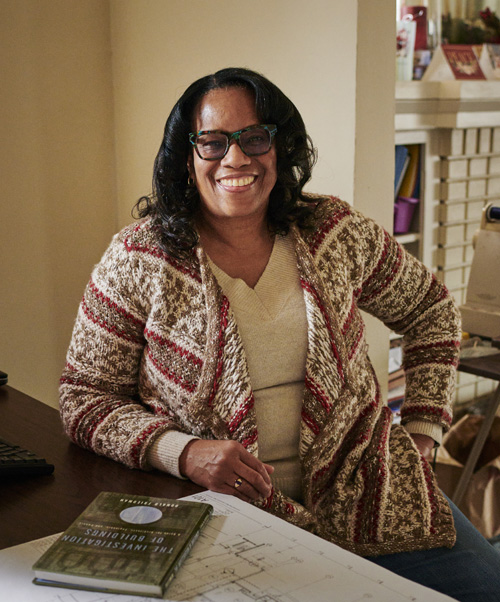
Growing up in the Moreland neighborhood, Crystal Montgomery was surrounded by some of the oldest homes in town. Most date back to the early 1920s, have front porches not typically found in other Shaker neighborhoods, and feature distinctive styles of simple leaded glass windows – details that did not escape her notice.
Perhaps it’s not surprising, then, that the young girl who enjoyed art class throughout her years at Moreland Elementary, Woodbury Junior High, and Shaker Heights High School grew up to become a historic preservationist. She earned her degree in architecture at the University of Cincinnati, with a certificate in Historic Preservation, and renovated her Tudor home there. She eventually relocated back to Shaker, where she lives in the Craftsman home her parents purchased when she was in first grade, which is – you guessed it – under renovation.
Montgomery now applies her talents as a cultural resource management consultant and historic preservation consultant with Northrup Grumman at NASA Glenn Research Center. She also serves as an executive board member and trustee with the Cleveland Restoration Society, is a member of the American Institute of Architects Historic Resources Committee, and sits on the City of Shaker Heights
Landmarks Commission.
She is also a member of several historic preservation organizations such as Heritage Ohio, the National Trust for Historic Preservation, and The Association for Preservation Technology. When it comes to matters of renovation and preservation, both commercial and residential, she feels right at home in Shaker Heights.
Talk a little more about the architecture of the Moreland neighborhood. What makes it distinctive?
The old houses in South Moreland, south of Chagrin Boulevard, are typically two-and-a-half stories or one-and-a-half stories, with architectural styles such as Arts and Craft, Cape Cod, Bungalow, Tudor Revival, and more. There is actually an architectural style known as the Cleveland Double, because it’s ubiquitous in Cleveland. It’s a two-family home, with one unit up and one down, with a front porch and a gable roof.
There is a well-kept row of them on Chelton Road. The older homes in Moreland were built before World War II when the average family could employ daily domestic help. The houses were designed so that the help could perform their duties without overlapping with the family and had separate entrances to come and go from the home. My house also has some unique features, like a built-in icebox, as well as the milk chute and laundry chute that are more commonly found in Shaker homes.
You now work as a consultant for NASA Glenn as a historic preservationist. What does that involve?
Initially, I landed a temporary position working with Civil Engineers and Surveyors at Glenn. Then I transitioned to a permanent position as support for Cultural Resource Management. CRM administers protection for assets above ground, such as the historic preservation of buildings, and assets below ground, which can include relics from Native American cultures. As an agency of the federal government, Glenn must administer CRM in consultation with the State Historic Preservation Office.
Essentially, I help them to be good stewards of their assets and abide by the National Historic Preservation Act. In 2016, we received designation as an Ohio historic district. That designation means that we need to protect the architectural style of the campus, which was built in the 1940s and is most closely related to the International Style – flat roofs, unornamented planes, lack of details, and ribbon windows.
You’re also a board member at Cleveland Restoration Society. What is their mission?
The Cleveland Restoration Society’s mission is to use the powerful tool of historic preservation to revitalize our diverse communities, strengthen the regional economy, and enhance the quality of life in northeastern Ohio. I use my knowledge to help facilitate and make decisions on how best to rehabilitate Cleveland’s historic building stock.
They have a fantastic program that more Shaker homeowners should utilize, the Heritage Home Program, which helps homeowners complete repairs while preserving the historic features of their home. It is a low interest loan program that offers technical assistance and expertise to help homeowners through the process of getting their house in good condition.
Rehabilitating an old Shaker home can involve some sticker shock, and it can be hard for the average homeowner to get the right balance of quality vs. cost when assessing what’s needed. You can find plenty of success stories on their website: clevelandrestoration.org. Look for the Homeowners tab.
Sustainability has become a buzzword in building and renovation. How does that overlap with historic preservation?
Historic preservation and sustainability are synonymous. They both involve protection of what is existing and offer methods for keeping buildings, waterways, and air clean for human usage. Sustainability largely focuses on environmental and energy issues, like using less fossil fuel by purchasing more efficient heating and cooling equipment.
Historic preservation focuses on conservation of the material used to construct our old building stock so they will last for generations to come. The goal is to keep the character-defining features intact whenever possible. Windows are a good example; you should try to fix first, before replacing. It’s important to make informed decisions, because typically it costs less to repair than replace.
Shaker is nationally known for the charm of its housing stock and curb appeal. As a historic preservationist, what do you appreciate most about our homes? Do you have a favorite architectural style?
I am amazed at how stylish Shaker houses are, the unique and spacious floor plans and elevations, how well kept they are, and how they retain all these characteristic features and still look beautiful through time. The care and craftsmanship that was taken to design and construct these houses are unmatched.
My personal favorite is the English Tudor style. There’s one on Aldersyde Road that I used to walk by all the time when I was in high school. I loved it then, and I love it now. The difference is that now I know why I love it — it’s a great mix of materials, the slate roof, half-timber, brick, and stone.
What are your other interests or pastimes?
I like to play tennis at the Shaker Heights High School courts where I learned to play in junior high. I also enjoy attending house tours and art festivals, as well as being creative at the sewing machine.
During the pandemic, I made masks for Cleveland Clinic, University Hospitals, and the City of Shaker Heights to give to people who did not have masks. Of course, my favorite pastime is taking a walk within the community to look at the beautiful architecture.
The Do’s and Dont’s of Repairing Your Older Home
Here are Crystal Montgomery’s top tips for keeping your Shaker home in good condition for years to come:
Maintenance is the key to longevity in any home. Hire a contractor who understands old homes. They will be more sensitive to protecting the charm of the house and will make better suggestions when it comes to conservation issues.
Be careful not to over-insulate your old home. Making an old house air tight is not good. Our brick homes were designed the way they are to dry out once building materials get wet. If you over-insulate, it can prevent necessary air circulation. Water is the enemy of old homes; air is the savior.
If you have wood clapboard, try to keep it, rather than replacing with vinyl. Paint has improved over the years.
Don’t paint the natural woodwork in the house – once you do it, you’ll always have to keep painting it. It’s better to keep the original character of the house.
Knowing the history of your house is beneficial to make informed decisions that fit the era of construction of your house. Meghan Hays, the Local History Librarian at the Shaker Heights Public Library, is a great resource for this.
If additional space is needed, construct an addition to the rear of the house to preserve the original view of the front façade.
There’s a whole world out there of businesses that specialize in historic preservation. Salvage places can be a saving grace for locating replacement parts. Try Habitat for Humanity, and check online.
YouTube is a treasure trove of “how to” videos, as well as magazines such as This Old House, Period Homes and Traditional Building.