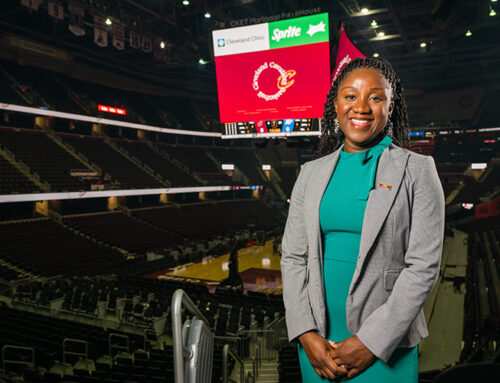
Colleen Jackson began her role on the City’s management team as the Chief Diversity, Equity and Inclusion Officer on June 1. Much of her previous experience as an actress in local and national theater – as well as working for one of the first regional theaters in the country, The Cleveland Play House – helped prepare her for this position.
Interview by Nate Paige
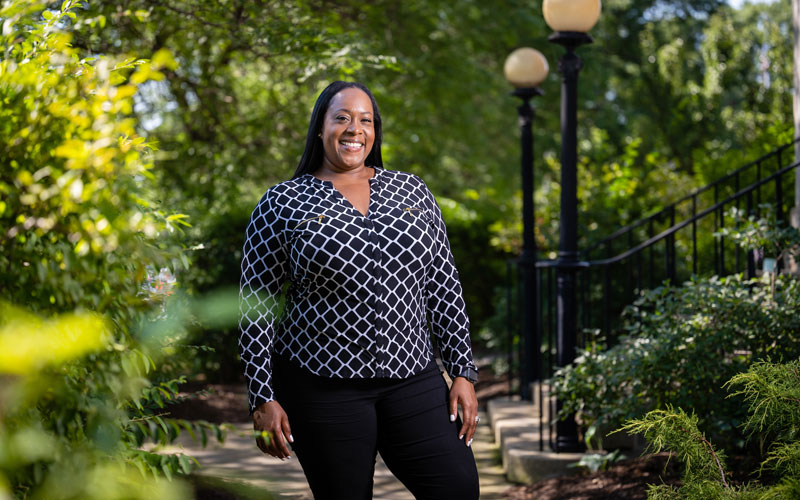
Colleen Jackson, the City’s new Chief Diversity, Equity & Inclusion Officer. Photography by Jason Miller
Colleen came to the City from The Cleveland Play House, where she held two positions: she helped develop the CARE (Compassionate Arts Remaking Education) Program, which used theater to teach social and emotional learning, and increase English Language Arts scores. She was also the Director of Community Partnerships and Programming, during which time she helped to lead the DEI charge.
A Cleveland native, Colleen attended middle school in Cleveland Heights, and graduated from Euclid High School. She holds a BFA and an MFA in Acting from Kent State. A professional union actor/singer, Jackson landed roles in a number of theatrical productions during her 10-plus years in New York, including a national tour of “Kiss Me Kate,” a regional premiere of “Hairspray,” and off-Broadway work with New York Musical Theater Festival. Locally, she’s performed in productions at Karamu House, Porthouse Theater, Dobama Theatre, Cain Park, and Beck Center.
In addition, she is a certified trauma specialist and has a Certificate in Diversity and Inclusion from Cornell University.
In her spare time Colleen loves bowling and reading, and she is an avid roller coaster enthusiast. She’s also very involved in her church’s outreach program and teaches in Baldwin Wallace Conservatory’s musical theater program, where she also strives to increase DEI competencies. Colleen lives in Cleveland Heights with her husband and their dog Angel, a Great Dane.
What does your position entail, and what are your goals?
Because it’s new, my position is being defi ned as I’m doing it. The title is Chief Diversity, Equity and Inclusion Offi cer. When you put the word Offi cer on the end of a title, there is an element of enforcement involved. And I think that speaks to how the City sees the issues of DEI – they want our mission, and our values, enforced. It’s that important. My job is to help the City, staff, residents, and our business community understand our values and our commitment to diversity, equity, and inclusion.
I think the unique challenge in my job is to take into consideration, with respect, appreciation, and admiration, what has already been done. When you think about the history of the City, you have to look at it in totality; we love to talk about all the good we’ve done, but we also have to talk about the not-so great parts of Shaker’s history so that we can move forward. I’m here to support Mayor Weiss and Chief Administrative Officer Jeri Chaikin, and to help Shaker become more diverse, equitable, and inclusive in all that we do – in our service delivery, in every way that the City operates – to make it better, for everyone.
You just touched on Shaker’s long history of being proactive on diversity issues. How will that inform your work going forward?
It will more than inform it, it gives me a leg to stand on! One of the things that attracted me to this position was what I already knew about Shaker as a diverse community committed to academic excellence. That is the reputation it has in the Greater Cleveland area. A community that has been proactive regarding issues of diversity is one that is usually eager to take it to the next level. One of my goals is to help move Shaker from diverse to inclusive. It is easier to do that when you have staff and community members who value the principles of DEI personally and want that refl ected throughout the City.
Is your work focused more internally or externally?
This is a great question. Ultimately the work will be focused both internally and externally. The plan is to start internally first, to do some housecleaning, so to speak, and make sure we have a good foundation and shared understanding about our DEI mission, vision, and goals. I think it is vitally important to make sure that each City employee feels seen and heard, and that they have equitable access to all the resources made available to Shaker employees. From that space our hope is that our residents will feel the same way, and my work will shift to encompass the needs and wants of the Shaker community at large.
What aspects of theater led you in the direction of DEI?
So many, but primarily my experiences as an actress. There was always a scarcity of roles available and the kinds of roles available were often filled with stereotypes. The disparities in the numbers of BIPOC (Black, Indigenous and Other People of Color) directors, designers, producers, theatre owners – all of this led me to wanting to impact DEI in the arts specifically. What made me want to do it at the City level was highly impacted by my experience on a national tour. We’d go to different cities, and the company manager would suggest good restaurants and interesting things to do, but they also talked about how to be safe. We’d be told “You don’t want to be by yourself in this city,” or, “Make sure you come right back to the bus after this show is over.”
I could feel how different cities, how different people, treated me based on me being a Black person. I realized through that tour experience how unsafe and unsettling it could be, just to be who you are and depending on what ZIP code you’re in. As I matured, I started to see an even greater responsibility within the arts. It was all about the narrative. That’s when I realized the power that I had as an artist, and the responsibility attached to that. I started to do work that provoked action and change, and that’s how I deal with theater now. Theater teaches empathy; you have to be able to see things from another perspective, not only to change people’s behavior, but to change their hearts and the way they understand.

You also have experience as a Trauma Specialist. How did that come about?
I was developing and implementing the CARE Program with The Cleveland Play House in the Cleveland School District. We initially started in schools labeled “Investment Schools” by the U. S. Department of Education, which were some of the lowest performing schools in the country.
We had all these lofty goals, but we were met with a lot of academic challenges, and we began to notice other issues that were blocking the students from being successful. These were the results of systemic inequities: food and uniform disparities, neighborhood safety, etc. I also looked at the Adverse Childhood Experience scores for our county, the City of Cleveland, and the entire state. Adverse childhood experiences are things that happen to a child between infancy and 18 that have negative impacts on their physical health, emotional health, and academic success. At the time, Cuyahoga County had the highest ACE scores in our state and Cleveland had the highest scores in our county. Situations such as having an incarcerated parent or witnessing violence affect a child’s ability to succeed academically. We realized right away that in order to teach a social-emotional learning curriculum, we needed to do it with a trauma-informed approach. That doesn’t mean we had to fi nd out every child’s individual trauma experiences – but we needed to take it into consideration and create safe spaces for kids who have experienced trauma to be able to thrive.
The team leaders became certifi ed as Trauma Specialists so that we could do that with the curriculum we were creating, and with the spaces we were inviting our scholars into. One of the interesting things about the intersection between these two kinds of work is there is nothing about racism on the Adverse Childhood Experience survey, but it is hugely traumatic and impactful in the lives of our children and whether they have access to what they need.
How broad is the DEI spectrum?
I think it’s huge. My version of DEI encompasses every way people identify, and that’s a myriad of social locations: socioeconomic status, class, race, wealth, nation of origin, gender identity, gender expression, sexual orientation, age, ability – all ways in which people can identify, and all their intersectionalities. Education level, how your race and age intersect – these affect your life drastically. It’s not just race. Right now, race is the hot-button topic. Race impacts all of the things I just mentioned, but there are so many ways that we differ and identify, and all of that is included in DEI.