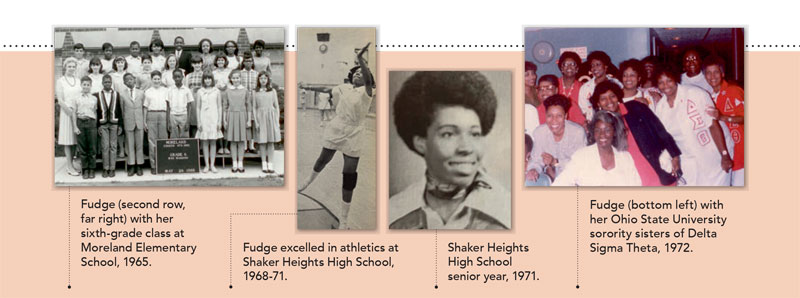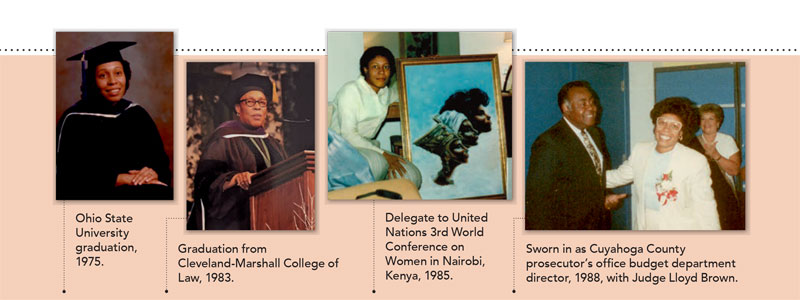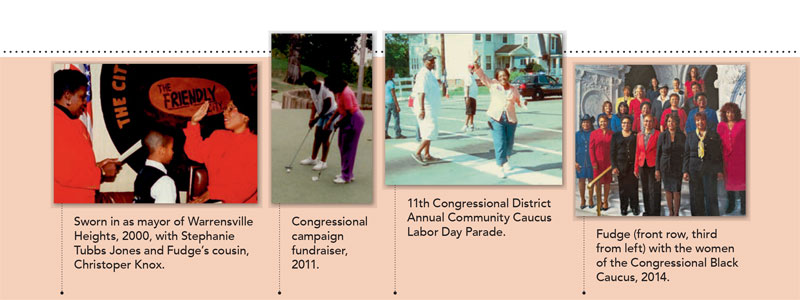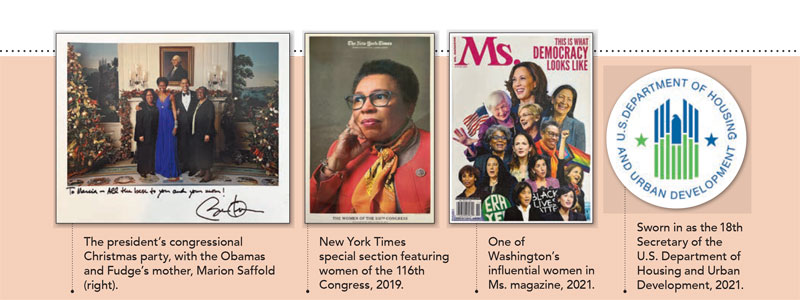
Marcia Fudge’s meteoric rise from Shaker’s Moreland neighborhood to Secretary of Housing and Urban Development wasn’t serendipitous. Her career prepared her for the moment.
By Joe Miller

Photographs courtesy of Marion Saffold and U.S. Department of Housing and Urban Development
Even as her star rose in Washington, D.C. as an influential member of Congress, Marcia Fudge always made a point of trying to attend her Shaker Heights High School reunions. That didn’t change this past September when the class of 1971 got together for their 50th reunion kickoff party at EDWINS Too at Shaker Square. Fudge, less than a year into a demanding new job as President Joe Biden’s Secretary of Housing and Urban Development, wasn’t going to bail on her classmates.
Even if it meant bringing her security detail.
“It was so fascinating to see everyone 50 years later,” the 69-year-old public servant says during a Zoom interview. “Most of my friends showed up. Everybody’s doing well. Everybody’s looking good.
“It just makes you feel so good that all the people you started this journey with are doing well and doing really good things, from judges to business owners to filmmakers to whatever you can think of. We got it. It really was a great class.”
Fudge isn’t exaggerating. The class of 1971’s celebrity roster includes Jane Campbell, Cleveland’s first female mayor; restaurateur Zack Bruell of Parallax and L’Albatros fame; Cleveland Public Theatre founder James Levin; former Cuyahoga County commissioner turned actor Peter Lawson Jones; former Cleveland Municipal Court Judge Angela Stokes; and current Aurora, Ohio, Mayor Ann Womer Benjamin. And that’s the abbreviated list.
“Whatever was in the water, Marcia had a healthy helping of it,” he adds.
Still, few back in high school would have predicted Fudge’s meteoric rise from Shaker’s Moreland neighborhood to a spot in the U.S. Presidential line of succession – she is 12th, just ahead of Secretary of Transportation Pete Buttigieg.

Fudge on her first trip to Cleveland after being sworn in as HUD secretary.
Along the way she earned a law degree, headed her national sorority, won election as the first Black and first female mayor of Warrensville Heights, and then followed in the footsteps of her friend and mentor, the late Stephanie Tubbs Jones, as U.S. Representative for Ohio’s 11th Congressional District.
Now she’s leading a federal agency with a nearly $70 billion budget proposed for 2022, and is tasked with such ambitious goals as ending homelessness and housing discrimination, as well as aiding millions of Americans who have fallen behind on rent and mortgage payments because of the pandemic.
Fudge compares her initial months as the head of HUD to “drinking from five fire hoses.”
“I’m drinking from about two at this point,” she says with a smile. “It’s a big role and we touch an awful lot of people, millions and millions of people,” she says. “My career has prepared me for this moment. But I’ll let history decide if I was any good at it. I just try to figure out every day how to make someone’s life better and give it the best that I’ve got.”
“Shaker Heights class of 1971 – and I don’t say this just because I was a member of it – might be one of the most accomplished classes of any high school anywhere,” says Jones, who was recently cast in an upcoming Tom Hanks movie.
Forged in the crucible of the 1960s
That personal philosophy was born out of the turmoil of the 1960s, when Fudge and her Shaker classmates faced the heady issues of the time, from the civil rights movement in America to international unrest over the Vietnam War.
Fudge recalls that Cleveland at the time was a crucible “for Black growth and Black leadership.” Martin Luther King Jr. was a regular visitor to the city, and Fudge and her mother joined the protests when King led a local boycott against Sealtest Dairy Products for its discriminatory hiring practices.
“People would just give anything to be in his presence, to listen to him speak, to march with him,” she says. “Even as a kid you understood why.”

Fudge tours an affordable housing project in Kansas City, May 2021.
As a young teen, Fudge joined “Young Folks for Stokes” to help Carl Stokes – uncle of classmate Angela Stokes – in his historic campaign to become the first African American mayor of Cleveland and the first Black leader of a major U.S. city.
She also traveled to Washington with friends for the Poor People’s March, held during May and June of 1968. The marchers built “Resurrection City” on the Mall – a rain- soaked village of 3,000 tents and wood huts – and lived there for 42 days. The demonstration was organized by the Southern Christian Leadership Conference under King’s leadership. He didn’t live to see it.
“We had a great awareness of what was going on in the world,” Fudge says. “The assassination of King was just devastating for me and so many of my classmates, as were the people coming home from war that we knew who would never be the same again. It was an enlightening time – but it was a tough time.”
Fudge and her classmates staged a walkout at the high school when they became frustrated with the school district’s apathetic response to King’s death.
“I had a big voice. I was a star athlete. I knew the teachers well,” Fudge says. “But I did feel that the voices of my people didn’t matter, which made me more vocal.”
“The walkout brought us closer together,” says Candy Godbold, who chaired the 50th reunion activities. “Jane Campbell once told us, ‘if the people in our class ran the world, it would be a much better place.’”
In high school, Fudge’s leadership was more often on display in sports – she played field hockey, volleyball, basketball, and softball, and was a champion fencer. (Decades later she would famously fence with comedian Stephen Colbert on “The Colbert Report.”) She was named best female athlete her senior year.
But she also had a reputation for speaking her mind. That initially got her labeled a troublemaker when her family first moved to Shaker from Cleveland’s Fairfax neighborhood and she started at Moreland Elementary.
“I was mischievous and I got in trouble quite a bit,” Fudge says. “I guess I had a voice then, but it was in the wrong direction, and then that voice became a voice for the right thing by the time I got to high school.”
“She would speak her piece and let them know where she stood on things,” says her mother, Marian Garth Saffold. “I really did not have to advocate for her.”
Fudge recognized that people would listen to her, but not necessarily to other Black students. “I had a big voice. I was a star athlete. I knew the teachers well,” Fudge says. “But I did feel that the voices of my people didn’t matter, which made me more vocal.”
She wasn’t alone. She says there were plenty of students in her class – Black and white – willing to stand up to the school administrators and teachers and “pull them to see what we were seeing.”
“There was a group of us who would take on anybody or anything,” Fudge says. “We were a very diverse group and we were a very influential group. I think we had a heightened sense of what was right and wrong and we always fought for what was right.”
Leadership runs in Fudge’s family. Her grandmother, who lived downstairs in their Chelton Road duplex and worked as a domestic, was a deaconess at their church. And Fudge’s mother, Mrs. Saffold, turned a job as a hospital laboratory technician into a trailblazing career as one of the first Black female union organizers in the American Federation of State, County and Municipal Employees. Even at age 90, Mrs. Saffold still remains active in the union as president of three local retiree groups.
“Marcia grew up in a household surrounded by union people and worked with me on campaigns,” says Mrs. Saffold, who now lives in Warrensville Heights. “We did a lot together and she did learn a lot from her involvement with the union.”

Fudge and New Jersey Governor Phil Murphy break ground on the Rebuild by Design Hudson River Project in Hoboken, May 2021.
“Growing up, I always knew my mother did important work, I just really didn’t’t know how important,” Fudge says. “I knew that people had great respect for who she was. But that’s no different from my grandmother, who was a domestic all her life. She was someone people respected.”
Fudge says she still turns to her mother for advice on her life and career, even as her new job has limited her trips back to Ohio.
“She is my biggest cheerleader. My mother has always made me believe that there were very few things I could not do.”
The other major influence in Fudge’s career was close friend Stephanie Tubbs Jones. Although Tubbs Jones was a couple of years older, the two connected through Delta Sigma Theta, a historically Black sorority. Fudge later served as national president of the sorority.
Fudge graduated from The Ohio State University and, in 1983, earned her law degree at Cleveland-Marshall College of Law. It was then that Tubbs Jones encouraged her to clerk in Cleveland Municipal Court and Common Pleas Court. When Tubbs Jones later won election as Cuyahoga County’s first Black prosecutor, she brought Fudge on board as her budget director. And when Tubbs Jones became the first African American woman elected to Congress from Ohio – succeeding Louis Stokes – Fudge followed her to Washington as her chief of staff.
“Stephanie was a nurturing person who would push you to places where you didn’t think you could go,” Fudge says. “She would push you and you’d realize she saw something in you that you didn’t see in yourself.”
Before Tubbs Jones, “it was never my intention to be involved in politics at all,” Fudge adds.
A turn to politics
And yet in 1999 – after a year in D.C., where she and Tubbs Jones were roommates – Fudge decided to run for office back home and won the mayoral race in Warrensville Heights, becoming that city’s first Black and first woman leader.
Then in 2008, Tubbs Jones died unexpectedly of a brain aneurysm. Urged by local Democratic leaders and friends to run, Fudge won the special election to succeed Tubbs Jones – and kept running. Fudge has worked to both honor her friend’s legacy and forge a path of her own, advocating for issues such as voting rights and food programs for those in need. During more than a decade in Congress, she chaired the Congressional Black Caucus and then the 2016 Democratic National Convention. In 2018, Fudge openly considered challenging Nancy Pelosi for the House Speaker role, only to endorse her fellow Democrat days later.
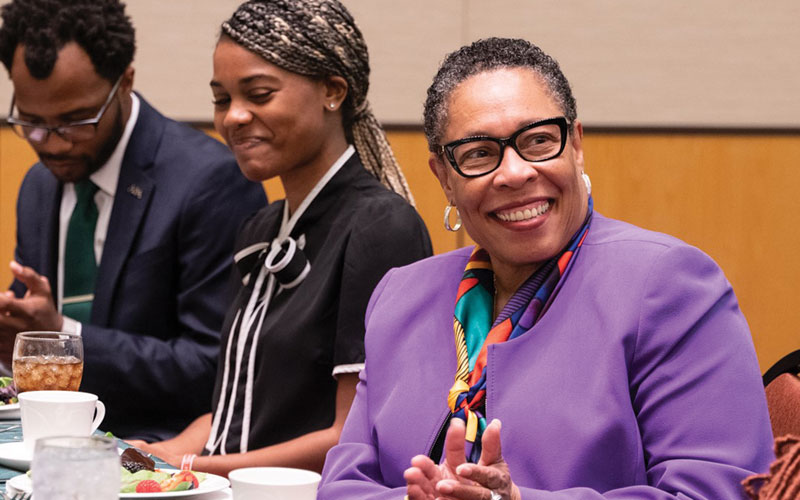
“I think about Stephanie often as I go through this journey,” Fudge says. “I think she would be as happy for me as I was for her during her entire career.”
Fudge is now one of only a handful of Black women who have held an executive-level cabinet position. These include Kamala Harris, Condoleezza Rice (G.W. Bush), Patricia Roberts Harris (Carter), and Hazel O’Leary (Clinton). But for the most part, Fudge says she doesn’t spend a lot of time thinking about the journey she’s taken or the barriers she has broken through. For one thing, she’s too busy with her work and on recruiting future generations of public servants.
“I don’t think about being the first other than to the degree that I don’t believe that I should be the last,” she says. “It drives me to bring somebody else along. It really drives me to try to mentor younger people. Over the many years that I’ve been at this, public service has gotten a bad rap with a lot of young people. I’m going to tell young people that this is a career, this is a profession. This is something that is needed in this country.”
So it was no surprise that Fudge invited her soon-to- be successor in Congress, 46-year-old Shontel Brown, to accompany her to the 50th reunion party and meet her Shaker classmates. Still, Fudge – with two security officers watching over her inside the restaurant and two outside – was the main attraction.
“People were genuinely interested in finding out what precisely Marcia is doing at HUD, and what it was like to serve in Congress and what it’s like working with Joe Biden and being in his cabinet,” says Peter Lawson Jones. “Those topics weren’t off limits at all. She’s still fun-loving and has a quick laugh and quick smile, but make no mistake, she is a serious human being,” he says. “And some of that adultness, that maturity, was on display and discernible when she was in high school.”
Reunion chair Godbold was just happy to see her old friend among the 100-plus attendees at the reunion that night. She has known Fudge since the seventh grade and played high school sports with both her and Jane Campbell. During the festivities, Godbold made a point of referring to both of them by the titles they have earned: Campbell as “Madame Mayor” and Fudge as “Madame Secretary.”
“But one on one,” says Godbold, “she’s still Marcia.”