A new Ohio Historical Marker honors the legacy of the Village Garden Club.
By Diana Simeon
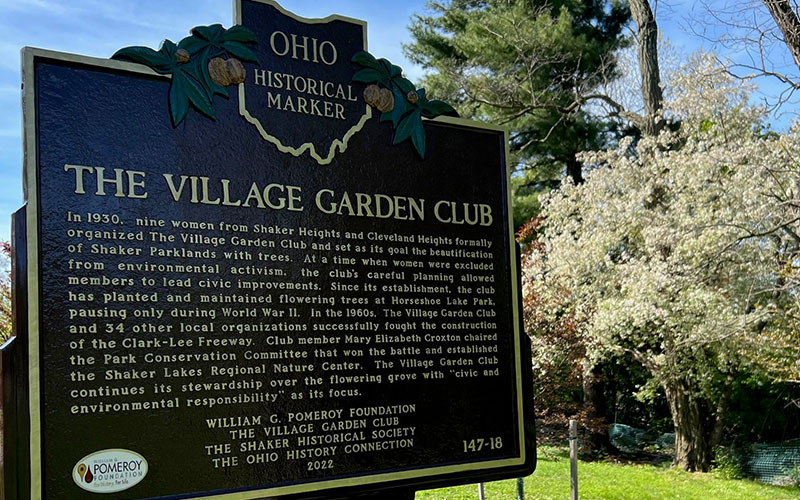
A sure sign of spring in Shaker Heights: the blooming of the cherry and other ornamental trees in the grove on South Park Boulevard at Horseshoe Lake. The grove was started in the 1930s by the Village Garden Club, which still maintains it. In May, the State of Ohio officially recognized the 92-year legacy of the Village Garden Club with an Ohio Historical Marker at the grove.
Pay a visit to Horseshoe Lake Park and it’s easy to see this legacy in the cherry tree grove and other flowering trees. The club estimates it has planted more than 350 trees there since its founding.
The club’s legacy is also in what you won’t see at Horseshoe Lake Park – namely the Clark and Lee Freeways, which were planned to run through the Shaker Parklands.
The Village Garden Club was established in 1930 by nine women, including Louise Marshall, for whom Marshall Lake was named and who served as the club’s first president. Inspired by the Japanese cherry trees in Washington D.C., Marshall and her fellow members hoped to beautify the Shaker Lakes in a similar fashion. They raised about $200 and got to work. Within the year, they had planted 50 cherry trees around Horseshoe Lake (then called Hampton Lake).
“Arborists said Cleveland is not Washington D.C., and there’s no way cherry trees are going to survive,” says Sally Cantor, chair of the club’s outreach committee.
But many of the original trees did survive that first year and beyond, thanks to the determined efforts of these women.
“We have early movies showing the women in their fur collars, hats, and gloves carrying buckets of water from the lake to water the trees,” says Cantor. “They consistently raised money and planted trees until World War II. They took a hiatus to support the war effort, then they got back to planting.”
“This kind of women’s history tends to get overlooked. But it’s important.”
In the early 1960s, club members learned about a plan by Cuyahoga County engineer Albert Porter to build a freeway straight through the Shaker Parklands, including Horseshoe Lake Park. Horrified at the prospect, the club joined with 34 other organizations to establish the Park Conservation Committee, which was led by Mary Elizabeth Croxton, a longtime club member. Thanks to this effort, Porter abandoned his plan.
In early 2020, Cantor, recognizing the historical importance of the club’s minutes and other materials gathered over 90-plus years, approached the Shaker Historical Society with the idea of doing an exhibit about the Village Garden Club.
“This kind of women’s history tends to get overlooked,” says Brianna Treleven, executive director of the SHS. “But it’s important. These women weren’t working, they were housewives, but they had a huge presence. They had the ability to beautify the area and fight a freeway – and it’s had a lasting impact.”
The exhibit, “It Takes a Village,” debuted in the summer of 2020. A virtual version of is available at
https://bit.ly/VGC-exhibit.
In the course of the exhibit, Treleven suggested that the club apply for an Ohio Historical Marker. Last year, Ohio History Connection – which manages the Historical Marker program for the state – announced a special call for applications that specifically addressed underrepresented history, including women’s history.
After a lengthy and competitive application process, the Village Garden Club was awarded its marker. A grant from the William G. Pomeroy Foundation helped pay for the marker, which is at the eastern edge
of the grove and visible as you drive (or walk or bike) along South Park.
The club continues to maintain the grove and plant additional trees there. In recent years, it has started to pivot to planting flowering native species. The club welcomes new members – or those who’d like to help out on occasion. There’s also a program to sponsor a tree in a loved one’s memory at the grove. To learn more, contact Sally Cantor at villagegardenclub1930@gmail.com.