
“The war changed my whole life.”
By Joe Miller
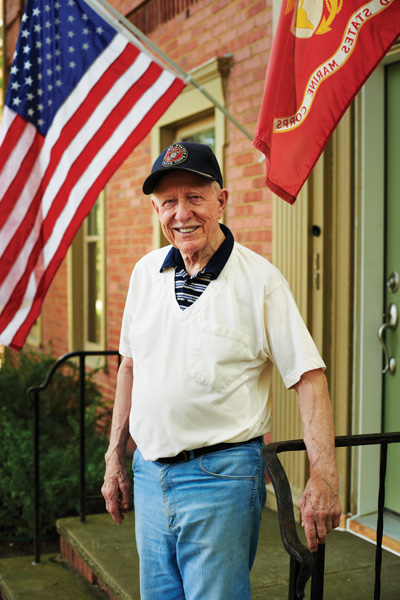
Photo: Angelo Merendino
With a U.S. Marine Corps flag flying in front of his Lomond neighborhood house and a “Semper Fi” sticker visible in the front window, it’s obvious 96-year-old Ray LeZak is proud of his military service. Yet, until recently, if you asked the World War II veteran for details, LeZak would shut down the conservation.
“I would say, look, the best place I was ever stationed was Omaha, Nebraska,” LeZak says with a laugh. “And that would turn everyone off . No more questions after that.”
“He’s been very tight-lipped about a lot of it and very humble about his early life,” says Erin Eggert, one of LeZak’s four grandchildren. “We’d ask him about the war. He always changed the subject.”
But something has changed. Maybe, he says, it’s been his role representing vets during the City’s Memorial Day ceremonies, or late-in-life pressure to put his affairs in order. Whatever the reason, LeZak is ready to tell his story.
“I wasn’t in intense combat. I don’t pretend I was.” Although he was on the Japanese island of Okinawa during what was arguably the bloodiest battle of the Pacific campaign, the heavy fighting happened on the opposite side of the island away from his battalion.
Still, at least one memory haunts him. He hands me worn dog tags with Japanese characters on them. He says he found them in a cave on Okinawa, but won’t go beyond that. LeZak wonders whether he could still track down the dead Japanese soldier’s family.
“For a long time I’ve worried about that family,” he says. “If there’s a family still, and there might be, they should have these.”
Alongside the dog tags, LeZak has laid out his life on an antique table in his dining room – a collection of photographs, journals, civic awards, and history books. Each item triggers a flood of recollections. He shows me pictures of his Polish-immigrant parents and of him during his baseball playing days in high school and college. But it’s his memorabilia from nearly three years in the Corps that takes center stage.
“The war changed my whole life,” he says.
LeZak was a 17-year-old high school senior when he enlisted in the Marines in 1943. He was a blue-collar kid who had never ventured far from his hometown of Detroit and was probably on track to “being a laborer at Ford.” The war changed that, introducing him to the world outside of Michigan and sparking an interest in academics that eventually led to a doctorate in audiology.
His stint in the Marines started with boot camp in San Diego and then training in Omaha as a radio repairman. He was assigned to the 9th Amphibian Tractor Battalion, a unit of the tank-like vehicles that delivered troops onto enemy shores. LeZak’s battalion joined the invasion of Okinawa in early 1945. Th ey spent three months on the island, he says, “eating only Spam and looking out for each other.”
There were moments both tense – guarding their camp at night from the Imperial Japanese Army – and comical – a joy-ride search for ice cream in an Amphibian that led to the accidental ramming of the battleship Massachusetts.
It was only after LeZak was finally shipped out of harm’s way to Guam that he found out that the U.S. had dropped atomic bombs on Japan and the war was over. It was also in Guam where LeZak picked up an appreciation for books and a desire to go to college.
“I had never even considered that before,” he says. “My parents knew nothing about academics. Their goal for me was for me to get a job where I could wear a white shirt.”
After earning degrees at the University of Michigan and Penn State University, LeZak came to Cleveland as an audiologist at Highland View Hospital. He later worked as director of audiology at Case Western Reserve University.
LeZak has made a name for himself in his adopted home as a noise pollution consultant in Shaker Heights, and through volunteering with Cleveland city schools, Shaker’s Citizens Police Academy, and the Lomond Association. He also found time to get his pilot’s license at age 60.
“I’ve had a lot of fun,” he says.